
Managing Author Contributions in Multi-Institutional Projects
Collaboration at Scale: Why Author Contribution Management Matters
Modern scientific research increasingly depends on collaboration across institutions, disciplines, and even countries. Advances in areas such as artificial intelligence, cybersecurity, Internet of Things (IoT), cloud computing, data science, smart systems, and ubiquitous computing often require expertise that extends beyond the capabilities of a single researcher or organization.
As collaborative projects become larger and more complex, managing author contributions has emerged as an essential component of responsible research practice. Clear contribution management not only supports publication ethics but also promotes transparency, accountability, and trust among collaborators. Crosslink Studies (CLS) journals, establishing a structured approach to authorship and contribution management can help prevent misunderstandings, strengthen teamwork, and facilitate a smoother publication process.
The Growing Complexity of Multi-Institutional Research
Multi-institutional projects bring together researchers with diverse expertise, resources, and perspectives. While these collaborations often lead to stronger scientific outcomes, they also introduce challenges related to authorship decisions, responsibility allocation, communication, and recognition of contributions.
A project may involve:
- Researchers from multiple universities.
- Industry and academic partnerships.
- International collaborators.
- Specialized technical teams.
- Data providers and domain experts.
- Software developers and system architects.
Without clear expectations regarding contributions and authorship, even successful projects can experience disputes during manuscript preparation and submission.
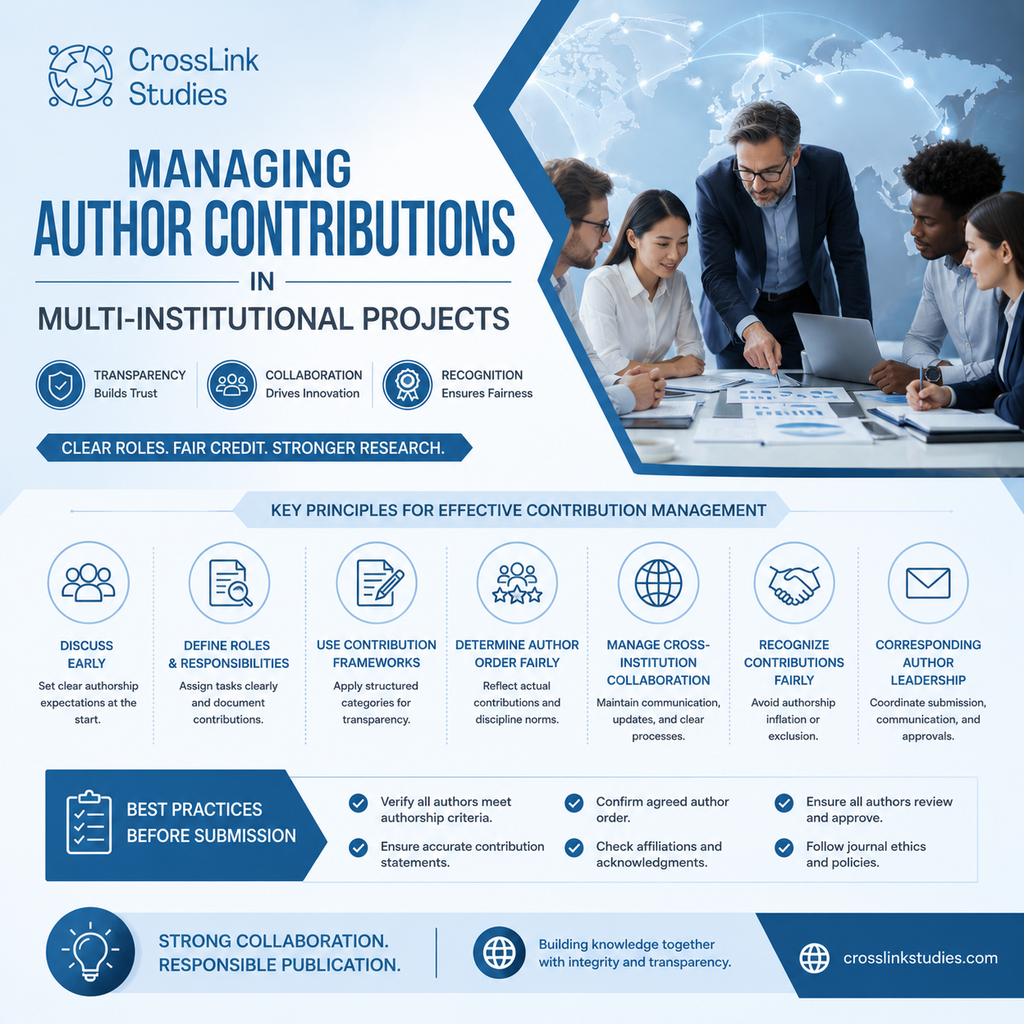
Establish Authorship Expectations Early
One of the most effective ways to avoid future disagreements is to discuss authorship at the beginning of a project. Research teams should openly address questions such as:
- Who will be listed as authors?
- What level of contribution is required for authorship?
- Who will serve as the corresponding author?
- How will author order be determined?
- What responsibilities will each contributor assume?
Early discussions help align expectations and reduce the likelihood of conflicts as the project evolves. Although contributions may change over time, establishing an initial framework provides a foundation for transparent decision-making throughout the research lifecycle.
Understand What Constitutes Authorship
Authorship carries both credit and responsibility. Being listed as an author indicates meaningful intellectual involvement in the research and accountability for the integrity of the published work. Contributions commonly associated with authorship include research conceptualization, experimental design, data collection, data analysis and interpretation, software development, methodology development, manuscript drafting, and critical revision of content.
Define Roles and Responsibilities Throughout the Project
Successful collaborations depend on well-defined responsibilities. Project teams should identify who will lead key activities such as literature review, data management, system implementation, experimental validation, statistical analysis, visualization development, manuscript preparation and journal correspondence.
Documenting these responsibilities can improve project coordination and provide valuable evidence when determining final contribution statements. Regular updates are particularly important in long-term projects where roles may evolve as research progresses.
Utilize Contribution Frameworks for Transparency
Many scholarly journals now encourage structured contribution reporting to improve transparency. Contribution frameworks help clarify individual involvement across various aspects of the research process. Rather than relying solely on author order to communicate contribution levels, structured reporting provides readers, reviewers, and editors with a more accurate understanding of how the work was completed.
Common contribution categories may include conceptualization, methodology, software, validation, formal analysis, investigation, data curation, writing original draft, writing review and editing, supervision and project administration.
Address Author Order Carefully
Determining author order is one of the most sensitive aspects of collaborative publishing. Different disciplines may follow different conventions. In some fields, the first author is the primary contributor, while the last author often represents the senior researcher or project leader. Other disciplines may use alphabetical ordering or alternative approaches.
Regardless of the convention used, teams should ensure that author order reflects agreed-upon contributions and is discussed openly among collaborators. Waiting until manuscript submission to resolve authorship order can create unnecessary tension and delay publication.
Manage Contributions Across Institutions Effectively
Collaborators from different institutions often work under varying policies, expectations, and administrative procedures. To support effective coordination, research teams should:
- Maintain clear communication channels.
- Schedule regular project meetings.
- Document decisions and responsibilities.
- Share updates on research progress.
- Establish timelines and milestones.
- Define manuscript review procedures.
A structured collaborative environment reduces confusion and helps ensure that all contributors remain informed and engaged. Strong communication practices are particularly important in international projects where geographic and cultural differences may affect collaboration dynamics.
Recognize Contributions Fairly
Fair recognition is fundamental to ethical research collaboration.
Researchers should avoid both authorship inflation and authorship exclusion. Authorship inflation occurs when individuals are listed despite limited involvement, while authorship exclusion occurs when significant contributors are omitted from the author list. Both situations can undermine trust and create ethical concerns.
Research teams should regularly evaluate contributions and ensure that recognition accurately reflects actual participation in the project. A culture of fairness strengthens long-term collaborative relationships and promotes responsible scholarship.
Handle Authorship Changes Transparently
As projects develop, contributors may join or leave the research effort. In some cases, individual responsibilities may expand significantly beyond original expectations. When authorship changes become necessary, they should be discussed openly among all contributors and documented appropriately.
Changes should be based on actual contribution levels rather than institutional status, seniority, or personal relationships. Transparency in authorship decisions helps prevent disputes and supports confidence in the final publication.
The Role of the Corresponding Author
The corresponding author plays a critical role in coordinating communication between the research team and the journal. Responsibilities often include:
- Managing manuscript submission.
- Coordinating revisions.
- Communicating with editors.
- Obtaining author approvals.
- Verifying contribution statements.
- Confirming compliance with journal policies.
Because the corresponding author serves as the primary contact during publication, careful attention to accuracy and transparency is essential.
Best Practices Before Manuscript Submission
Before submitting a manuscript, collaborative research teams should verify that:
- All authors meet authorship criteria.
- Contributions are accurately documented.
- Author order has been agreed upon.
- Contribution statements are complete.
- Institutional affiliations are correct.
- All authors have reviewed the manuscript.
- Publication ethics requirements have been satisfied.
Why Contribution Transparency Strengthens Research Integrity
Transparent contribution management benefits everyone involved in the research process. For authors, it ensures fair recognition and accountability. For editors and reviewers, it provides clarity regarding individual responsibilities. For readers, it increases confidence in the credibility and integrity of the published work. As collaborative research continues to expand across institutions and disciplines, contribution transparency will remain a critical component of responsible scholarly communication. Research excellence is not only measured by scientific outcomes but also by the integrity of the processes used to achieve them.
Conclusion
Multi-institutional research projects have become essential drivers of innovation in modern science and technology. However, successful collaboration requires more than technical expertise it requires careful management of contributions, responsibilities, and authorship expectations.
By establishing clear roles, maintaining open communication, documenting contributions, and recognizing participants fairly, researchers can build stronger collaborative partnerships and produce higher-quality scholarly work. For authors submitting to Crosslink Studies journals, transparent contribution management supports publication ethics, enhances research credibility, and helps ensure that every contributor receives appropriate recognition for their role in advancing knowledge.