
Authorship Criteria for Collaborative Technology Research
Modern technology research is increasingly collaborative. A single project may involve software engineers developing a system, data scientists analyzing datasets, domain specialists defining the research problem, researchers designing experiments, and senior investigators supervising the work. In large interdisciplinary projects, several people may contribute substantially to the research while performing very different roles.
This collaborative environment creates an important question: Who should be listed as an author?
Authorship is more than recognition for participating in a project. It represents scholarly credit, intellectual contribution, and responsibility for the published work. Adding someone who did not make a sufficient intellectual contribution can create gift or honorary authorship, while excluding someone who made a substantial contribution can result in ghost authorship. Both practices undermine research integrity.
For researchers preparing manuscripts for Crosslink Studies authorship should therefore be considered from the beginning of a project rather than treated as an administrative issue immediately before submission. CLS’s publication-ethics framework addresses authorship disputes through established ethical procedures, while its submission guidance requires all authors to approve the final manuscript and relevant submission requirements.
Why Authorship Is Particularly Important in Technology Research
Collaborative technology projects often have complex contribution structures. Consider an artificial intelligence project. One researcher may formulate the research question, another may develop the model, a third may prepare and analyze the dataset, another may conduct statistical validation, and another may write and revise the manuscript. A software engineer may develop essential code, while a domain expert may interpret the results. Simply counting tasks or assigning authorship according to seniority does not adequately represent these contributions.
Authorship Is Different from Acknowledgment
Not everyone who assists with a research project automatically qualifies for authorship. Researchers may receive valuable support from:
- laboratory or technical staff;
- administrative personnel;
- research assistants performing limited tasks;
- organizations providing facilities;
- individuals providing routine data collection;
- language or proofreading services;
- funding or institutional support.
These contributions may deserve acknowledgment, but they do not necessarily establish authorship. The key distinction is between substantial intellectual contribution and supporting contribution.
Core Criteria for Authorship
Different disciplines and publishers may use somewhat different frameworks, so researchers should always check the target journal’s requirements. Nevertheless, major publishing guidance shows strong common principles.
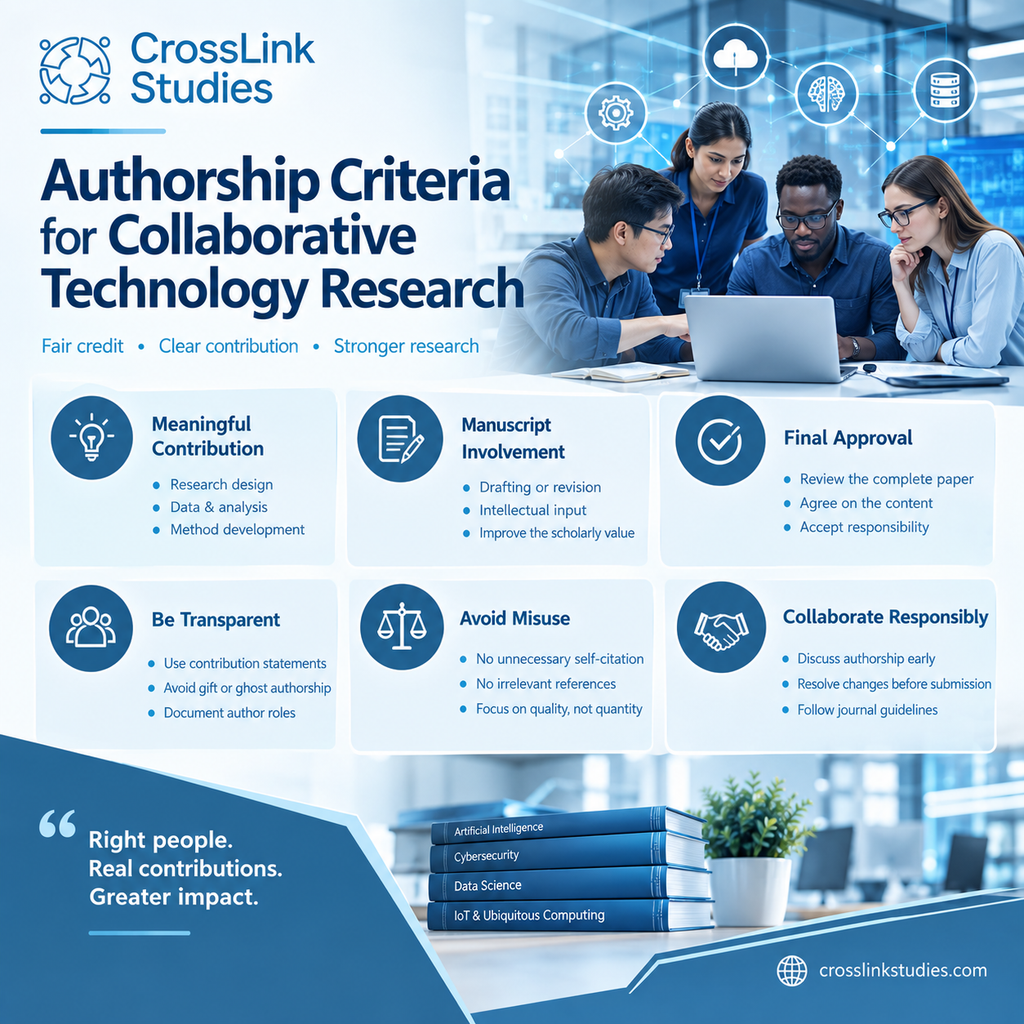
1. Substantial Intellectual Contribution
Authorship should begin with meaningful involvement in the intellectual development of the research. This may include:
- developing the research question;
- designing the study;
- developing a novel algorithm;
- designing a system architecture;
- developing or substantially preparing research datasets;
- conducting important analysis;
- interpreting results;
- developing theoretical models;
- designing significant experiments.
2. Contribution to the Manuscript
Research contribution and authorship responsibility extend into manuscript development. An individual who substantially contributes to the research but has no involvement in preparing or critically revising the manuscript may not meet the complete authorship criteria used by some publishers. Conversely, simply editing grammar does not normally transform a contributor into an author. The important question is whether the person participates meaningfully in developing or critically evaluating the scholarly content.
3. Approval of the Final Manuscript
Every listed author should have an opportunity to review and approve the final version submitted for publication. This requirement is important because authorship means that a person is publicly associated with the research.
4. Accountability
Authorship also carries responsibility. Authors should be prepared to address questions concerning the accuracy and integrity of the research, particularly within their areas of contribution. This becomes increasingly important in interdisciplinary projects.
Use Contribution Statements to Create Transparency
Large collaborative projects can benefit from a formal contribution statement. Contribution frameworks such as CRediT (Contributor Roles Taxonomy) allow research teams to describe roles such as conceptualization, methodology, software, validation, formal analysis, investigation, resources, data curation, writing, visualization, supervision, project administration, and funding acquisition. A contribution statement can make authorship decisions easier to discuss because it moves the conversation away from titles and seniority toward documented research contributions.
Discuss Authorship Before the Research Is Finished
One of the most effective ways to prevent authorship disputes is to discuss authorship early. Teams should ideally discuss:
Who is expected to qualify as an author?
What contributions are expected?
Who will be corresponding author?
How will author order be determined?
How will changes in contribution affect authorship?
These discussions do not need to remain fixed. Contributions can change during a project, so authorship should be revisited when responsibilities change significantly. CLS’s own submission checklist advises authors to confirm that all authors have read and approved the final version of the manuscript and the instructions for authors.
Avoid Gift, Guest, and Ghost Authorship
Gift or Honorary Authorship
Gift authorship occurs when someone is included despite not meeting the relevant contribution requirements. Common reasons might include seniority, institutional position, personal relationships, or expectations that a senior researcher should automatically appear on the paper. Being a department head, supervisor, laboratory director, or project manager does not by itself establish authorship.
Ghost Authorship
Ghost authorship occurs when someone who made a qualifying contribution is omitted from the author list. This can be equally problematic because it removes appropriate scholarly credit and obscures responsibility for the research. CLS’s research-ethics guidance specifically states that authorship should be appropriately attributed without unwarranted credit or denial, including concerns associated with ghost authorship.
Author Order Should Be Discussed Separately
Determining who qualifies as an author is different from determining the order in which authors appear. Different disciplines use different conventions. In some research communities, the first author represents the primary contributor, while the corresponding author manages communication with the journal. In other collaborative fields, author order may follow different conventions.
Teams should therefore avoid assuming that one universal ordering system applies to every discipline. The most important principle is transparency: authors should agree on the ordering approach before submission and document the reasoning where necessary.
The Corresponding Author Has Additional Responsibilities
The corresponding author serves as the main communication point with the journal. This role commonly includes coordinating submission, communicating editorial decisions to co-authors, confirming author approval, and managing revisions.
What Happens When Authorship Changes?
Research projects evolve. Someone may take on substantial responsibilities later, while another contributor may become less involved. For this reason, authorship should be reassessed when the project’s scope or contributions change.
CLS has a policy for authorship modifications and handles authorship disputes through its publication-ethics framework.
Authorship in AI-Assisted Research
Technology researchers increasingly use artificial intelligence for coding assistance, language editing, literature organization, data processing, and other research tasks. AI tools, however, should not be treated as authors. Authorship requires human intellectual contribution, approval, and accountability.
CLS’s guidance on responsible AI use emphasizes that AI can assist manuscript preparation but cannot replace human responsibility for accuracy, originality, and research integrity. Researchers should therefore distinguish between using an AI tool as part of a workflow and assigning authorship to a tool.
A Practical Authorship Checklist
Before submitting a collaborative technology manuscript, the research team should ask:
- Has everyone listed as an author made a substantial intellectual contribution?
- Have all qualifying contributors been included?
- Have non-author contributions been appropriately acknowledged?
- Has every author participated in drafting or substantive intellectual revision?
- Has every author reviewed and approved the final manuscript?
- Do all authors understand their responsibilities?
- Has the corresponding author been clearly designated?
- Have author order and contribution roles been discussed?
- Has the team documented contributions?
- Have potential authorship changes been discussed before submission?
- Are all authors aware of the journal’s specific requirements?
A short authorship discussion at the beginning of a project can prevent a much more difficult dispute at the end.
Collaborative Research Requires Shared Responsibility
Modern technology research depends on collaboration. As projects become more interdisciplinary, authorship decisions will increasingly involve researchers with very different technical backgrounds and responsibilities.
The solution is not to create a rigid formula for every project. Instead, research teams should use transparent criteria, document contributions, communicate early, and follow the specific requirements of their target journal. For Crosslink Studies and UTJ authors, this approach complements the journal’s broader emphasis on publication ethics, research integrity, author approval, and responsible attribution.