
How to Explain Novelty Without Over claiming?
In academic publishing, novelty is essential, but credibility is critical. Authors must clearly communicate what is new in their work without exaggeration or unsupported claims. Overstating novelty can undermine trust, trigger critical reviewer responses, and even lead to rejection.
At Ubiquitous Technology Journal (UTJ), where interdisciplinary rigor and integrity are central, authors are expected to present novelty in a way that is clear, evidence-based, and proportionate. This guide outlines how to strike that balance effectively.
Why Over claiming is a problem
Over claiming often appears as:
- “This is the first study…” (without verification)
- “This method completely solves…” (without limitations)
- “No prior work exists…” (rarely accurate)
Consequences
- Loss of reviewer confidence, increased scrutiny during peer review and requests for major revision or rejection. Strong research does not need exaggeration. It needs clear positioning.
What “Novelty” Really Means
Novelty does not always mean something entirely new. It can include a new method or model, an improvement over existing approaches, a new application of known techniques, a new dataset or experimental validation, and new perspective or synthesis. Novelty is about meaningful contribution, not absolute originality.
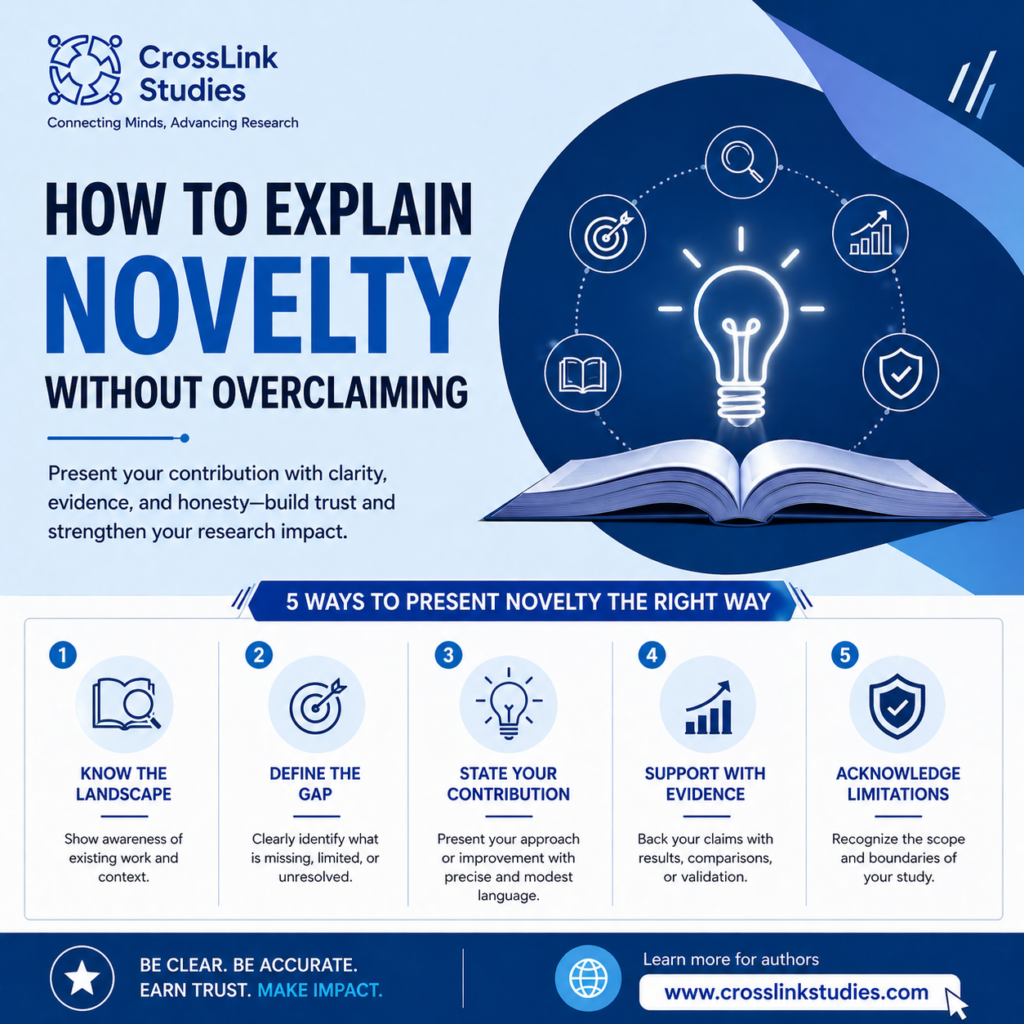
The UTJ Framework for Presenting Novelty
Anchor Your Claim in Existing Literature
Start by briefly positioning your work within prior studies. Show awareness of related research and identify what has already been done. This builds credibility before introducing your contribution.
Define the Gap Precisely
Clearly state what is missing or limited in current research.
✔ Be specific (method, data, context, performance)
❌ Avoid vague claims like “limited research exists”
Example:
“Existing models fail to incorporate real-time environmental variability in urban forecasting.”
State Your Contribution Modestly but Clearly
Present your novelty using measured and accurate language.
✔ Use phrases like:
- “This study proposes…”
- “This work extends…”
- “We introduce an approach that improves…”
❌ Avoid absolute claims like:
- “This is the first ever…”
- “This completely solves…”
Support Claims with Evidence
Your novelty must be backed by results or reasoning. It includes comparative performance, experimental validation and theoretical justification. Evidence transforms claims into credible contributions.
Acknowledge Limitations
Recognizing limitations does not weaken your paper it strengthens it. Briefly mention constraints or scope boundaries and show awareness of where your method may not apply. This demonstrates academic maturity and honesty.
Language Guide: Strong vs Weak Positioning
| Over claiming (Avoid) | Balanced (Recommended) |
| “This is the first study…” | “To our knowledge, this study is among the first to…” |
| “This method solves all issues…” | “This method addresses key limitations in…” |
| “No prior work exists…” | “Limited research has explored…” |
| “This approach is perfect…” | “This approach improves…” |
Small changes in language create a big difference in credibility.
Practical Example (CLS Style)
Over claimed Version:
“This study presents a completely novel AI model that solves all limitations of existing forecasting systems.”
Revised CLS-Compliant Version:
“This study proposes a hybrid AI-based forecasting model that addresses key limitations in existing systems, particularly in handling dynamic environmental variables. The model demonstrates improved accuracy and adaptability across multiple datasets.”
Common Mistakes to Avoid
❌ Making unsupported “first-ever” claims
❌ Ignoring existing literature
❌ Using exaggerated or absolute language
❌ Failing to provide evidence
❌ Hiding limitations
❌ Confusing novelty with complexity
These issues often lead to reviewer skepticism and delays.
CLS Novelty Checklist
Before submission, confirm:
✔ My contribution is clearly defined
✔ Claims are supported by evidence
✔ Language is accurate and measured
✔ Existing literature is acknowledged
✔ Limitations are briefly addressed
✔ No exaggerated or absolute statements
In high-quality academic publishing, credibility outweighs exaggeration. A well-positioned, evidence-backed contribution is far more persuasive than bold but unsupported claims.
At CLS Crosslink Studies and UTJ we encourage authors to communicate novelty with precision, integrity, and clarity, ensuring that their research stands out for the right reasons.