Why Manuscripts Are Returned Before Peer Review
Understanding Early Editorial Decisions and How Authors Can Avoid Common Submission Pitfalls
A Returned Manuscript Is Not Always a Rejection
Receiving a notification that a manuscript has been returned before peer review can be disappointing, particularly after months or even years of research. Many authors interpret this decision as a rejection of their work or its scientific merit. In reality, a manuscript returned at this stage often reflects issues with submission quality, journal fit, documentation, or compliance with editorial requirements rather than the value of the research itself.
Before a manuscript is sent to independent reviewers, journals perform a series of editorial assessments designed to ensure that every submission is complete, ethically compliant, scientifically appropriate, and aligned with the journal’s publishing standards. These preliminary evaluations protect the integrity of the peer-review process, reduce unnecessary delays, and allow reviewers to focus on manuscripts that are genuinely ready for scientific evaluation.
At Crosslink Studies (CLS), every manuscript follows a structured editorial workflow. After submission, manuscripts undergo technical and editorial screening before external peer review begins. If significant issues are identified during these early stages, the manuscript may be returned to the corresponding author for correction and resubmission. This process is intended to improve submission quality and create a more efficient publishing experience for authors, editors, and reviewers.
What Does “Returned Before Peer Review” Mean?
A manuscript returned before peer review has not yet been evaluated by external reviewers. Instead, it has been assessed by the editorial office or handling editor during the journal’s initial screening process.
Returning a manuscript does not necessarily indicate that the research lacks merit. Rather, it means that the submission requires attention before it is suitable for scientific evaluation. In many cases, authors are encouraged to revise the manuscript, address the identified concerns, and submit an improved version. This distinction is important because a returned manuscript often represents an opportunity to strengthen the submission rather than the end of the publication process.
Why Do Journals Conduct Initial Screening?
CLS conduct rigorous preliminary assessments before peer review. These checks help ensure that manuscripts entering review meet minimum standards for quality, ethics, and presentation.
Without these early evaluations, reviewers would spend valuable time assessing manuscripts that contain preventable technical errors, incomplete documentation, or significant scope mismatches. Initial screening therefore improves editorial efficiency while supporting a fair and transparent review process. For authors, understanding these editorial expectations can significantly increase the likelihood of progressing smoothly to peer review.
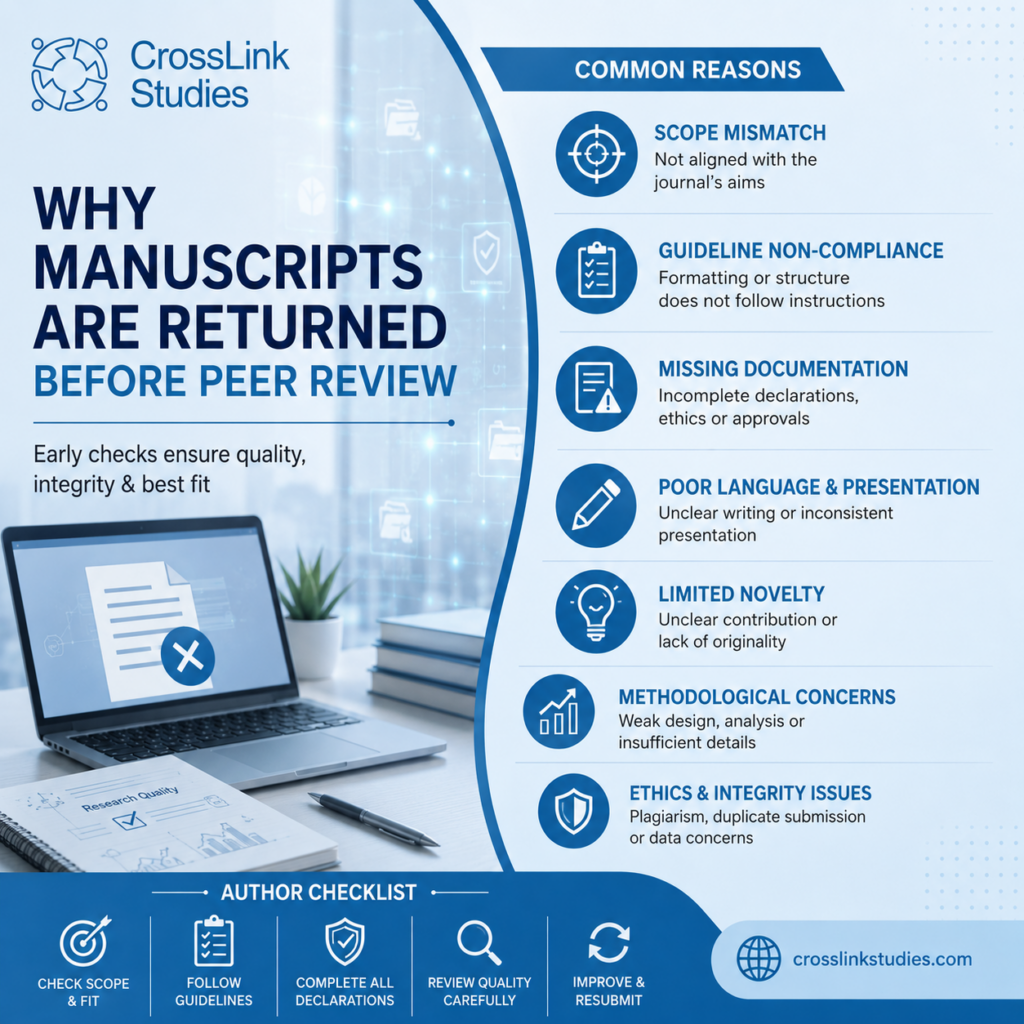
The Most Common Reasons Manuscripts Are Returned
Although every journal has its own editorial policies, the reasons manuscripts are returned before peer review are often similar across reputable scholarly publishers.
1. The Manuscript Falls Outside the Journal’s Scope
One of the most common reasons for an early return is a mismatch between the manuscript and the journal’s aims and scope. Even a well-designed study may not proceed if its subject area, methodology, or intended audience does not align with the journal’s mission. Editors seek manuscripts that contribute directly to the disciplines and research communities served by the journal. Before submission, authors should carefully review the journal’s scope, recently published articles, and author guidelines to ensure an appropriate fit.
2. Failure to Follow Author Guidelines
Every scholarly journal provides detailed submission instructions covering manuscript formatting, reference style, figure preparation, word limits, and required sections. Ignoring these requirements can delay editorial processing and may result in the manuscript being returned for correction. Common formatting issues include:
- Incorrect manuscript structure
- Missing abstract or keywords
- Improper reference formatting
- Low-quality figures or tables
- Missing supplementary files
- Incomplete author information
Carefully preparing the manuscript according to journal instructions demonstrates professionalism and facilitates efficient editorial handling.
3. Missing Ethical or Administrative Documentation
Modern scholarly publishing places strong emphasis on research integrity. Depending on the nature of the research, journals may require ethics committee or institutional approval, informed consent statements and animal research compliance. If required declarations are absent or incomplete, editors may return the manuscript until all documentation has been provided.
4. Poor Language Quality and Presentation
Scientific quality can be difficult to evaluate when the manuscript is poorly written. Grammatical errors, unclear explanations, inconsistent terminology, or disorganized presentation may prevent editors from accurately assessing the research.
A manuscript should communicate ideas clearly, logically, and professionally. Authors who are not native English speakers are encouraged to seek language editing or proofreading before submission.
5. Limited Novelty or Unclear Contribution
Editors perform an initial assessment of whether the manuscript offers meaningful value to the existing literature. If the study does not clearly explain:
- What research gap it addresses,
- Why the study is important,
- How it advances current knowledge, or
- What practical or theoretical contribution it makes,
the manuscript may be returned before peer review.
6. Methodological Concerns
Although editors do not conduct a full scientific review during the initial screening, they may identify fundamental methodological weaknesses.
7. Publication Ethics Concerns
Research integrity remains central to scholarly publishing.
Editors routinely evaluate submissions for potential ethical issues, including plagiarism, duplicate publication, simultaneous submission to multiple journals, image manipulation, fabricated or falsified data and inappropriate authorship practices.
If concerns arise during editorial screening, additional clarification may be requested, or the manuscript may be declined in accordance with established publication ethics policies. Maintaining transparency throughout the submission process protects both authors and the wider research community.
How Authors Can Reduce the Risk of an Early Return
Many of the reasons manuscripts are returned are entirely preventable. Investing additional time before submission can substantially improve editorial outcomes.
Consider the following best practices:
- Align Your Research with the Journal
- Follow Every Submission Requirement
- Complete All Required Declarations
- Strengthen Your Scientific Narrative
- Perform a Final Quality Review
A Returned Manuscript Can Strengthen the Final Publication
Authors sometimes view returned manuscripts negatively, yet early editorial feedback often improves the quality of the final publication.
Addressing formatting issues, clarifying methods, improving language, strengthening ethical documentation, or refining the manuscript’s contribution can significantly enhance reviewer confidence and streamline the peer-review process. Rather than delaying publication unnecessarily, these improvements frequently reduce later rounds of revision by resolving important concerns at the earliest possible stage.
Successful publication is rarely the result of submitting a perfect first draft. Instead, it is achieved through careful preparation, constructive editorial feedback, and a commitment to continuous improvement.
Preparing for a Successful Peer Review
The journey from manuscript submission to publication begins long before reviewers evaluate the research. Initial editorial screening plays an essential role in maintaining research quality, publication ethics, and editorial efficiency.
Understanding why manuscripts are returned before peer review enables authors to approach submission more strategically. By selecting an appropriate journal, following author guidelines carefully, presenting research clearly, and ensuring complete ethical compliance, researchers can improve the quality of their submissions and increase the likelihood of progressing smoothly to external review.
At Crosslink Studies (CLS), these early editorial assessments are designed not as barriers but as quality assurance measures that support authors in presenting their research at the highest possible standard. Careful preparation before submission benefits everyone involved in scholarly publishing from authors and editors to reviewers and, ultimately, the global research community.
A manuscript returned before peer review should be viewed as an opportunity to improve not as a reflection of the importance of the research. Most early returns stem from issues that authors can address through careful preparation, adherence to journal guidelines, and attention to research integrity. By understanding the editorial process and responding proactively to feedback, researchers can strengthen their manuscripts and move confidently toward successful peer review and publication.