
Building a Reference List That Signals Scholarly Depth
Why Your Reference List Matters More Than You Think
In scholarly publishing, a reference list is far more than a formality at the end of a manuscript. It is a visible demonstration of the breadth, depth, and credibility of an author’s research journey. While readers often focus on the title, abstract, and findings, editors and reviewers frequently examine the references to assess whether a study is grounded in relevant, current, and authoritative scholarship.
A well-constructed reference list communicates that the author understands the intellectual landscape of the field, recognizes foundational contributions, and engages with the latest developments. In contrast, a weak or outdated bibliography can raise concerns about the rigor of the literature review and the novelty of the research itself.
For manuscripts submitted to the Ubiquitous Technology Journal (UTJ), where innovation in computer science, artificial intelligence, ubiquitous computing, IoT, cybersecurity, and related disciplines is central, the quality of references plays a critical role in demonstrating scholarly maturity and research relevance.
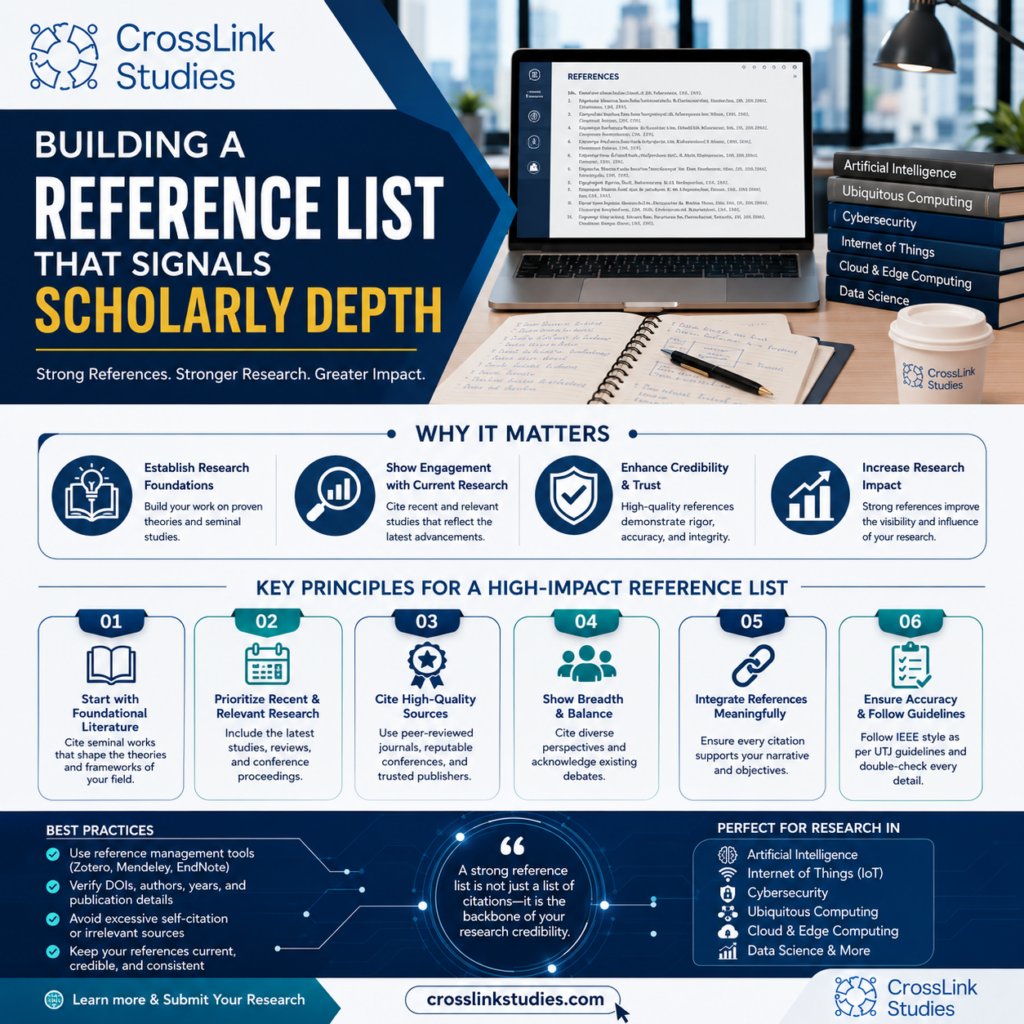
What Scholarly Depth Looks Like?
Scholarly depth is not measured by the number of references alone. A manuscript with 100 poorly selected citations may be less persuasive than one with 30 carefully chosen sources.
A reference list that signals depth typically exhibits:
- Strong engagement with landmark studies in the field.
- Inclusion of recent publications reflecting current developments.
- Coverage of diverse perspectives and methodologies.
- Citations from reputable journals, conferences, and academic publishers.
- Clear connections between cited literature and the research problem.
The goal is not simply to cite extensively but to cite strategically.
Start with Foundational Literature
Every research area has seminal works that shaped its evolution. Ignoring these studies can create the impression that the manuscript lacks awareness of the field’s intellectual foundations.
For example, authors working in machine learning, human-computer interaction, edge computing, or IoT should identify key theories, frameworks, and influential publications that continue to guide contemporary research. These foundational references provide context and help readers understand how the current study contributes to ongoing scholarly conversations. A strong literature base often combines classical references with modern advancements, creating a bridge between established knowledge and emerging innovation.
Prioritize Recent and Relevant Research
Technology-related disciplines evolve rapidly. A reference list dominated by older sources may suggest that the research does not adequately reflect current developments.
Authors should actively engage with recent journal articles, current conference proceedings, emerging technological frameworks, contemporary systematic reviews and recent methodological advances. This is particularly important in fields such as artificial intelligence, cybersecurity, cloud computing, pervasive systems, and smart technologies, where new discoveries and applications appear continuously. A current reference list demonstrates awareness of the latest debates, challenges, and opportunities within the discipline.
Cite High-Quality Sources
Not all citations carry equal scholarly weight.
When building a reference list, prioritize sources from:
- Peer-reviewed journals.
- Reputable academic conferences.
- Recognized scholarly publishers.
- Established professional organizations.
- Authoritative technical reports and standards.
Where possible, avoid excessive reliance on:
- Unverified websites.
- Non-academic blogs.
- Outdated online resources.
- Sources lacking clear authorship or publication standards.
Quality references strengthen the credibility of the entire manuscript.
Demonstrate Breadth Without Losing Focus
One common mistake is citing only papers that support a preferred viewpoint. Strong scholarship acknowledges the broader research landscape, including differing perspectives and competing findings. A balanced reference list should represent multiple schools of thought, include studies with varying conclusions, highlight existing debates and identify research gaps and unresolved questions.This approach signals intellectual honesty and critical engagement rather than selective citation practices.
Integrate References into the Research Narrative
References should not exist merely to increase citation counts. Each citation should contribute meaningfully to the manuscript’s argument. Effective authors use references to establish context, support methodological decisions, compare findings, identify limitations in existing research, and justify the significance of the study.
When references are thoughtfully integrated throughout the manuscript, the bibliography becomes a reflection of a coherent and well-developed scholarly narrative.
Pay Attention to Reference Accuracy
Even high-quality sources lose value when citation details are inaccurate.
Before submission, verify:
- Author names.
- Publication years.
- Article titles.
- Journal names.
- Volume and issue numbers.
- Page ranges.
- Digital Object Identifiers (DOIs).
Reference management tools such as EndNote, Zotero, and Mendeley can help maintain consistency and reduce errors. However, authors should always perform a final manual review before submission.
Follow the Journal’s Referencing Requirements
One of the most overlooked aspects of manuscript preparation is adherence to the journal’s prescribed citation style. UTJ requires authors to comply with the journal’s formatting and bibliographic standards, including IEEE-style referencing. Consistency in citation formatting improves readability, facilitates verification, and reflects professional attention to detail. Manuscripts that fail to follow journal guidelines may face delays during editorial screening or peer review.
An exceptional reference list does more than document sources, it demonstrates expertise, credibility, and scholarly engagement. It tells reviewers that the research is grounded in a thorough understanding of the field and positioned within the broader scientific conversation. Before submitting your next manuscript, take a closer look at your bibliography. Ask whether it reflects the depth of knowledge, critical thinking, and academic rigor that your research deserves. In many cases, the strength of a paper can be seen long before a reviewer reaches the results section starting with the references that support it.