
Preparing Supplementary Materials for Review
A Complete Guide to Supporting Your Manuscript with High-Quality Supplementary Files
A well-written manuscript is only one part of a successful journal submission. Increasingly, scholarly journals expect authors to provide supplementary materials that improve transparency, reproducibility, and the overall understanding of their research. Whether these files include additional datasets, extended methods, multimedia content, detailed figures, questionnaires, or source code, they play an essential role in supporting the scientific record.
However, supplementary materials are often overlooked during manuscript preparation. Authors may upload incomplete files, provide insufficient descriptions, use inconsistent naming conventions, or omit important supporting information altogether. These issues can delay editorial processing, create confusion during peer review, and reduce confidence in the reported research.
At Crosslink Studies (CLS), supplementary materials contribute to a transparent and efficient editorial process by providing reviewers with the additional evidence needed to assess the validity, completeness, and reproducibility of submitted research.
This blog explains why supplementary materials matter, what they typically include, and how researchers can prepare them effectively for successful peer review.
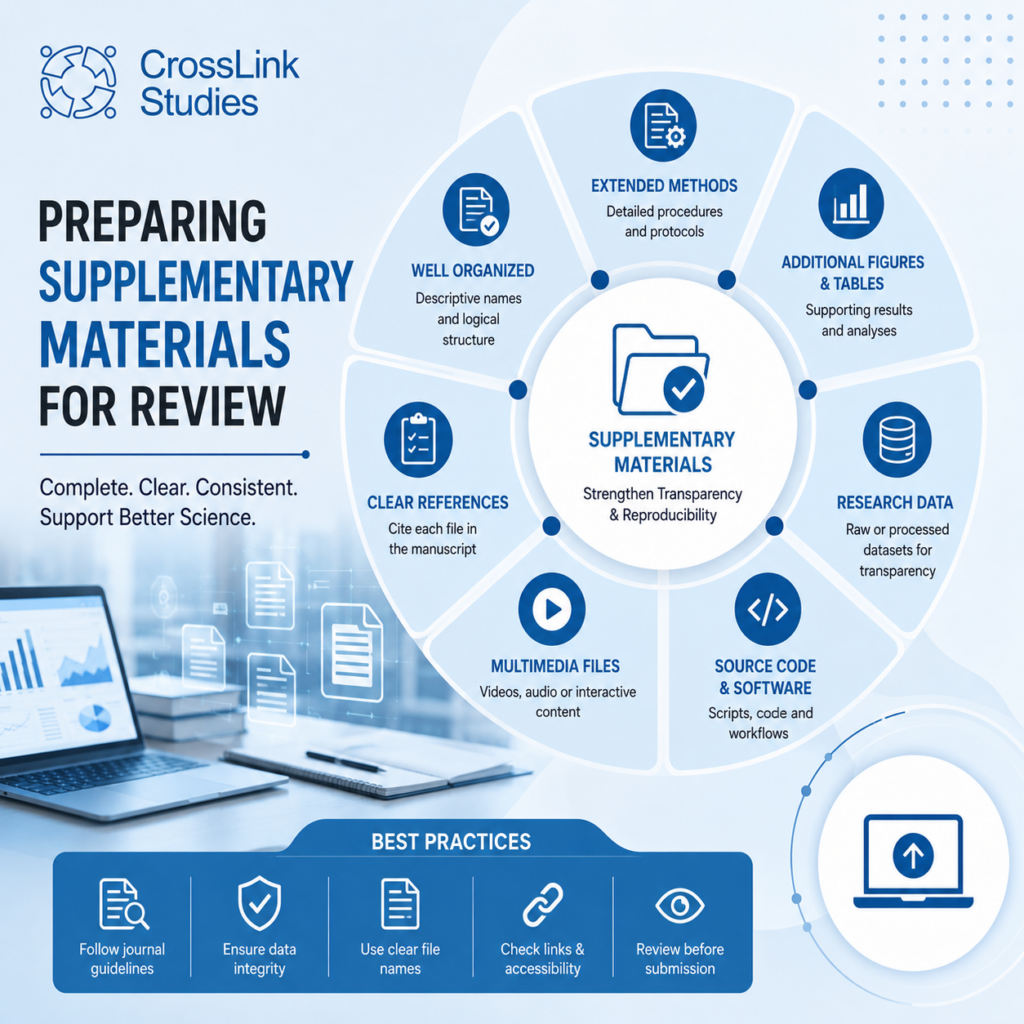
What Are Supplementary Materials?
Supplementary materials are files submitted alongside the main manuscript that provide additional information supporting the research but are not essential to the primary narrative of the article. These materials allow authors to present comprehensive evidence without exceeding manuscript length limitations or interrupting the flow of the main text.
Unlike appendices that may appear within the published article, supplementary materials are generally provided as separate files and are made available to editors, reviewers, and, where appropriate, readers after publication. Their primary purpose is to strengthen the transparency, reproducibility, and credibility of scientific findings.
Why Are Supplementary Materials Important?
Scientific publishing increasingly emphasizes openness and reproducibility. Readers and reviewers should be able to understand not only the reported findings but also how those findings were generated.
Well-prepared supplementary materials help reviewers verify experimental procedures, examine additional analyses, evaluate supporting evidence, and gain confidence in the reported conclusions. They also provide future researchers with valuable resources for replication, validation, and further investigation.
From an editorial perspective, complete supplementary files reduce requests for clarification during peer review, improve communication between authors and reviewers, and contribute to a more efficient publication process. Rather than being viewed as optional attachments, supplementary materials should be considered an integral component of responsible scholarly communication.
What Can Be Included as Supplementary Material?
The specific requirements vary among journals and research disciplines, but supplementary files commonly include the following types of content.
Extended Methodology
Some studies require detailed experimental procedures, laboratory protocols, computational workflows, survey instruments, or technical descriptions that exceed the space available within the manuscript. Providing these details enables reviewers and future researchers to understand exactly how the study was conducted.
Additional Figures and Tables
Supporting visual information that complements but does not directly affect the interpretation of the main results may be included as supplementary content.
Research Data
Many journals encourage or require authors to share datasets that support published findings. Depending on the discipline, supplementary datasets may include raw measurements, processed data, survey responses, laboratory observations and simulation outputs. Providing accessible and well-organized datasets promotes transparency while enabling independent verification of research findings.
Source Code and Software
Computational research often relies on custom software, scripts, algorithms, or analytical workflows. When appropriate, authors should provide source code, programming scripts, software documentation, installation instructions and computational workflows. Clear documentation helps reviewers understand how analyses were performed and improves research reproducibility.
Multimedia Files
Certain research benefits from multimedia content that cannot be effectively presented within a traditional article. High-quality multimedia files can enhance reviewer understanding and improve scientific communication.
Characteristics of High-Quality Supplementary Materials
Submitting additional files alone is not sufficient. Supplementary materials should meet the same standards of quality and organization as the manuscript itself. Editors and reviewers expect supporting files to be:
Well Organized
Each file should have a logical structure and descriptive filename. Examples include:
- Supplementary Table 1
- Supplementary Figure 2
- Dataset Research Data
- Appendix Methods
- Statistical Analysis
Avoid vague filenames such as Final Version, New File, or Data1.
Clearly Referenced
Every supplementary file should be cited within the manuscript at the appropriate location.
For example: “Additional experimental details are provided in Supplementary Methods.”
Or “Complete statistical results are available in Supplementary Table S3.”
Complete and Consistent
Ensure that:
- Figure numbering matches manuscript references.
- Dataset labels remain consistent throughout all files.
- Terminology is identical across the manuscript and supplementary materials.
- Variable names, abbreviations, and units are used consistently.
Consistency minimizes reviewer confusion and demonstrates careful manuscript preparation.
Common Mistakes Authors Should Avoid
Many supplementary files require revision because they contain avoidable problems.
Frequent issues include:
- Missing files referenced in the manuscript
- Incorrect numbering of figures or tables
- Unclear filenames
- Poor-quality images
- Incomplete datasets
- Unsupported file formats
- Missing legends or captions
- Lack of documentation for software or code
- Broken links to external repositories
- Inclusion of confidential or personally identifiable information
Performing a thorough review before submission helps prevent these problems from delaying editorial assessment.
Best Practices Before Submission
Preparing supplementary materials should be part of the manuscript development process rather than a final administrative task. Before submitting your manuscript, consider the following checklist:
- Verify that every supplementary file is complete.
- Confirm that all files are referenced correctly in the manuscript.
- Use descriptive filenames.
- Include captions for every supplementary figure and table.
- Check file readability across different devices.
- Ensure datasets are properly organized and documented.
- Remove unnecessary duplicate files.
- Confirm that confidential information has been removed where required.
- Review journal formatting and file type requirements.
- Ask a colleague to locate information using only your file names and manuscript references to ensure clarity.
Supporting Transparency and Research Integrity
The role of supplementary materials has expanded significantly as scholarly publishing continues to embrace open science and reproducible research.
Providing complete supporting documentation demonstrates transparency, strengthens scientific credibility, and enables independent verification of published findings. Well-prepared supplementary materials also reduce reviewer uncertainty, improve editorial confidence, and increase the overall quality of the publication.
At Crosslink Studies (CLS), authors are encouraged to view supplementary materials as an essential extension of their manuscript rather than an optional addition. Careful preparation, thoughtful organization, and clear documentation contribute to a smoother editorial workflow and a more meaningful peer-review process.
Preparing supplementary materials requires the same attention to detail as writing the manuscript itself. Well-organized supporting files help editors evaluate submissions efficiently, enable reviewers to assess research comprehensively, and provide readers with valuable resources for understanding and reproducing scientific work. Researchers who invest time in preparing clear, complete, and professionally organized supplementary materials not only strengthen their submissions but also contribute to higher standards of transparency, integrity, and excellence in scholarly publishing. By treating supplementary files as an integral part of the research record, authors can enhance the impact, credibility, and long-term value of their published work.