What Happens After Submission to a CLS Journal?
For many researchers, submitting a manuscript is both an exciting and anxious moment. Months or even years of research, experimentation, data analysis, and writing culminate in a single action: clicking the submission button. Yet for many authors, especially early-career researchers, the period after submission often feels uncertain. Questions such as Has my manuscript been received? What are the editors doing? How long will peer review take? What happens if revisions are requested? are common.
Understanding the post-submission journey is an important part of academic publishing. While every manuscript follows its own path, reputable scholarly publishers employ a structured editorial process designed to ensure quality, integrity, and scientific rigor. At Crosslink Studies (CLS), this process helps maintain high publication standards while providing authors with a fair and transparent evaluation of their work.
This blogexplains what typically happens after a manuscript is submitted to a CLS journal and how authors can navigate each stage successfully.
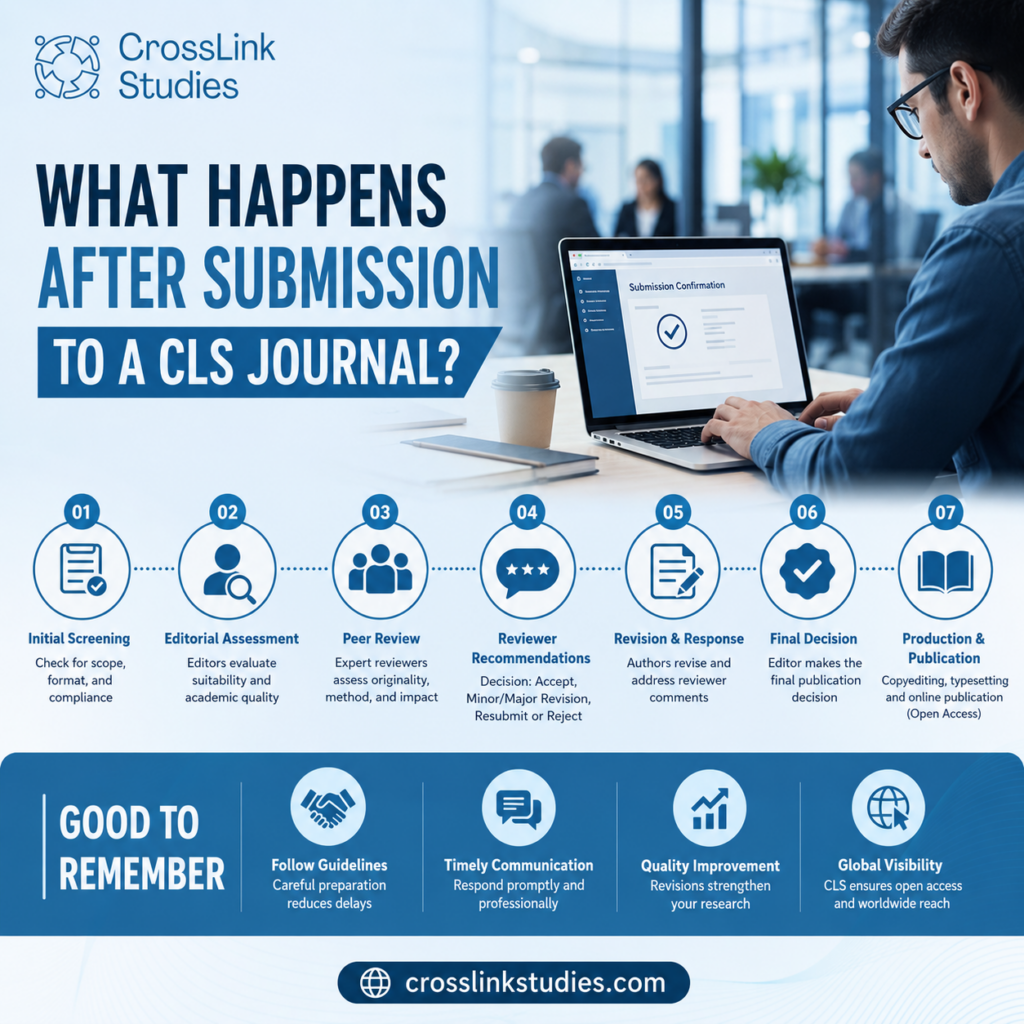
Submission Confirmation: The First Step
Immediately after submission, authors receive confirmation that their manuscript has been successfully uploaded to the journal system. At this stage, the manuscript enters the editorial workflow and awaits an initial assessment.
Many authors assume that peer review begins immediately after submission. In reality, several important quality-control procedures occur before a manuscript reaches external reviewers. These early checks help ensure that reviewers can focus on evaluating the scientific content rather than technical or administrative issues.
Initial Editorial Screening
The first stage of evaluation is commonly known as the initial screening or desk assessment. During this stage, the editorial office examines whether the submission complies with the journal’s requirements and policies.
Editors typically review several key aspects, including:
- Alignment with the journal’s aims and scope
- Compliance with author guidelines
- Completeness of submission files
- Quality of manuscript presentation
- Ethical declarations and author information
- Reference formatting and citation practices
A manuscript that falls outside the journal’s scope or fails to meet basic submission requirements may be returned to the authors for correction before proceeding further. This step helps streamline the review process and improves efficiency for both authors and reviewers. For researchers, carefully following submission guidelines before uploading a manuscript can significantly reduce delays during this stage.
Editorial Evaluation of Scientific Suitability
Once technical requirements have been verified, editors conduct a more detailed assessment of the manuscript’s academic value. At this point, editors consider questions such as:
- Does the study address an important research problem?
- Is the contribution original and meaningful?
- Is the methodology appropriate and scientifically sound?
- Are the results presented clearly and logically?
- Will the research be valuable to the journal’s readership?
Editors must ensure that only manuscripts with sufficient scholarly merit proceed to peer review. This responsibility protects reviewer resources and maintains the overall quality of published research. Although authors sometimes view editorial screening as a hurdle, it is actually an essential quality-control mechanism used throughout reputable scholarly publishing.
Assignment to Peer Reviewers
If the manuscript successfully passes editorial evaluation, it enters the peer review stage. Peer review is widely regarded as the cornerstone of academic publishing because it allows independent experts to evaluate the quality, accuracy, and significance of research findings.
Reviewers are selected based on their expertise and familiarity with the manuscript’s subject area. Their role is not merely to identify weaknesses but also to provide constructive recommendations that can improve the quality of the work.
During review, experts typically evaluate research originality technical correctness, methodological rigor, data quality and interpretation, clarity of presentation, literature coverage and significance of findings. The peer review process serves as an important safeguard for scientific integrity and helps ensure that published research meets accepted academic standards.
Understanding Reviewer Feedback
Once reviewers complete their evaluations, they submit detailed reports and recommendations to the editor. For many researchers, reviewer comments represent one of the most valuable parts of the publication process. Independent expert feedback often highlights opportunities to strengthen arguments, improve methodology descriptions, clarify results, and increase the overall impact of the study.Reviewer recommendations generally fall into several categories:
Acceptance
In rare cases, a manuscript may be accepted with little or no modification. This outcome is uncommon because most papers benefit from at least minor improvements.
Minor Revisions
Minor revision requests usually involve relatively small changes, such as clarifying explanations, improving figures, correcting references, or addressing specific reviewer concerns.
Major Revisions
Major revisions indicate that the manuscript shows promise but requires substantial improvement before publication can be considered. Authors may need to expand discussions, strengthen analyses, revise methodologies, or provide additional evidence supporting their conclusions.
Rejection
Not all manuscripts proceed to publication. Rejection does not necessarily mean the research lacks value; it may indicate that the study is not a suitable fit for the journal or that significant scientific concerns remain unresolved.
Understanding reviewer comments objectively and professionally is one of the most important skills researchers can develop throughout their academic careers.
The Revision Stage: An Opportunity for Improvement
Authors sometimes view revision requests as setbacks. In reality, revisions are a normal and valuable part of scholarly publishing. Many highly cited articles underwent multiple rounds of revision before publication. Reviewer feedback often strengthens the manuscript by improving clarity, addressing weaknesses, and enhancing scientific credibility.
When preparing a revised submission, authors should address every reviewer comment carefully, explain all modifications clearly and provide evidence supporting disagreements when necessary. A detailed response document that systematically addresses reviewer concerns can significantly improve the efficiency of the re-evaluation process.
Final Editorial Decision
After the revised manuscript is submitted, editors evaluate the changes and determine whether reviewer concerns have been adequately addressed. Depending on the circumstances, the editor may accept the manuscript, request additional revisions and send the manuscript for further review. The final decision is based on scientific quality, reviewer recommendations, editorial judgment, and compliance with publication standards. Although authors naturally focus on acceptance outcomes, it is important to recognize that editorial decisions are intended to uphold the integrity and quality of the scholarly record.
Production and Publication
Acceptance marks a major achievement, but it is not the final stage of the publication journey. After acceptance, the manuscript enters production, where it undergoes final preparation for publication. This stage may include:
- Copyediting
- Formatting and typesetting
- Metadata preparation
- Proof generation
- Final author review
- Online publication
These procedures ensure that the published article is professionally presented, discoverable, and accessible to the research community. Once published, the article becomes part of the scholarly literature and contributes to ongoing scientific discussion within its field.
Why Understanding the Process Matters?
Researchers often invest considerable effort in preparing manuscripts but spend less time learning about the publication process itself. Understanding what happens after submission can help authors manage expectations, reduce uncertainty, and engage more effectively with editors and reviewers.
Publication is not simply an evaluation of research; it is a collaborative process involving authors, editors, reviewers, and publishing professionals working toward a common goal: the dissemination of high-quality scholarly knowledge.
Submitting a manuscript to a CLS journal is the beginning of a structured academic journey rather than the end of a research project. From editorial screening and peer review to revisions and publication, each stage plays a critical role in ensuring that published research meets professional and scientific standards. Authors who understand this process, respond constructively to feedback, and adhere to journal guidelines are better positioned to navigate peer review successfully and maximize the impact of their research. While waiting for editorial decisions can sometimes test a researcher’s patience, every stage of the process contributes to the credibility, quality, and long-term value of scholarly communication.