
What Information to Provide for Suggested Reviewers
Helping Editors Identify the Right Experts
Peer review is the foundation of scholarly publishing. It ensures that research is evaluated by qualified experts who can assess its originality, methodological rigor, technical accuracy, and contribution to the field. To support this process, many journals invite authors to recommend potential reviewers during manuscript submission.
Providing reviewer suggestions can help editors identify specialists with the appropriate expertise, particularly in highly specialized or emerging research areas. However, the value of these recommendations depends largely on the quality and completeness of the information supplied by authors. A well-prepared reviewer recommendation not only assists editors in making informed decisions but also demonstrates the author’s commitment to a transparent and ethical peer review process.
Why Reviewer Information Matters
Editors are responsible for selecting independent experts capable of providing objective evaluations. Reviewer suggestions can be particularly useful when manuscripts involve niche methodologies, interdisciplinary topics, or rapidly evolving technological fields.
Incomplete or inaccurate reviewer information may:
- Delay the review process.
- Make reviewer verification more difficult.
- Increase administrative workload.
- Reduce the likelihood of reviewer invitations being sent.
Providing comprehensive and accurate details helps journals manage peer review efficiently while maintaining high editorial standards.
Essential Information to Include
When recommending reviewers, authors should provide information that allows editors to assess both expertise and suitability.
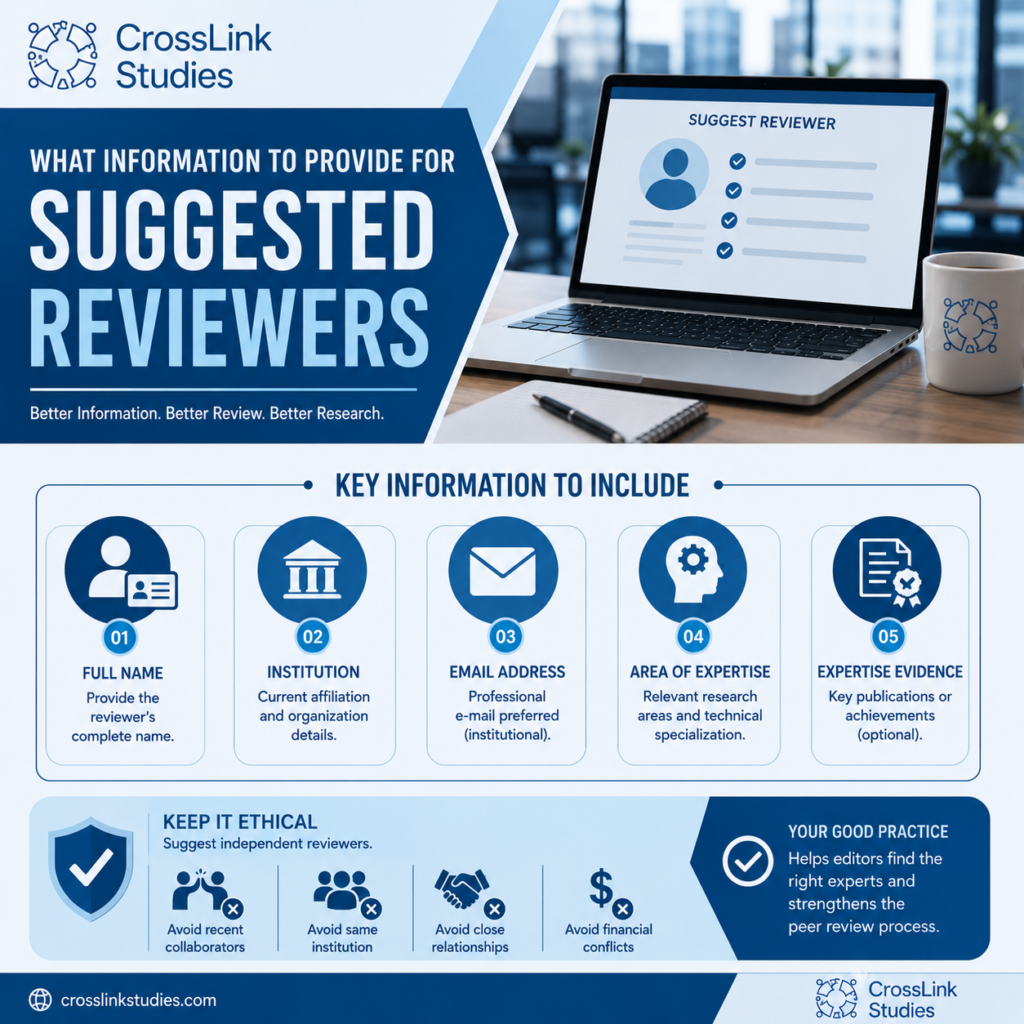
Full Professional Name
Always provide the reviewer’s complete name rather than initials or abbreviated forms.
Accurate identification helps editors distinguish between researchers with similar names and locate their academic profiles more efficiently.
Institutional Affiliation
Include the reviewer’s current institution, organization, or research center. This information helps editors to verify professional credentials, assess potential conflicts of interest, confirm subject-area expertise and determine institutional independence.Current affiliations are generally more useful than previous positions.
Professional Email Address
Whenever possible, provide an institutional or professional email address rather than a personal email account. Professional email addresses enhance credibility and facilitate reviewer verification. Examples include university email accounts, research institute addresses and organizational email domains. Editors may be less likely to use reviewer recommendations that cannot be adequately verified.
Area of Expertise
Briefly explain why the reviewer is qualified to evaluate the manuscript. This may include expertise related to research methodology, technical specialization, subject matter knowledge, emerging technologies, interdisciplinary research areas. A concise explanation helps editors understand the relevance of the recommendation.
Demonstrating Reviewer Expertise
Rather than simply listing names, authors should provide context that highlights a reviewer’s qualifications. Useful indicators may include relevant publication history, research specialization, conference participation, leadership in professional organizations and contributions to the field. The objective is to help editors quickly recognize the alignment between reviewer expertise and manuscript content.
Information That Supports Editorial Evaluation
Editors often assess reviewer recommendations using several criteria beyond technical expertise. Helpful information may include:
Research Interests
A brief description of the reviewer’s research interests can help editors determine subject compatibility.
Geographic Diversity
Suggesting reviewers from different countries and institutions may contribute to a broader and more balanced evaluation process.
Independence from the Authors
Reviewer recommendations should be free from conflicts of interest. Authors should avoid suggesting:
- Recent co-authors.
- Current institutional colleagues.
- Close collaborators.
- Personal acquaintances with direct involvement in the research.
- Individuals with financial interests related to the study.
Independent reviewers strengthen the credibility of peer review and support fair editorial decision-making.
Common Mistakes to Avoid
Reviewer recommendations are most effective when they prioritize expertise and objectivity. Authors should avoid:
Incomplete Contact Information
Missing affiliations or email addresses can make reviewer identification difficult.
Generic Expertise Descriptions
Statements such as “expert in the field” provide little value to editors.
Specific expertise is far more useful.
Suggesting Reviewers with Conflicts of Interest
Even highly qualified experts may be unsuitable if their independence could reasonably be questioned.
Recommending Only Familiar Researchers
Diverse reviewer suggestions often improve the quality and balance of peer review.
Best Practices for Reviewer Recommendations
Before submitting reviewer suggestions, consider the following checklist:
✓ Provide full names.
✓ Include current institutional affiliations.
✓ Supply professional email addresses.
✓ Describe relevant expertise.
✓ Verify independence from the research team.
✓ Ensure information is accurate and up to date.
✓ Recommend reviewers based on qualifications rather than personal relationships.
These practices help editors identify suitable reviewers while promoting transparency and research integrity.
The Editor’s Final Decision
While reviewer recommendations are valuable, authors should recognize that final reviewer selection remains the responsibility of the editorial team. Editors may invite suggested reviewers, select alternative experts, combine author suggestions with independent reviewer searches and exclude recommendations that present potential conflicts. This editorial oversight helps preserve the objectivity and credibility of the peer review process.
Providing reviewer recommendations is an opportunity for authors to contribute constructively to the peer review process. The most effective recommendations are accurate, transparent, and focused on scholarly expertise rather than personal familiarity. By supplying complete reviewer information including professional affiliations, contact details, and relevant areas of expertise authors can help editors identify qualified evaluators and facilitate a more efficient review process. Ultimately, thoughtful reviewer recommendations support stronger peer review, higher-quality publications, and greater trust in scholarly communication.