
Mapping Research Gaps in AI, IoT, Robotics, and Cyber-Physical Systems
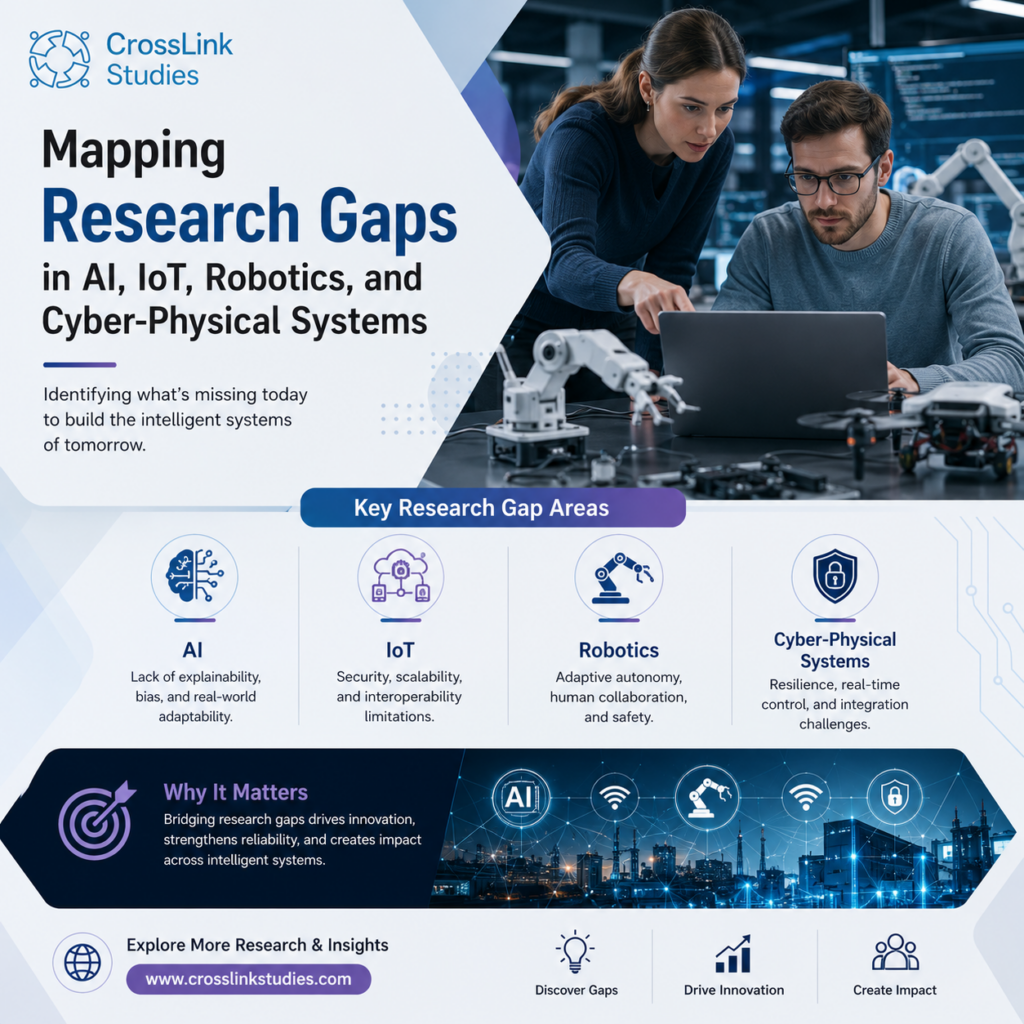
The rapid convergence of Artificial Intelligence (AI), Internet of Things (IoT), robotics, and Cyber-Physical Systems (CPS) is transforming the technological landscape of modern society. From intelligent healthcare systems and autonomous vehicles to smart manufacturing and adaptive urban infrastructures, these interconnected technologies are redefining how digital and physical environments interact. However, despite remarkable progress, substantial research gaps continue to limit scalability, interoperability, security, trustworthiness, and real-world deployment.
Ubiquitous Technology Journal (UTJ), published by Crosslink Studies, emphasizes innovative, interdisciplinary, and forward-looking research within ubiquitous computing, artificial intelligence, smart systems, robotics, and cyber-physical environments.
Understanding the Interdisciplinary Nature of Modern Intelligent Systems
AI, IoT, robotics, and CPS are no longer independent research domains. Modern intelligent ecosystems increasingly combine machine learning algorithms, interconnected sensing infrastructures, autonomous decision-making, embedded computing, and real-time physical interaction. This convergence has created highly complex systems that operate across multiple layers simultaneously data acquisition through IoT sensors, real-time analytics using AI models, autonomous action through robotics.
The interdisciplinary scope of UTJ specifically highlights topics such as edge AI, distributed sensing, smart environments, ubiquitous robotics, autonomous systems, context-aware computing, and cybersecurity in pervasive systems. As a result, mapping research gaps in modern intelligent systems requires researchers to examine not only individual technologies but also their integration challenges, operational limitations, and societal implications.
Why Research Gap Mapping Matters in Emerging Technologies
One of the most common weaknesses in contemporary technology research is the repetition of already explored problems with only minor modifications. Many manuscripts introduce slightly adjusted algorithms, datasets, or architectures without addressing deeper unresolved issues affecting practical implementation and scientific advancement.
Research gap mapping helps overcome this limitation by identifying underexplored technical problems, contradictions between existing studies, weaknesses in methodologies and scalability limitations. UTJ’s submission guidelines similarly emphasize originality, technical depth, analytical rigor, and future-oriented contributions in survey, review, and applied research articles.
Identifying Research Gaps in Artificial Intelligence
Artificial Intelligence has experienced unprecedented growth across nearly every domain of ubiquitous technology. However, despite impressive achievements in machine learning, deep learning, and generative models, several major research gaps remain unresolved.
One significant gap involves explain ability and transparency. Many advanced AI systems function as black-box models, making it difficult for users and decision-makers to understand how predictions are generated. Bias, fairness, and ethical governance also represent growing research gaps. Existing datasets frequently contain imbalances that affect decision accuracy across different populations and environments. Consequently, responsible AI design has emerged as a critical research direction in modern intelligent systems. Recent publications within UTJ similarly emphasize ethical AI frameworks, risk mitigation, and responsible technological innovation.
Mapping Gaps in Internet of Things (IoT) Systems
The Internet of Things continues to expand rapidly through interconnected smart devices, industrial monitoring systems, wearable technologies, and intelligent urban infrastructures. However, large-scale deployment of IoT ecosystems still faces numerous unresolved scientific and engineering challenges.
Security and privacy remain among the most significant concerns. Many IoT devices operate with limited computational capacity, preventing implementation of advanced encryption and authentication mechanisms. As a result, IoT environments remain vulnerable to cyberattacks, unauthorized access, and data manipulation.
Interoperability is another persistent challenge. Devices developed using different communication standards, protocols, and architectures often struggle to exchange information effectively across heterogeneous environments. Modern researchers must therefore focus on designing IoT systems that are secure, scalable, interoperable, energy-efficient, and capable of intelligent autonomous operation.
Research Gaps in Robotics and Autonomous Systems
Robotics research has advanced significantly through developments in AI-driven perception, machine vision, autonomous navigation, and human–robot interaction. Nevertheless, practical deployment of intelligent robotic systems remains constrained by several unresolved limitations.
One critical challenge is adaptive decision-making in unpredictable environments. Many robotic systems perform effectively under controlled laboratory conditions but struggle within dynamic real-world scenarios involving uncertain environmental changes and incomplete data.
Human–robot collaboration also presents substantial research gaps. As robots become increasingly integrated into healthcare, manufacturing, education, and service industries, ensuring safe and intuitive interaction with humans becomes essential.
Energy efficiency and autonomous learning represent additional challenges. Mobile robots often face limited battery capacity and computational constraints, restricting operational flexibility. UTJ’s focus on autonomous systems, intelligent agents, distributed AI, and ubiquitous robotics reflects the increasing importance of these interdisciplinary research challenges.
Cyber-Physical Systems and Integration Challenges
Cyber-Physical Systems form the technological backbone of modern smart infrastructures by integrating computational intelligence with physical processes. Examples include smart grids, autonomous transportation systems, industrial automation, healthcare monitoring, and intelligent manufacturing environments.
However, CPS research faces complex integration challenges due to the interaction between software reliability, hardware synchronization, networking, sensing, and real-time control.
One major research gap involves resilience and fault tolerance. CPS infrastructures must continue functioning reliably even under hardware failures, communication disruptions, or cyberattacks. Recent UTJ publications examining smart city infrastructures, Industrial IoT integration, predictive maintenance, and digital twin architectures demonstrate growing scholarly attention toward scalable and fault-tolerant CPS frameworks.
Methods for Systematically Mapping Research Gaps
High-impact research gap mapping requires structured and evidence-based methodologies rather than subjective observation alone.
Researchers commonly use several analytical approaches:
Systematic Literature Reviews
Systematic reviews synthesize large collections of peer-reviewed studies to identify recurring limitations, unresolved questions, and methodological weaknesses.
Bibliometric Analysis
Bibliometric visualization tools such as VOSviewer and CiteSpace help researchers map keyword relationships, citation networks, and emerging thematic clusters. Studies using bibliometric methods have proven effective for identifying scientific evolution and future research opportunities.
Comparative Analysis
Comparing methodologies, datasets, architectures, and performance metrics across studies often reveals inconsistencies and underexplored areas.
Industrial Trend Evaluation
Examining real-world deployment challenges, industrial reports, and technological adoption patterns provides additional insight into practical research needs.
Gap Classification Frameworks
Researchers increasingly classify gaps into categories such as methodological gaps, theoretical gaps, practical implementation gaps, dataset limitations and security gaps.
Building High-Impact Research Around Identified Gaps
Identifying a research gap alone is insufficient. Researchers must also demonstrate how their proposed work addresses the limitation effectively.
Strong research proposals generally:
- Clearly define the unresolved challenge.
- Explain why existing approaches are inadequate.
- Present measurable objectives.
- Justify methodological choices.
- Demonstrate practical significance.
- Discuss scalability and future applicability.
For UTJ and CLS meaningful research contributions are expected to provide analytical depth, methodological rigor, and future-oriented innovation across rapidly evolving technological ecosystems. Ultimately, the most valuable research does not simply follow technological trends; it identifies the unresolved scientific challenges that will shape the future of intelligent systems and ubiquitous computing.