
How to Explain Data Pre-processing Transparently?
Data preprocessing is one of the most influential stages in modern computational research. In fields such as artificial intelligence, machine learning, software engineering, IoT analytics, cybersecurity, and data science, preprocessing decisions directly affect model behavior, experimental validity, and research outcomes. Yet many manuscripts describe preprocessing only briefly, leaving reviewers uncertain about how raw data became the final experimental dataset.
Why Data Pre-processing Matters
Raw datasets are rarely suitable for direct experimentation. Researchers often need to clean incomplete records, normalize values, handle outliers and remove duplicates. These operations can dramatically influence the final results of a study. For example, a machine learning model trained on normalized data may perform very differently from one trained on unscaled data. Similarly, aggressive filtering or augmentation can unintentionally introduce bias or inflate performance metrics.
This is why preprocessing should never be treated as a minor implementation detail.
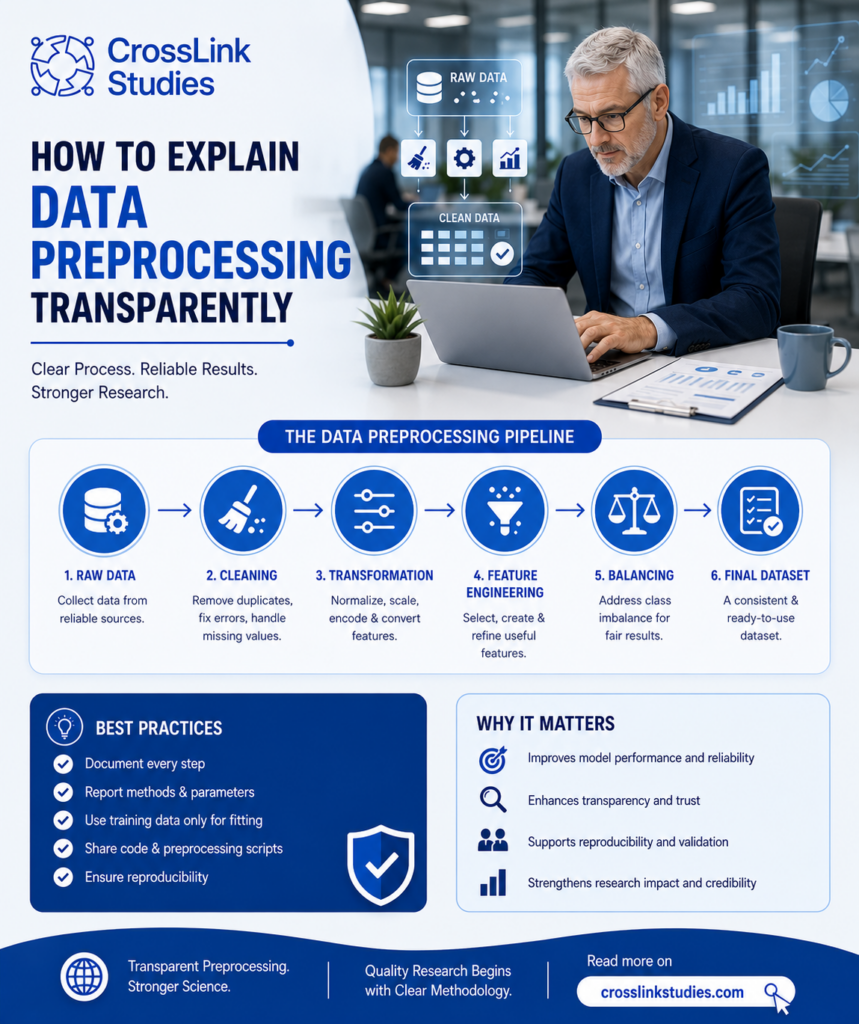
What Is Transparent Data Pre-processing?
Transparent preprocessing means clearly documenting:
- The original dataset condition
- Every transformation applied
- The reasons for each pre-processing decision
- The tools and methods used
- The effect of pre-processing on the dataset
Why Reviewers Expect Detailed Pre-processing Reporting
CLS increasingly prioritize reproducibility, open science practices, transparent workflows, methodological integrity, FAIR data principles and experimental traceability. For UTJ authors, transparent preprocessing strengthens both reviewer confidence and manuscript quality.
How to Explain Data Pre-processing Transparently
1. Describe the Original Dataset First
Before discussing preprocessing, explain the dataset’s initial condition.
Include:
| Dataset Information | Recommended Details |
| Dataset size | Number of records |
| Missing values | Percentage or quantity |
| Feature types | Numerical, categorical, text |
| Noise issues | Corrupted or inconsistent entries |
| Class distribution | Balanced or imbalanced |
This gives readers a clear understanding of the preprocessing requirements.
2. Explain Missing Data Handling
Missing data treatment should always be documented. Researchers should specify missing value percentage, removal criteria, imputation methods and statistical replacement strategies.
Strong Example
“Numerical missing values were replaced using median imputation, while categorical features used mode replacement.”
Avoid vague statements such as: “Incomplete records were cleaned.”
3. Report Data Cleaning Procedures
Data cleaning directly affects experimental reliability. Clearly explain duplicate removal, outlier handling, noise filtering, error correction and invalid sample exclusion
Example
| Cleaning Step | Method Used |
| Duplicate Removal | Exact record matching |
| Outlier Detection | Interquartile Range (IQR) |
| Noise Filtering | Threshold-based filtering |
4. Document Feature Engineering Transparently
Feature engineering can significantly alter experimental outcomes.
Authors should report generated features, feature selection methods, dimensionality reduction techniques and encoding procedures. Without this information, experiments become difficult to reproduce.
5. Explain Normalization and Scaling Methods
Scaling procedures influence model convergence and evaluation performance. Common approaches include min-max normalization, standardization, Z-score normalization and log transformation.
6. Discuss Data Balancing Techniques
Imbalanced datasets can create biased experimental outcomes. Authors should explain original class distribution, oversampling techniques, under sampling methods and synthetic data generation. Transparent balancing procedures improve methodological fairness.
Example
| Class | Before Balancing | After Balancing |
| Benign | 90,000 | 90,000 |
| Malicious | 12,000 | 90,000 |
7. Prevent Data Leakage
Improper preprocessing can unintentionally leak information from test data into training data. Researchers should explain train-test split timing, validation procedures, isolation of test datasets and cross-validation workflow.
Best Practice
“All preprocessing operations were fitted exclusively on training data before being applied to validation and test sets.”
8. Mention Software Tools and Libraries
Professional manuscripts should report programming language, framework versions, data processing libraries and automation scripts.
9. Include a Pre-processing Workflow Figure
Ubiquitous Technology Journal (UTJ), frequently use workflow diagrams to visualize preprocessing pipelines.
A preprocessing figure may include:
Raw Data → Cleaning → Transformation → Feature Engineering → Balancing → Final Dataset
Visual workflows improve readability and reviewer understanding.
Common Mistakes in Pre-processing Reporting
Many manuscripts reduce methodological quality by:
- Skipping pre-processing details
- Omitting missing value methods
- Ignoring balancing procedures
- Failing to explain feature engineering
- Hiding filtering criteria
- Using undocumented transformations
- Providing incomplete software information
These issues frequently result in reviewer revision requests.
Best Practices Followed by CLS
CLS increasingly encourage transparent workflows, open datasets, reproducible pre-processing pipelines, detailed methodological reporting and supplementary materials. Crosslink Studies also emphasizes methodological rigor, structured reporting, and reproducible experimentation within its submission expectations.
How Transparent Pre-processing Improves Manuscript Quality
Clear preprocessing documentation helps researchers increase reviewer trust, improve reproducibility, strengthen scientific validity and reduce revision requests, Transparent workflows also allow future researchers to extend and validate the work more effectively.
For authors submitting to Ubiquitous Technology Journal (UTJ), comprehensive preprocessing explanations can significantly improve methodological clarity and peer-review outcomes. Clear preprocessing workflows reflect professional research standards and support reliable scientific communication. Researchers should therefore treat preprocessing transparency as an essential scholarly practice in software engineering, AI, and computational research.