
Reporting Dataset Selection Without Selection Bias
Dataset selection is one of the most critical stages in software engineering, artificial intelligence, machine learning, and data-driven research. A strong experimental design can still produce misleading conclusions if the dataset selection process introduces bias. For this reason, reputable journals increasingly expect researchers to justify how datasets were selected, filtered, balanced, and evaluated.
In modern scientific publishing, transparent dataset reporting is essential for reproducibility, fairness, reliability, and methodological integrity. For Ubiquitous Technology Journal (UTJ), careful experimental reporting aligns with the journal’s emphasis on scientifically rigorous and reproducible computer science research.
Why Dataset Selection Matters
Datasets form the foundation of computational research. In areas such as artificial intelligence, machine learning, cybersecurity, IoT systems, software engineering, data analytics and smart environments the quality and representativeness of the dataset directly influence the reliability of experimental outcomes.
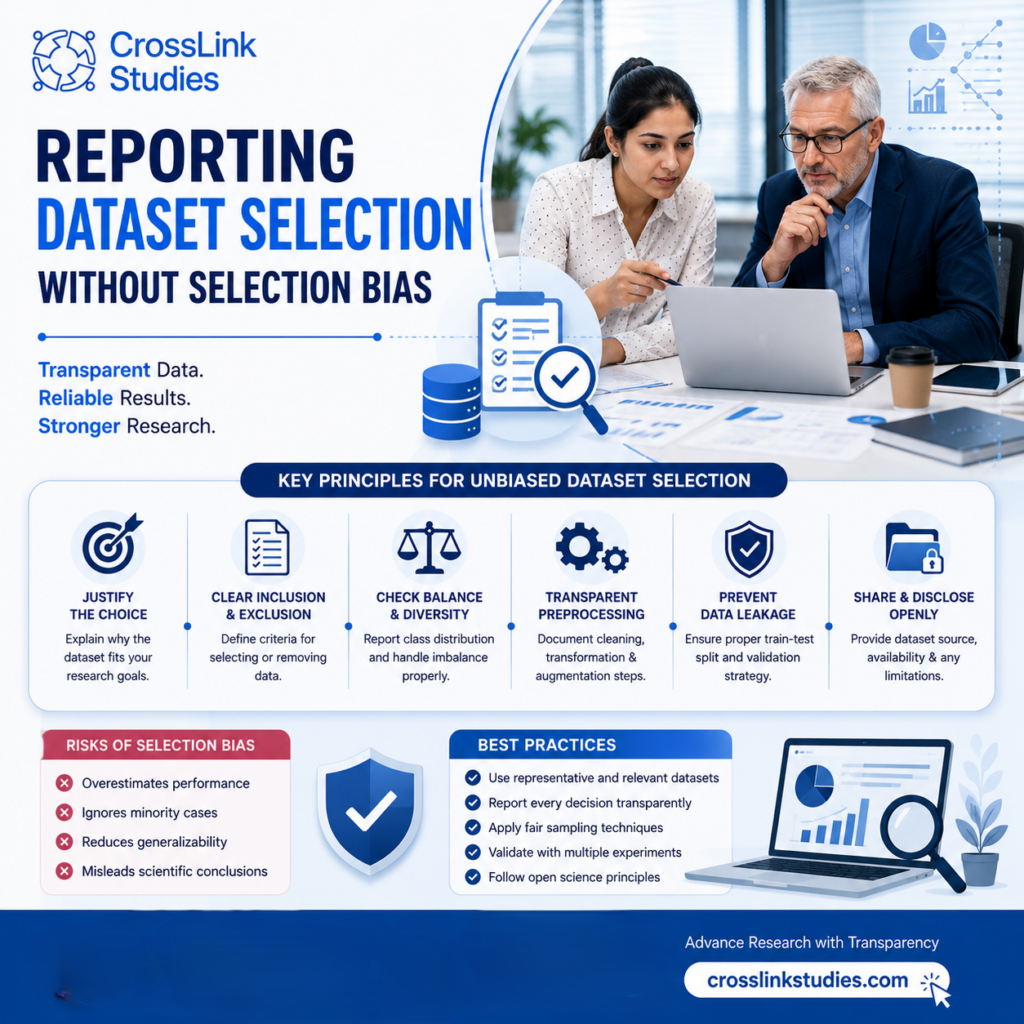
If dataset selection is biased, the resulting model or system may produce misleading performance results, fail in real-world environments, overestimate accuracy, ignore minority cases and reduce generalizability.
What Is Selection Bias?
Selection bias occurs when the selected dataset does not accurately represent the target population or research problem.
This often happens when researchers use overly convenient datasets, remove difficult samples without justification, select only high-quality data, ignore class imbalance, exclude negative cases and prefer datasets that improve performance metrics. As a result, experiments may appear stronger than they actually are.
Why UTJ Expect Transparent Dataset Reporting
Leading publishers and scholarly standards increasingly emphasize reproducibility, transparent methodology, open science practices, data accessibility and ethical experimentation. Modern research guidelines encourage authors to clearly document datasets, preprocessing decisions, sampling procedures, and data availability statements.
How to Report Dataset Selection Properly?
1. Clearly Identify the Dataset Source
Authors should specify:
| Dataset Information | Required Details |
| Dataset Name | Official dataset title |
| Source | Repository or organization |
| Version | Dataset release/version |
| Access Method | Public or private |
| Collection Date | Data acquisition period |
2. Explain Why the Dataset Was Chosen
A professional manuscript should justify dataset selection scientifically.
Explain relevance to research objectives, dataset popularity in prior studies, benchmark suitability, real-world applicability and data diversity.
Strong Example
“The dataset was selected due to its balanced representation of benign and malicious network traffic patterns.”
This demonstrates methodological reasoning rather than convenience-based selection.
3. Describe Inclusion and Exclusion Criteria
Researchers should explain:
- Which records were included
- Which records were removed
- Why samples were filtered
- How missing data was handled
4. Address Dataset Imbalance
Class imbalance is a major source of experimental bias.
Authors should report class distribution, minority and majority ratios, balancing methods and oversampling or under sampling techniques.
Example
| Class | Samples |
| Normal Traffic | 120,000 |
| Attack Traffic | 118,000 |
Transparent distribution reporting improves experimental fairness.
5. Document Pre-processing Procedures
Preprocessing can unintentionally introduce bias if not reported correctly. It includes data cleaning methods, normalization techniques, feature engineering, data augmentation, duplicate removal and noise filtering. Readers should understand exactly how raw data became experimental data.
6. Prevent Data Leakage
Data leakage is one of the most serious experimental mistakes in AI and software engineering research.
Authors should clearly explain train-test separation, validation methodology, cross-validation strategy and feature isolation procedures.
7. Report Sampling Methods Transparently
Sampling strategies should be clearly defined. Possible approaches include random sampling, stratified sampling, cluster sampling, time-based sampling and cross-domain sampling. Random or stratified approaches are often preferred because they reduce sampling bias.
8. Include Dataset Limitations
Professional manuscripts acknowledge dataset weaknesses. Examples include limited geographic coverage, small sample size, domain-specific constraints and imbalanced classes.
9. Provide Data Availability Information
Modern journals increasingly encourage open science practices. Authors should provide dataset repository links, DOI references, access permissions and data availability statements. Research transparency policies increasingly emphasize accessible data, code, and supplementary materials to support validation and reproducibility.
Common Mistakes That Create Selection Bias
Researchers often unintentionally introduce bias by:
- Choosing datasets solely for high accuracy
- Removing difficult samples
- Ignoring minority classes
- Using unbalanced training data
- Failing to document preprocessing
- Combining datasets inconsistently
- Applying hidden filtering steps
These issues frequently trigger reviewer concerns during peer review.
Best Practices Followed by CLS
CLS journals like UTJ commonly expect:
- Transparent dataset justification
- Reproducible pre-processing
- Balanced experimental design
- Ethical data usage
- Clear train-test separation
- Statistical validity
- Open science compliance
Structured dataset reporting improves manuscript quality and aligns with modern publication standards.
How Proper Dataset Reporting Improves Manuscript Quality
Transparent dataset reporting helps authors increase reviewer trust, improve reproducibility, strengthen methodological rigor, reduce revision requests, and improve result credibility. Well-documented datasets also help future researchers extend and validate the work more effectively.
For authors submitting to Ubiquitous Technology Journal (UTJ), careful dataset reporting can significantly strengthen the methodological quality and publication readiness of a manuscript. Reproducible and unbiased dataset selection reflects professional research standards and supports trustworthy scientific communication. Researchers should therefore treat dataset transparency as a core component of responsible and impactful software engineering and AI research.