
Building a Literature Gap That Reviewers Can Verify
A clearly defined literature gap is the foundation of publishable research. It tells editors and reviewers why your study is needed and how it contributes to ongoing scholarly conversations. However, many manuscripts fail not because the research is weak but because the gap is unclear, unconvincing, or unverifiable.
At Ubiquitous Technology Journal (UTJ), authors are expected to present literature gaps that are not only well-articulated but also evidence-based and verifiable. This guide explains how to construct a gap that reviewers can confidently assess and validate.
Why Verifiable Gaps Matter
Reviewers evaluate your manuscript by asking:
- Does the gap actually exist?
- Is it supported by recent literature?
- Does the study meaningfully address it?
If your gap cannot be verified, it may result in reviewer skepticism, requests for major revision and rejection due to weak justification. A strong gap builds trust, clarity, and relevance.
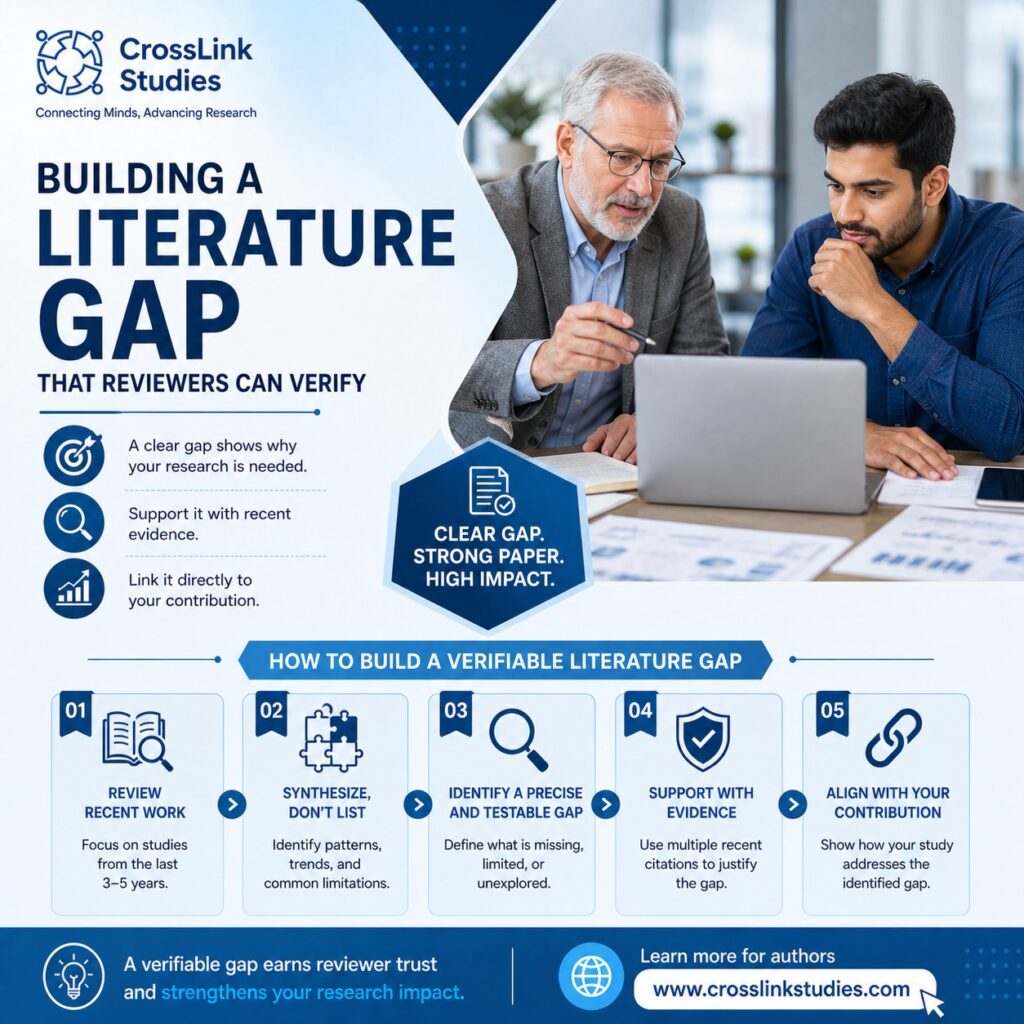
What Makes a Literature Gap “Verifiable”?
A verifiable gap is:
- Specific → Clearly defined and focused
- Evidence-Based → Supported by recent studies
- Contextualized → Positioned within current research
- Testable → Addressed by your methodology
A gap is not a claim; it is a demonstrated absence or limitation in existing work.
The CLS Framework for Building a Verifiable Gap
1. Start with Targeted Recent Literature
Focus on studies from the last 3–5 years that are directly relevant. Identify key papers in your domain and highlight major approaches or findings. This establishes the current research landscape.
2. Synthesize—Don’t List
Avoid turning your literature review into a summary of individual studies.
✔ Group studies by theme, method, or outcome
✔ Highlight patterns and common limitations
❌ Avoid:
- “Author A did this, Author B did that…”
Show what the literature collectively achieves and where it falls short.
3. Identify a Precise and Testable Gap
Define what is missing in clear, specific terms.
✔ Methodological gap (e.g., lack of real-time data integration)
✔ Performance gap (e.g., low accuracy in dynamic conditions)
✔ Contextual gap (e.g., limited application in certain domains)
✔ Interdisciplinary gap (e.g., lack of cross-domain integration)
The gap should be measurable or observable.
4. Support the Gap with Evidence
Your claim must be backed by citations. Reference multiple recent studies showing the limitation and use comparative language to highlight consistency.
Example:
“Recent studies have improved prediction accuracy; however, several works report reduced performance in real-time dynamic environments.”
5. Align the Gap with Your Contribution
Immediately connect the gap to your research. Show how your study addresses the limitation.
Maintain logical flow: Literature → Gap → Contribution
This ensures your research is seen as a direct response, not an isolated effort.
Practical Example (CLS Style)
Weak Gap:
“There is limited research in this area.”
Strong Verifiable Gap:
“Recent studies have advanced machine learning-based forecasting models; however, these approaches often lack adaptability to real-time environmental variability, particularly in urban energy systems. This limitation highlights the need for models that integrate dynamic data sources to improve predictive performance.”
Common Mistakes to Avoid
❌ Making vague or generic gap statements
❌ Failing to cite recent supporting literature
❌ Relying on outdated references
❌ Listing studies without synthesis
❌ Defining gaps that are too broad or untestable
❌ Not linking the gap to your contribution
These issues weaken both novelty and credibility.
CLS Literature Gap Checklist
Before submission, confirm:
✔ Gap is clearly defined and specific
✔ Supported by multiple recent references
✔ Based on synthesized—not listed—literature
✔ Logically leads to your research contribution
✔ Can be verified by reviewers through cited studies
✔ Relevant to current research trends
A strong literature gap is not about claiming what is missing, it is about demonstrating it convincingly. When reviewers can easily verify your gap, they are more likely to trust your research and recognize its value.
At Crosslink Studies, we encourage authors to build gaps that are clear, evidence-driven, and strategically aligned with their contributions. If your gap is clear and verifiable, your research stands on solid ground.