
Positioning Your Contribution Against Recent Journal Literature
In competitive academic publishing, it is not enough to present strong research you must position it effectively within the current literature. Editors and reviewers expect authors to demonstrate not only what they have done, but also how their work advances, differs from, or complements recent studies.
At Ubiquitous Technology Journal (UTJ), successful manuscripts clearly articulate their contribution in relation to the latest research landscape. This blog provides a structured approach to positioning your work with precision and credibility.
Why Positioning Matters
Positioning your contribution helps editors quickly answer:
- Is this research novel enough?
- Does it build on recent work?
- Is it relevant to current academic discussions?
Poor positioning can lead to reviewer confusion, perceived lack of novelty and increased revision cycles. Strong positioning transforms your paper from isolated research into a recognized contribution.
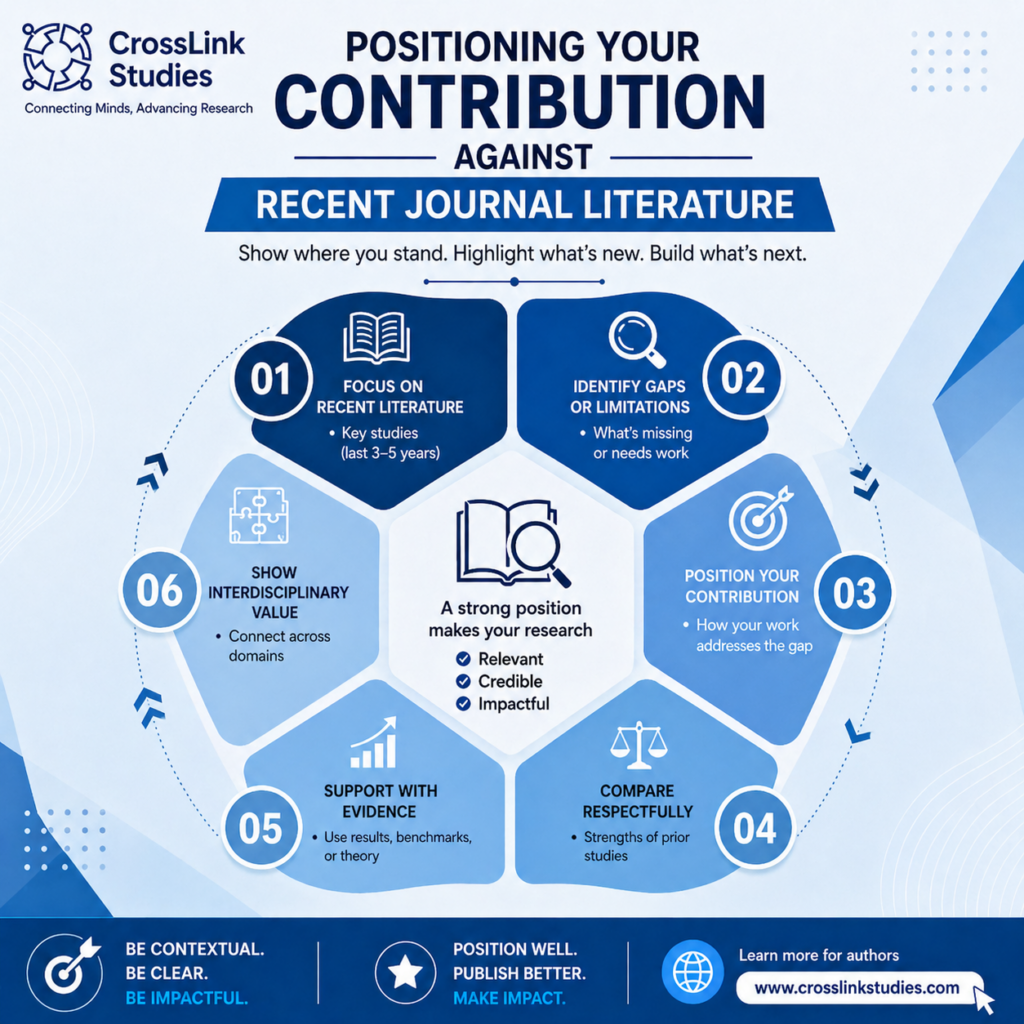
Understanding “Recent Literature”
Recent literature typically refers to:
- Studies published within the last 3–5 years
- Articles in high-impact or relevant journals
- Work directly related to your method, domain, or application
Reviewers often compare your work with the most recent advancements not older foundational studies.
The CLS Framework for Positioning Your Contribution
1. Start with a Focused Literature Context
Avoid broad literature reviews. Instead:
✔ Highlight key recent studies directly related to your work
✔ Identify dominant approaches, models, or findings
This demonstrates awareness of the current research landscape.
2. Identify Specific Gaps or Limitations
After presenting recent work, define what is missing: methodological limitations, performance gaps, contextual constraints and lack of integration across domains. Avoid vague statements like “limited research exists”
Example:
“Recent studies have improved prediction accuracy but often lack adaptability to real-time environmental variability.”
3. Position Your Work as a Response
Clearly connect your contribution to the identified gap.
✔ Use structured positioning statements:
- “To address this limitation, this study…”
- “Building on recent work, we propose…”
- “Unlike existing approaches, our method…”
This creates a logical bridge between past work and your contribution.
4. Compare Without Over claiming
Positioning is not about dismissing prior work it is about differentiation with respect.
✔ Acknowledge strengths of existing studies
✔ Highlight your improvement or extension
❌ Avoid:
- “Previous methods are ineffective”
- “Our work is the only solution”
Balanced positioning builds credibility and professionalism.
5. Highlight Incremental and Interdisciplinary Value
Not all contributions are revolutionary and that’s acceptable.
Your work may improve efficiency or accuracy, apply methods in a new domain and combine techniques from different fields. CLS particularly values cross-disciplinary integration, so emphasize connections across domains.
6. Use Comparative Evidence
Strengthen your positioning with performance comparisons, benchmark results and theoretical advantages. Evidence reinforces your claims and supports reviewer evaluation.
Practical Example (CLS Style)
Weak Positioning:
“Many studies have been conducted in this area, but more work is needed.”
Strong CLS-Compliant Positioning:
“Recent studies have demonstrated improved forecasting accuracy using machine learning models; however, these approaches often lack adaptability to dynamic environmental conditions. To address this limitation, this study proposes a hybrid framework integrating adaptive optimization with deep learning techniques, resulting in enhanced accuracy and scalability across diverse datasets.”
Common Mistakes to Avoid
❌ Relying on outdated references
❌ Writing a generic literature review
❌ Failing to define a clear gap
❌ Over claiming superiority
❌ Ignoring closely related recent work
❌ Not linking contribution to literature
These mistakes weaken both novelty and credibility.
CLS Positioning Checklist
Before submission, confirm:
✔ I have reviewed recent (3–5 years) literature
✔ My paper identifies a clear and specific gap
✔ My contribution directly addresses that gap
✔ I compare my work respectfully and accurately
✔ I provide evidence supporting my claims
✔ My positioning highlights interdisciplinary relevance
Effective positioning is a strategic skill in academic writing. It ensures your research is not viewed in isolation, but as part of a continuum of scholarly progress. At CLS Crosslink Studies and Ubiquitous Technology Journal (UTJ), we encourage authors to present their work with clarity, context, and credibility demonstrating not just what they have done, but why it matters now.