How to Decide Whether Your Work Fits a Journal’s Scope
One of the most common and avoidable reasons for manuscript rejection is a scope mismatch. Even high-quality research can face immediate desk rejection if it does not align with a journal’s aims and scope. Top-tier publishers consistently emphasize that fit is as important as quality. Before submission, authors must evaluate whether their work contributes meaningfully to the journal’s scholarly mission.
For authors considering Ubiquitous Technology Journal (UTJ), this guide provides a structured, practical approach to determining whether your manuscript is a strong fit.
Why Scope Alignment Matters
A journal’s scope defines the research domains it covers, the type of contributions it values and the audience it serves. Submitting outside this scope can result in immediate desk rejection, delays in publication, and reduced visibility among the right audience. In contrast, a well-aligned submission significantly improves review efficiency and acceptance probability.
Understanding CLS Crosslink Studies’ Focus
CLS Crosslink Studies emphasizes interdisciplinary and impactful research that connects ideas across domains. The journal of CLS like Ubiquitous Technology Journal (UTJ) prioritizes:
- Cross-disciplinary innovation
- Emerging technologies and applied research
- Methodological advancements
- Practical and theoretical contributions
CLS is not limited to a single field, it values integration across fields, making it ideal for research that bridges gaps between disciplines.
Step-by-Step Framework to Evaluate Fit
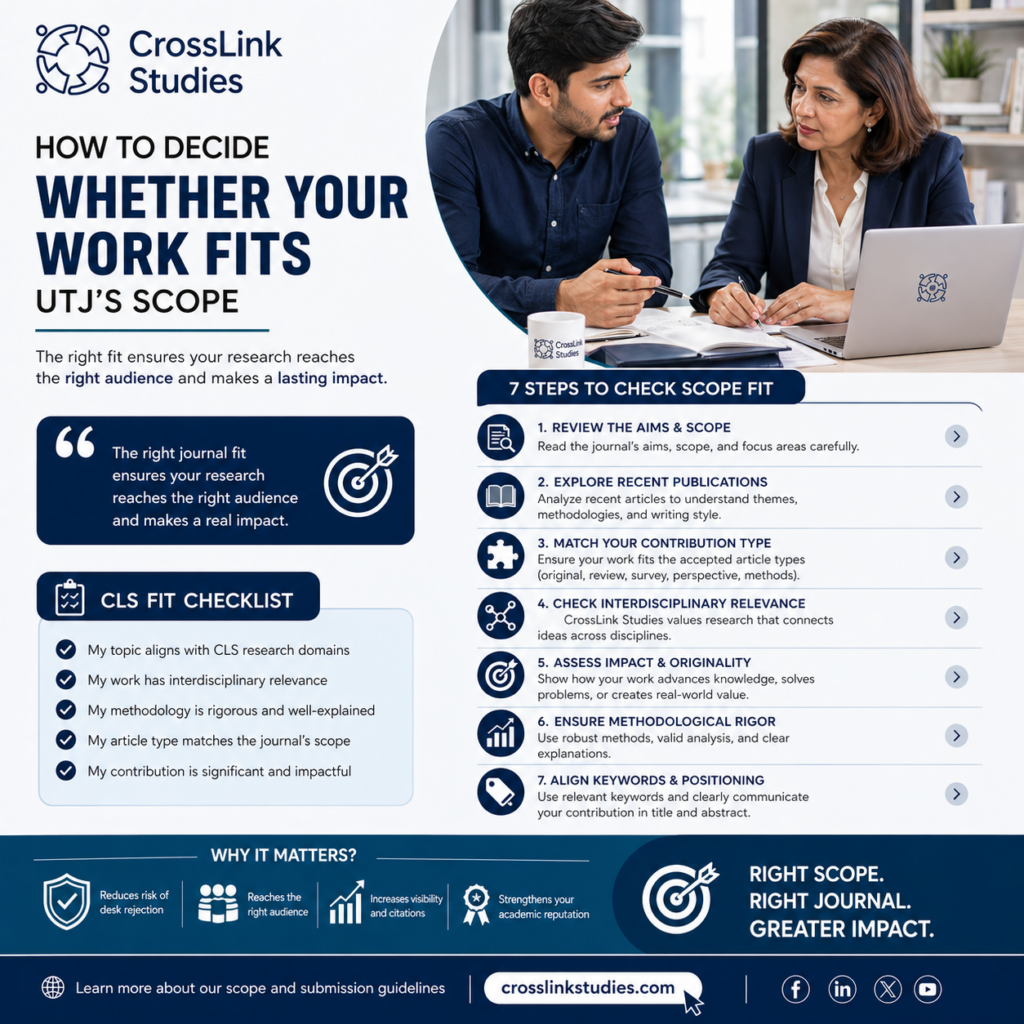
1. Analyze the Journal’s Aims and Scope
Start by carefully reviewing the official scope statement on the journal website.
Ask yourself:
- Does my topic fall within the journal’s listed domains?
- Does my research address problems relevant to its audience?
If your work feels “forced” into the scope, it likely isn’t a strong fit.
2. Review Recently Published Articles
Examine 10–15 recent papers published in CLS Crosslink Studies. Look for common themes and research areas, preferred methodologies and writing style and structure. If your paper could naturally sit alongside these articles, you are on the right track.
3. Identify Your Contribution Type
Match your manuscript with the journal’s accepted article types as original research, review / survey, perspective, methods. Ensure your contribution type aligns with journal expectations, not just your content.
4. Evaluate Interdisciplinary Relevance
CLS Crosslink Studies places strong emphasis on crosslinking knowledge across domains.
Ask:
- Does my research connect multiple fields or perspectives?
- Does it offer broader implications beyond a single niche?
Papers with isolated or highly narrow focus may need repositioning.
5. Assess Practical and Scholarly Impact
Top journals prioritize impact not just novelty.
Consider:
- Does my work solve a real problem?
- Does it advance theory or practice?
- Is it relevant to researchers, practitioners, or both?
Strong submissions clearly demonstrate why the research matters.
6. Check Methodological Rigor
Even if your topic fits, weak methodology can still lead to rejection. Ensure clear research design, validated methods, reproducible results, logical argumentation. CLS values both innovation and rigor.
7. Align Keywords and Positioning
Your title, abstract, and keywords should reflect the journal’s focus. Use terminology common in CLS publications, highlight interdisciplinary elements, emphasize contribution and relevance. Positioning your work correctly can significantly influence editorial decisions.
Common Mistakes to Avoid
❌ Submitting without reading the journal scope
❌ Assuming “good research fits everywhere”
❌ Ignoring interdisciplinary expectations
❌ Using mismatched article types
❌ Failing to demonstrate impact
These mistakes often result in quick rejection without review.
CLS Fit Checklist (Quick Self-Assessment)
Before submission, confirm:
✔ My topic aligns with CLS research domains
✔ My work has interdisciplinary relevance
✔ My methodology is rigorous and clearly presented
✔ My article type matches journal expectations
✔ My contribution is meaningful and impactful
If you can confidently check all five, your manuscript is likely a strong candidate for submission. Choosing the right journal is not just a submission step, it is a strategic decision that shapes your research visibility and impact. At UTJ, we encourage authors to go beyond basic fit and aim for intellectual alignment where your research not only belongs in the journal but actively contributes to its mission.