
Choosing Between a Regular Article, Review, Survey, Perspective, and Methods Paper
Selecting the right manuscript type is one of the most critical early decisions in academic publishing. A mismatch between your research objective and article type can lead to desk rejection even before peer review. Leading publishers emphasize that each article type serves a distinct scholarly purpose, from presenting original findings to shaping future research directions.
At CLS Crosslink Studies, we encourage authors to align their manuscript type with their research contribution, methodological depth, and intended impact. This guide clarifies five major article types to help you make a confident and strategic choice.
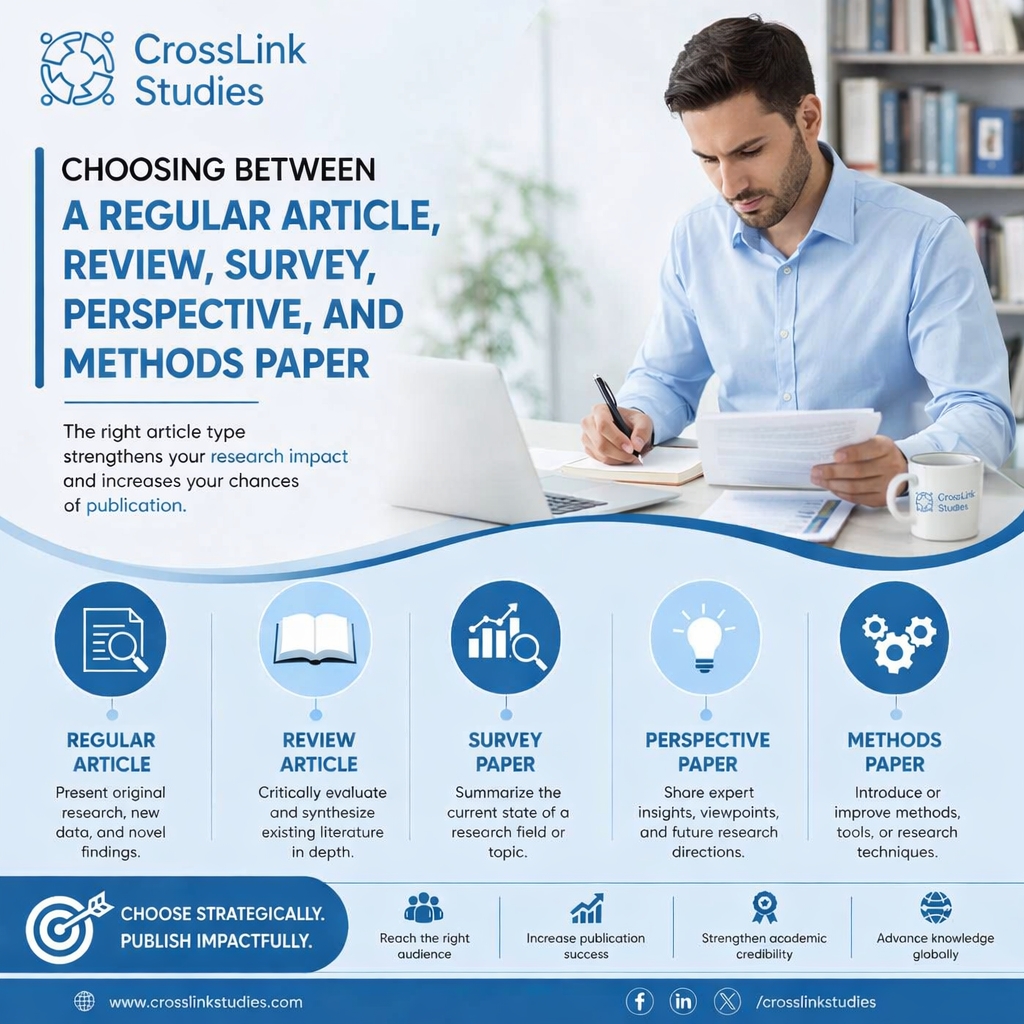
1. Regular (Original Research) Article
Purpose
To present novel findings, experiments, or theoretical developments.
Key Features
- Introduces an original research question
- Includes structured sections: Introduction, Methods, Results, Discussion
- Provides new data or analysis
- Highest weight in academic evaluation
When to Choose
Choose this format if your work produces new datasets, models, or experiments, tests hypotheses or proposes innovations and contributes directly to advancing knowledge. This is the core publication type in most journals and the backbone of scientific progress.
2. Review Article
Purpose
To critically evaluate and synthesize existing literature.
Key Features
- No new experimental data
- Focus on analysis, comparison, and interpretation
- Identifies gaps, trends, and contradictions
- Often includes systematic or narrative approaches
When to Choose
Choose this format if your goal is to provide a deep critical analysis of existing studies, resolve conflicting findings and build theoretical understanding. Unlike surveys, review articles go beyond summarization and provide critical insight.
3. Survey Paper
Purpose
To organize and summarize the current state of a research field.
Key Features
- Broad and structured overview of literature
- Categorizes studies by methods, trends, or timelines
- Highlights research evolution and directions
- Minimal critical evaluation
When to Choose
Choose this format if you want to help readers quickly understand a research domain, map developments in emerging or interdisciplinary fields and provide an accessible entry point for new researchers. Survey papers are especially valuable in fast-growing fields like AI, energy systems, and digital technologies.
4. Perspective (or Opinion) Paper
Purpose
To present a scholarly viewpoint, argument, or future vision.
Key Features
- Focuses on interpretation rather than data
- Offers new insights or conceptual frameworks
- Often shorter and more discursive
- Supported by selected literature
When to Choose
Choose this format if you aim to challenge existing paradigms, propose future research agendas and provide expert interpretation of trends. Perspective papers are influential in shaping research directions and academic debates.
5. Methods (Methodological) Paper
Purpose
To introduce or improve research methods, tools, or techniques.
Key Features
- Focus on methodology rather than results
- Includes validation, comparison, or application examples
- Emphasizes reproducibility and technical rigor
When to Choose
Choose this format if your work develops a new algorithm, model, or framework, improves existing research techniques and enhances experimental or analytical processes. Methods papers are highly valued for their practical and cross-disciplinary impact.
Comparative Overview
| Article Type | Main Goal | Data Requirement | Level of Analysis | Typical Use Case |
| Regular Article | Present new findings | High | Moderate–High | Original research |
| Review Article | Critically analyse literature | None | High | Theory building |
| Survey Paper | Summarize research field | None | Moderate | Field overview |
| Perspective Paper | Present expert viewpoint | None | Conceptual | Future directions |
| Methods Paper | Introduce/improve methods | Moderate | Technical | Tool development |
How to Choose the Right Type (UTJ Strategy)?
Before submission to Ubiquitous Technology Journal (UTJ), ask yourself:
- Do I have new data? → Regular Article
- Am I evaluating existing work? → Review Article
- Am I summarizing a field? → Survey Paper
- Am I proposing ideas or debates? → Perspective Paper
- Am I introducing a technique? → Methods Paper
Many rejections occur not due to weak research, but due to wrong article classification. In today’s competitive publishing environment, success is not only about what you write, but also how you position it. Understanding article types allows authors to target the right audience, meet journal expectations and increase acceptance probability. At CLS Crosslink Studies, we encourage authors to adopt a strategic publishing mindset aligning contribution, structure, and impact with the appropriate manuscript type.