What Plagiarism Screening Checks and What It Does Not
Plagiarism screening has become a standard step in modern academic publishing. Most journals now use similarity detection tools to ensure that submitted manuscripts meet ethical and originality standards.
However, there is a common misconception: a similarity report is not the same as a judgment of plagiarism. Understanding what these tools can and cannot do is essential for authors, reviewers, and editors alike.
For Ubiquitous Technology Journal (UTJ), responsible use of plagiarism screening supports research integrity, transparency, and trust.
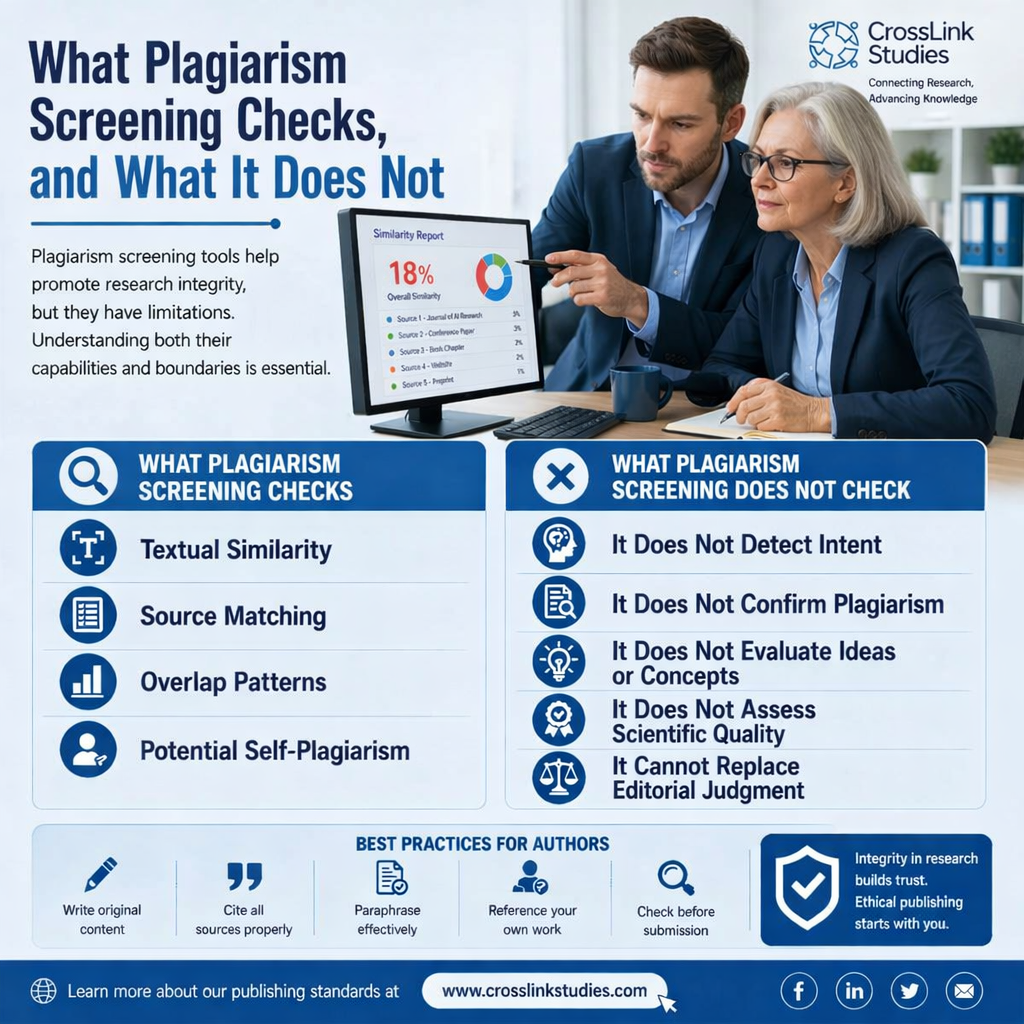
What Plagiarism Screening Actually Checks
Plagiarism detection tools (e.g., similarity-checking software) compare submitted text against large databases of published journal articles, books and conference papers, web content, preprints and institutional repositories. They generate a similarity report, highlighting text overlaps and providing a percentage score.
1. Textual Similarity
These tools identify matching or closely similar text between the manuscript and existing sources.
This includes exact matches (copy-paste text), paraphrased content with similar structure, reused phrases or sentences.
2. Source Matching
The report shows where the matched text originates, helping editors and reviewers trace original sources, assess whether proper citation is provided.
3. Overlap Patterns
Editors look beyond percentages and analyze which sections contain overlap (methods vs. discussion), whether overlap is concentrated or scattered, whether it involves self-citation or external sources.
4. Potential Self-Plagiarism
Tools can detect overlap with an author’s previously published work, indicating redundant publication, reuse of text without citation.
What Plagiarism Screening Does NOT Check
Despite its usefulness, plagiarism screening has important limitations.
1. It Does Not Detect Intent
A similarity report cannot determine whether overlap is intentional or accidental, whether proper attribution is ethically sufficient. Human judgment is always required.
2. It Does Not Confirm Plagiarism
High similarity ≠ plagiarism
Low similarity ≠ originality
For example:
- Properly cited text may still show high similarity
- Poor paraphrasing may appear acceptable in percentage terms
3. It Does Not Evaluate Ideas or Concepts
Plagiarism tools focus on text, not ideas. They cannot detect idea plagiarism, conceptual copying, unoriginal research questions
4. It Does Not Assess Scientific Quality
A manuscript may pass plagiarism checks but still have weak methodology, invalid results and poor contribution. Screening ensures textual integrity not scientific merit.
5. It Cannot Replace Editorial Judgment
Editors must interpret reports carefully by considering context of overlap, discipline-specific writing norms, acceptable reuse (e.g., methods descriptions). Automated tools support but do not replace editorial decision-making.
How Editors Use Plagiarism Reports
At leading journals, similarity reports are used to flag potential concerns early in submission, guide editorial evaluation and inform decisions on desk rejection or further review. Editors typically examine nature of overlap, citation practices, section-specific similarities.
Best Practices for Authors
To avoid issues during screening, authors should write original text and avoid copy-paste practices, properly cite all sources, paraphrase effectively not mechanically, clearly reference reused content, including their own work, use plagiarism-checking tools before submission. Ethical writing is essential for credible publication.
Common Misconceptions
“A low similarity score guarantees acceptance”
❌ False, quality and originality still matter.
“A high similarity score means automatic rejection”
❌ Not always, context and citation are evaluated.
“Plagiarism tools detect everything”
❌ Incorrect, they only detect textual overlap, not deeper issues.
At Crosslink Studies (CLS), plagiarism screening is part of our commitment to ethical publishing and research transparency.
We emphasize responsible interpretation of similarity reports, fair and context-based editorial decisions, author awareness of ethical writing practices. Our goal is to ensure that published work reflects both originality and integrity, particularly in rapidly evolving AI and interdisciplinary research. In scholarly publishing, integrity goes beyond percentages it lies in honest, responsible research practices.