
Responsible Use of AI in Peer Review: What Reviewers Should Never Upload
Artificial Intelligence (AI) is reshaping academic workflows but in peer review, its use requires extreme caution. Unlike manuscript preparation, peer review involves confidential, unpublished research, making ethical boundaries for stricter.
Leading publishers and editorial bodies are clear: reviewers must protect confidentiality above all else. Misuse of AI especially uploading sensitive material can compromise intellectual property, violate journal policies, and undermine trust in scholarly publishing.
For journals like UTJ, understanding what must never be uploaded to AI tools is essential for maintaining integrity in AI-driven research environments.
Why AI Use in Peer Review Is Highly Restricted
Peer review operates on three core principles: confidentiality, accountability, expert human judgment. AI tools pose risks because they may store or reuse uploaded data, cannot guarantee confidentiality, may produce biased or incorrect outputs. Publishers emphasize that reviewers are selected for their expertise not AI assistance.
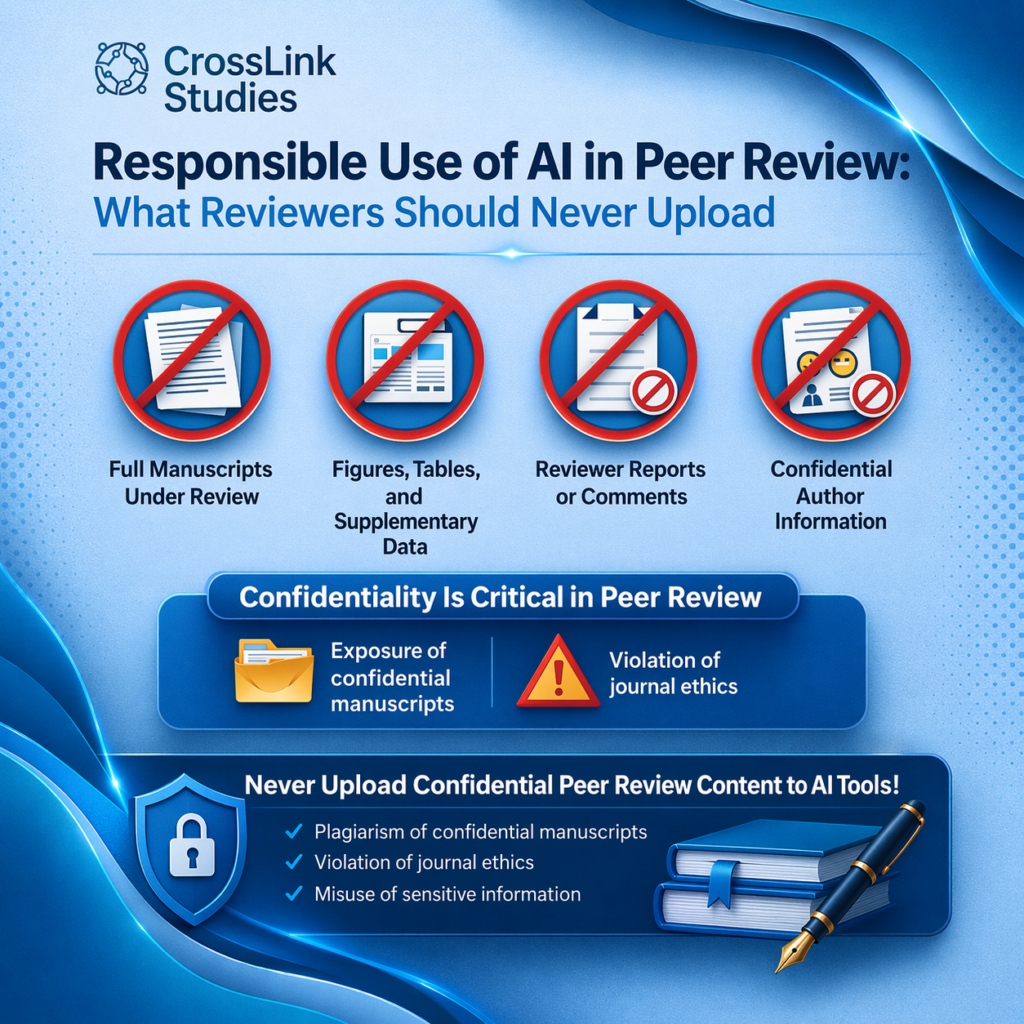
What Reviewers Should Never Upload to AI Tools
Full Manuscripts Under Review
Uploading a manuscript (even partially) into AI tools is strictly prohibited. Manuscripts contain unpublished ideas, data, and intellectual property. AI systems may retain or learn from this information, this violates confidentiality agreements.
Figures, Tables, and Supplementary Data
Even partial content such as figures, tables, datasets, graphs must never be uploaded. These elements often contain core findings or proprietary data, and sharing them externally risks exposure or misuse.
Reviewer Reports or Comments
Your own review report is also confidential. It may include sensitive critique or editorial insights, uploading it for AI editing or rewriting can expose confidential content. Guidelines emphasize that review reports should not be processed through AI systems.
Any Identifiable or Confidential Author Information
This includes author names (in non-blind review), institutional affiliations, ethical or conflict-related information. Sharing such details with AI tools may violate privacy and data protection standards.
Manuscript Content for Generating Review Text
Using AI to summarize the manuscript, generate reviewer comments, evaluate methodology or results is not acceptable in most major journals. IEEE clearly states that reviewers must not use AI platforms to generate review content, as this breaches confidentiality and undermines reviewer responsibility.
Why These Restrictions Exist
Confidentiality Risks
Uploading content to AI tools may expose it to external servers, model training processes, unauthorized access. There is no guarantee of data protection once content is uploaded.
Integrity and Accountability
Peer review requires critical thinking, domain expertise, independent judgment. Delegating this to AI compromises the credibility of the review process.
Legal and Ethical Concerns
Improper AI use may result in breach of copyright or data rights, violation of journal policies, ethical misconduct investigations
Is Any AI Use Allowed for Reviewers?
✔ Limited Acceptable Use
Some guidelines allow minimal use such as basic grammar or spell-check tools, non-generative editing assistance.
⚠ Conditional Use (with disclosure)
If AI is used in any meaningful way, it must be fully disclosed to the editor, he reviewer remains fully responsible. Transparency is essential to maintain trust in the process.
Best Practices for Responsible Reviewers
To align with global standards:
- Treat all manuscripts as strictly confidential
- Do not upload any content to AI tools
- Write reviews based on your own expertise
- Avoid relying on AI for evaluation or judgment
- Disclose any permitted AI use transparently
- When in doubt, consult the journal editor
CLS Crosslink Studies Perspective
At Crosslink Studies (CLS), we recognize the importance of AI in modern research but in peer review, ethical boundaries must remain firm. We emphasize zero tolerance for confidentiality breaches, human-centered evaluation, transparent and responsible use of technology. AI should support research but never compromise trust in the peer review process.


