
What Editors Mean by Minor Revision, Major Revision, and Reject
After submitting a manuscript, one of the most anticipated and often misunderstood moments is receiving the editorial decision. Terms like minor revision, major revision, and reject may seem straightforward, but they carry specific academic meanings that determine your manuscript’s future.
For authors publishing in technology-driven journals like Ubiquitous Technology Journal (UTJ), understanding these decisions is essential to respond effectively, improve your work, and navigate the peer review process with confidence.
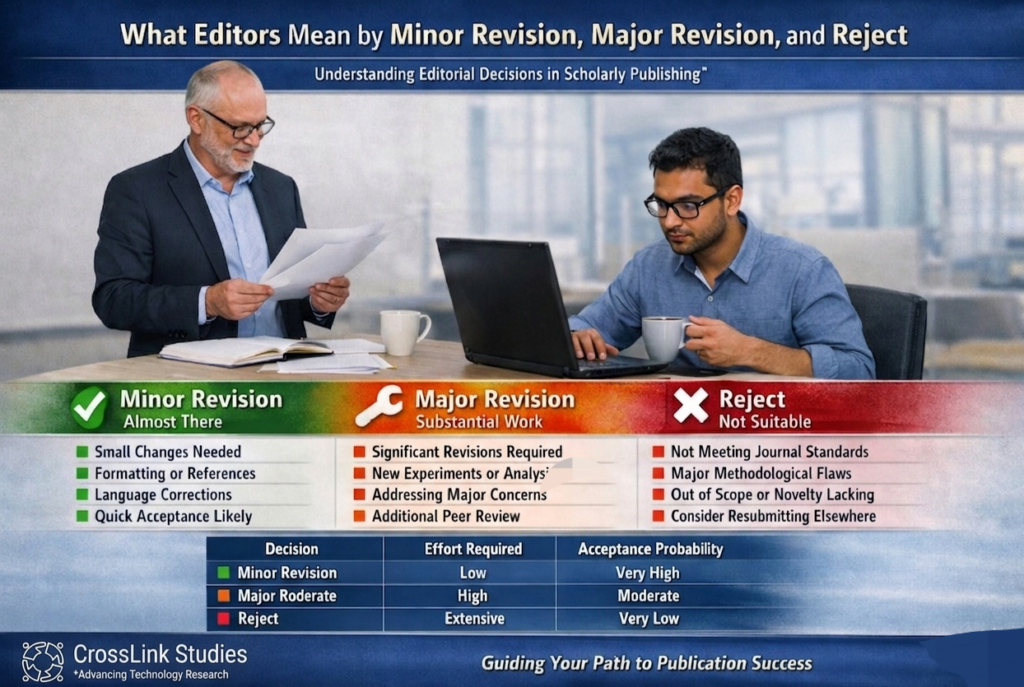
The Role of Editorial Decisions in Peer Review
Editorial decisions are based on reviewer evaluations, editorial assessment of quality and scope, journal standards and priorities Most journals follow a structured decision system:
Accept – Minor Revision – Major Revision – Reject
Each decision reflects not just the current state of your manuscript, but also the editor’s confidence in its potential for publication.
Minor Revision: Almost There
A decision of minor revision indicates that the manuscript is very close to publication, requiring only small improvements. Minor revision is often considered the final step before acceptance, provided authors carefully address all comments.
What It Typically Means
- The research is sound and acceptable
- Only minor issues need correction
- High likelihood of acceptance after revision
Common Requests
- Clarifying arguments or wording
- Fixing formatting, figures, or tables
- Adding a few references
- Minor language or grammar improvements
Major Revision: Strong Potential, Significant Work
A major revision decision signals that the manuscript has publishable potential but requires substantial improvement before it can be accepted. Major revisions usually involve another round of peer review, and failure to address comments thoroughly can still lead to rejection.
What It Typically Means
- The study is valuable but not yet ready
- Reviewers identified significant concerns
- Acceptance is possible but not guaranteed
Common Requests
- Rewriting sections (introduction, methodology, discussion)
- Additional data analysis or experiments
- Strengthening theoretical framework
- Addressing methodological weaknesses
Reject: Not Suitable in Current Form
A reject decision means the manuscript is not accepted for publication in the journal.
What It Typically Means
- The manuscript does not meet journal standards
- There may be fundamental issues (scope, novelty, methodology)
- The editor does not see a clear path to acceptance
In some cases, rejection may still include constructive feedback, allowing authors to improve and submit elsewhere.
Types of Rejection
- Desk rejection: before peer review (scope or quality issues)
- Post-review rejection: after reviewer evaluation
Key Differences at a Glance
| Decision | Meaning | Effort Required | Acceptance Probability |
| Minor Revision | Nearly publishable | Low | Very High |
| Major Revision | Promising but incomplete | High | Moderate |
| Reject | Not suitable for journal | Extensive rework | Low (in same journal) |
How Authors Should Respond
If you receive minor revision address every comment carefully, submit quickly but thoroughly, avoid introducing unnecessary changes. If you receive major revision, take time to revise deeply, provide a detailed response to reviewers, justify any disagreements respectfully. If you receive rejection, read feedback objectively, revise your manuscript, submit to a more suitable journal.
CLS Crosslink Studies Perspective
At Crosslink Studies (CLS), editorial decisions are designed to be transparent, constructive, and improvement-focused especially in fields like AI, computing, and interdisciplinary research.
We encourage authors to view:
- Minor revision as a final polishing stage
- Major revision as an opportunity for meaningful enhancement
- Rejection as a learning step toward stronger research