How to Choose Keywords that Improve Discoverability?
In the evolving landscape of scholarly communication, publishing high-quality research is only part of the equation. Equally important is ensuring that your work can be found, read, and cited. One of the most powerful yet often underestimated tools for achieving this is the strategic selection of keywords.
At Crosslink Studies (CLS), we recognize that well-chosen keywords significantly enhance the visibility and impact of published research. They serve as the bridge between your manuscript and the global academic audience searching for relevant knowledge.
Why Keywords Matter in Academic Publishing
Keywords are not merely descriptive labels they are essential components of research discoverability systems. Search engines, indexing databases (such as Scopus, Web of Science), and digital libraries rely heavily on keywords to categorize and retrieve content. Effective keywords improve search engine visibility, increase article indexing accuracy, enhance citation potential, connect your work with the right audience.
In short, keywords determine whether your research remains hidden or becomes part of the global scholarly conversation.
Think Like Your Reader (Search Engine)
Selecting effective keywords begins with understanding how others search for research. Balancing technical precision with search-friendly language is key.
Ask yourself:
- What terms would a researcher use to find this study?
- Are there common synonyms or variations?
- Which terms are widely used in recent literature?
Use Specific and Targeted Terms
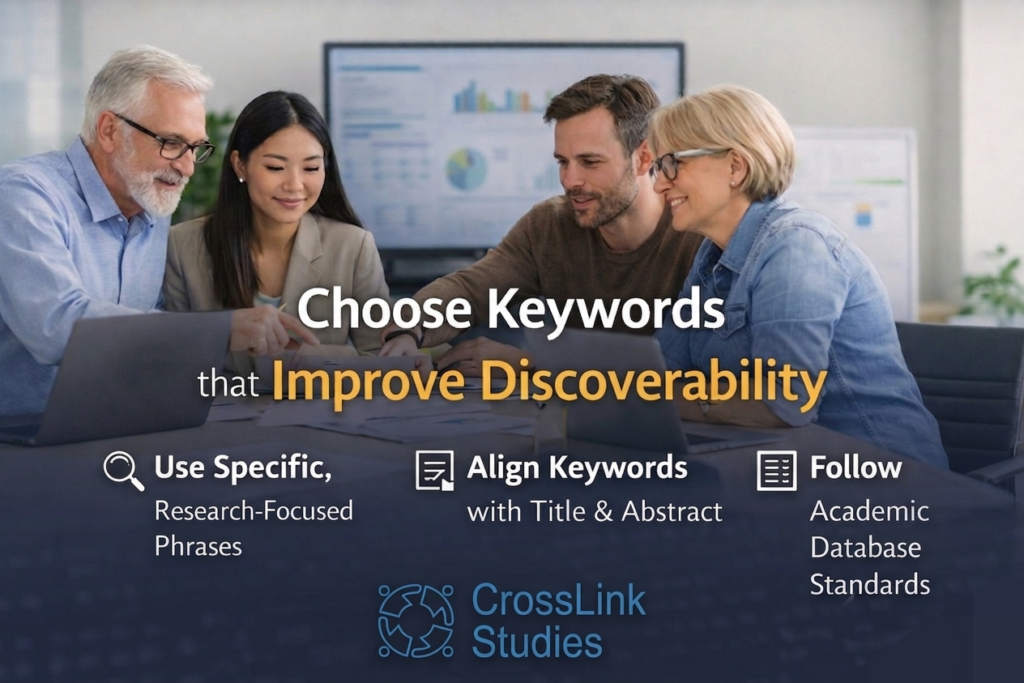
Generic keywords are too broad and often ineffective. Instead, focus on specific, descriptive phrases that reflect your study’s unique contribution. Use 2–4-word phrases where appropriate, include methodological terms (e.g., “panel data analysis,” “machine learning”), reflect geographical or contextual focus.
Align Keywords with Title and Abstract
Consistency across your manuscript is critical. Keywords should naturally align with the terms used in your title and abstract. This alignment strengthens indexing algorithms, improves ranking in search results, reinforces the core themes of your research. Avoid introducing completely new terms in keywords that are not reflected in the main text.
Leverage Standardized and Indexed Terms
Whenever possible, use terms that are already recognized in academic databases and indexing systems.
How to do this:
- Review keywords from high-impact journal articles in your field
- Use database tools (e.g., Scopus, Google Scholar suggestions)
- Follow discipline-specific terminology standards
Using established terminology increases the likelihood that your article will appear in relevant database searches.
Avoid Common Mistakes
Even strong research can suffer from poor keyword selection. Avoid the following pitfalls:
❌ Overly broad or vague terms
❌ Repetition of the same word in different forms
❌ Excessive number of keywords
❌ Irrelevant or misleading terms
At CLS, we recommend selecting 5–7 well-balanced keywords that accurately represent your study.
The CLS Approach to Discoverability
At Crosslink Studies, we emphasize the strategic importance of metadata including keywords as part of our commitment to research visibility and impact. Authors submitting to CLS are encouraged to choose keywords that reflect core research contributions, ensure clarity, relevance, and specificity, align with global indexing standards.
Keywords are more than a submission requirement; they are a visibility strategy. Thoughtfully selected keywords ensure that your research is accessible, discoverable, and impactful in an increasingly competitive academic environment. A well-written paper deserves to be found. The right keywords make that possible.