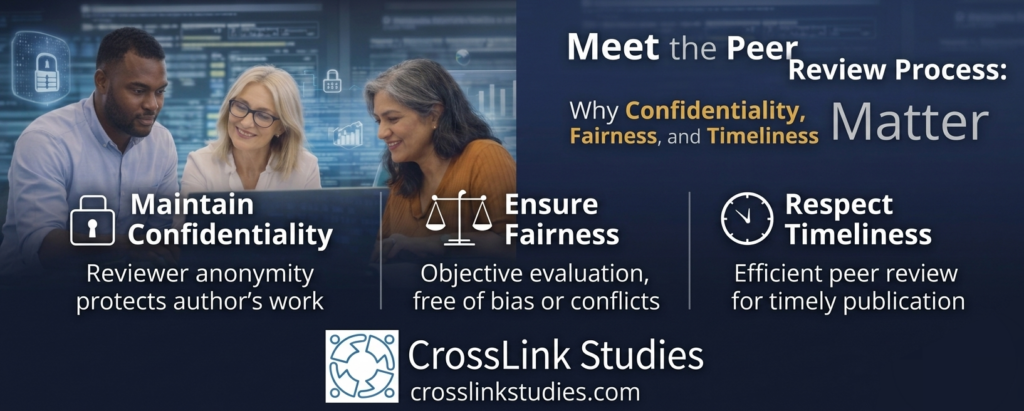
Meet the Peer Review Process: Why Confidentiality, Fairness, and Timeliness Matter
In scholarly publishing, the peer review process is more than a procedural checkpoint, it is the foundation upon which academic credibility, integrity, and trust are built. Every manuscript submitted to a reputable journal undergoes rigorous evaluation by subject experts, ensuring that published research meets the highest standards of quality, originality, and relevance.
At Crosslink Studies (CLS), peer review is not merely a gatekeeping mechanism; it is a collaborative and ethical process designed to strengthen research and advance global knowledge. Understanding the principles that guide this process confidentiality, fairness, and timeliness is essential for authors, reviewers, and editors alike.
Understanding the Peer Review Process
The peer review journey typically begins with an initial editorial screening, where submissions are evaluated for scope, originality, and compliance with journal guidelines. Suitable manuscripts are then assigned to expert reviewers who assess the work’s methodology, contribution, and academic rigor.
This structured evaluation ensures that research is validated by experts, feedback is constructive and developmental, editorial decisions are evidence-based and transparent. Peer review thus acts as both a quality filter and an improvement mechanism, elevating the overall standard of scholarly communication.
Why Confidentiality Is Essential
Confidentiality is a cornerstone of ethical peer review. Manuscripts under review are treated as privileged documents, and their content must not be disclosed or used outside the review process.
Key roles of confidentiality:
- Protects intellectual property and prevents misuse of unpublished ideas
- Builds trust between authors, reviewers, and editors
- Ensures unbiased evaluation free from external influence
Without strict confidentiality, the integrity of the academic publishing system can be compromised, leading to ethical breaches and erosion of trust within the research community. At CLS, all submissions are handled through secure systems, and all participants are expected to adhere to internationally recognized ethical standards.
Ensuring Fairness and Objectivity
Fairness in peer review means that manuscripts are evaluated solely on scholarly merit, independent of the author’s identity, affiliation, nationality, or background.
What fairness looks like in practice:
- Double-blind review systems to minimize bias
- Conflict of interest disclosures by reviewers and editors
- Objective, evidence-based feedback
Editors play a critical role in safeguarding fairness by selecting qualified reviewers and ensuring that evaluations remain impartial and constructive. A fair review process not only improves manuscript quality but also promotes equity and inclusivity in global research publishing.
The Importance of Timeliness
In today’s fast-paced research environment, timeliness is not a luxury, it is a necessity. Delayed reviews can hinder academic progress, affect career advancement, and slow the dissemination of important findings. Reviewers and editors are therefore expected to respond promptly to review invitations, complete evaluations within agreed timelines, maintain efficient communication throughout the process. Timely peer review ensures that authors receive feedback without unnecessary delays and that high-quality research reaches the scholarly community efficiently. At CLS, maintaining an efficient review cycle is a priority, reflecting our commitment to both authors and the wider academic community.
The CLS Commitment to Ethical Peer Review
Crosslink Studies is committed to upholding international best practices in scholarly publishing by ensuring that every manuscript undergoes a review process that is:
- Confidential – safeguarding author work and reviewer integrity
- Fair – grounded in objectivity and academic merit
- Timely – respecting the value of researchers’ time and contributions
By fostering a culture of ethical responsibility and academic rigor, CLS aims to create a publishing environment that supports innovation, transparency, and trust.
The strength of any academic journal lies in the robustness of its peer review process. Confidentiality protects ideas, fairness ensures equity, and timeliness accelerates knowledge dissemination. Together, these principles form the backbone of credible and impactful research publishing.
For authors, understanding this process enhances submission success. For reviewers, it reinforces professional responsibility. And for journals like Ubiquitous Technology Journal (UTJ), it defines excellence.