Software and Code
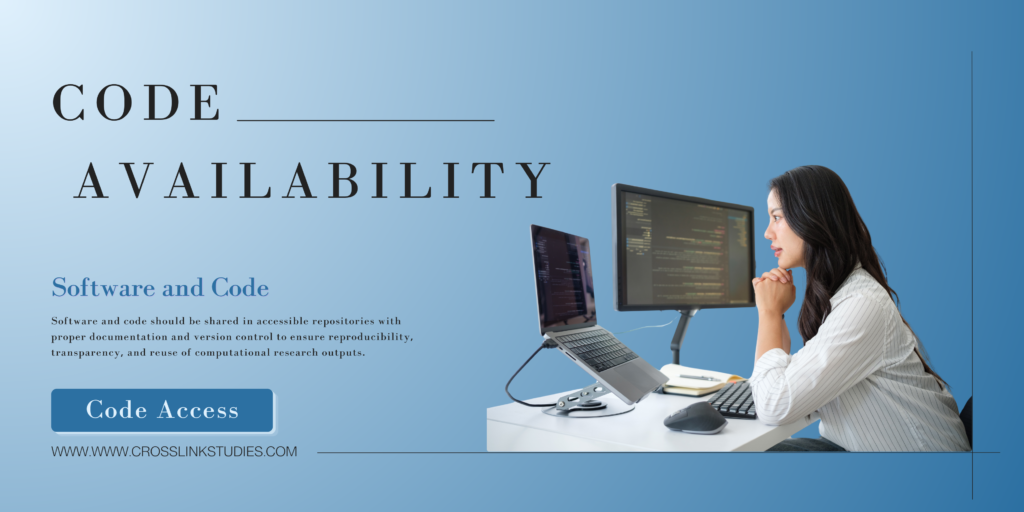
CrossLink Studies (CLS) recognizes that software, algorithms, and source code are essential components of modern research. To promote transparency, reproducibility, and scientific advancement, CLS encourages authors to make all relevant software and code openly accessible alongside their publications. This practice strengthens the credibility of research findings and enables the wider community to validate, reuse, and build upon published work.
Policy Statement
Authors submitting to CLS journals are expected to ensure that any software, scripts, models, or computational workflows used in their research are clearly described and, where possible, made publicly available. Code availability enhances reproducibility and aligns with CLS’s broader commitment to open access and knowledge dissemination.
Code Availability Requirements
- Authors should provide sufficient detail about the software used, including version numbers, dependencies, and execution environment.
- Custom-developed code must be shared in a readable and reusable format.
- Where proprietary or restricted software is used, authors must clearly state access limitations and provide alternative reproducibility pathways if possible.
- All code-related information should be included either within the manuscript, as supplementary material, or via external repositories.
Recommended Repositories
CLS recommends depositing software and source code in trusted, long-term repositories such as GitHub, GitLab, Zenodo, or institutional repositories. Deposited code should be accompanied by:
- Documentation (README files)
- Usage instructions
- Licensing information
- Version control history (if applicable)
Depositing code in recognized repositories ensures persistent access and facilitates citation and reuse. CLS explicitly recommends that “data and code be deposited in a trusted repository to facilitate maximum reuse.”
Licensing and Reuse
Authors are encouraged to apply open-source licenses (e.g., MIT, GPL, Apache) to their code to clarify reuse permissions. Software shared under open licenses promotes collaboration while protecting authorship and intellectual contributions.
Where applicable, code associated with published articles should follow the same open-access principles that govern CLS publications, ensuring broad accessibility and lawful reuse.
Integration with Supplementary Materials
Software and code should be treated as integral supplementary materials. Authors may:
- Provide direct repository links in the manuscript
- Upload code archives as supplementary files
- Include executable notebooks or workflows
If repository deposition is not feasible, authors should still provide comprehensive code descriptions to enable replication.
Reproducibility and Transparency
CLS strongly supports reproducible research. Authors should ensure that:
- Code executes as described in the manuscript
- Key results can be reproduced using provided scripts
- Random seeds, parameters, and configurations are disclosed
Clear documentation and structured code sharing significantly enhance peer review quality and post-publication validation.
Ethical and Legal Considerations
Authors must ensure that:
- Shared code does not violate third-party licenses or agreements
- Sensitive or restricted data embedded in code is properly anonymized or excluded
- All contributors to the software are appropriately acknowledged
Long-Term Accessibility
To support long-term preservation, CLS encourages authors to use repositories that provide persistent identifiers (e.g., DOIs). This aligns with CLS archiving principles that ensure continued accessibility of research outputs.
Conclusion
By promoting open and well-documented software practices, CLS advances scientific integrity, reproducibility, and innovation. Authors are encouraged to view software and code not merely as supporting materials, but as fundamental scholarly outputs that deserve visibility, citation, and long-term preservation.