

Avoiding Citation Padding and Irrelevant References
A well-constructed reference list is not measured by its length. In scholarly writing, citations are intended to connect a manuscript with the evidence, theories, methods, and findings on which its arguments are built. When authors add references that do not meaningfully support the manuscript, the reference list can become inflated without becoming more informative. This practice is commonly described as citation padding.
Citation padding can take several forms: adding loosely related papers simply to increase the number of references, repeatedly citing an author’s own work without a genuine need, including highly cited publications because of their prestige rather than relevance, or retaining references that were never actually used in developing the manuscript. Although these practices may appear minor, they can weaken the credibility of a paper and distort the scholarly record.
For technology researchers, the issue is particularly important because fields such as artificial intelligence, cybersecurity, data science, IoT, cloud computing, software engineering, and ubiquitous computing evolve rapidly. A technically strong manuscript requires references that are not merely numerous, but accurate, current, relevant, and connected to the claims being made.
Crosslink Studies’ Ubiquitous Technology Journal (UTJ) explicitly requires authors to cite relevant papers, expects a substantial reference base primarily from journal articles, asks authors to keep manuscripts up to date, and requires citations to appear in the text in sequential IEEE style. Its review-article guidance also emphasizes comprehensive and unbiased coverage, critical evaluation, research gaps, controversies, and implications for future research.
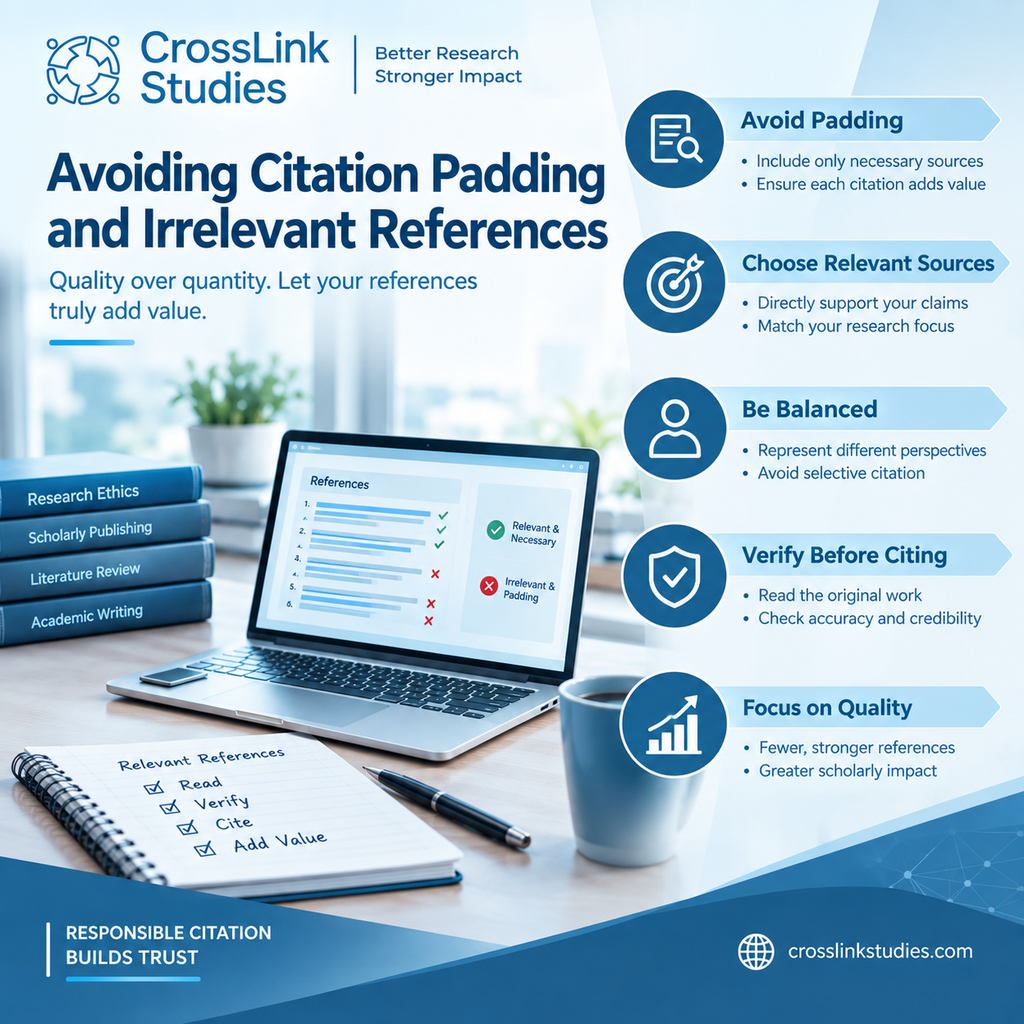
What Is Citation Padding?
Citation padding occurs when references are added without sufficient scholarly justification. The problem is not simply having a large bibliography. A long reference list can be entirely appropriate for a systematic review or comprehensive survey. The issue is unnecessary inclusion.
Citation Quantity Should Not Replace Citation Quality
Researchers sometimes assume that more references automatically make a manuscript appear more rigorous. This can lead to unnecessary citations being added to introductions, literature reviews, and discussion sections. However, scholarly quality depends on the relationship between claims and evidence, not simply the number of references.
A paragraph supported by four highly relevant studies can be stronger than a paragraph containing twelve loosely connected references.
Why Irrelevant References Are a Problem
An irrelevant citation can mislead readers about the relationship between two pieces of research.
Consider a sentence stating: Recent studies demonstrate that edge computing reduces latency in IoT applications. If the cited paper actually investigates cloud-based data management without evaluating latency or edge computing, the reference does not adequately support the statement.
This creates what can be called a citation–claim mismatch: the reference exists, but it does not provide the evidence that the surrounding sentence implies.
Common Forms of Citation Padding
1. Excessive Self-Citation
Self-citation is legitimate when previous work genuinely provides the foundation for the current study. For example, an author may need to cite a previous algorithm, dataset, theoretical model, or empirical result developed by the same research group. The problem occurs when self-citations are added primarily to increase citation counts.
A practical test is to ask:
Would I cite this paper if it had been written by another researcher?
If the answer is no, its inclusion deserves closer examination.
2. Citing Famous Papers for Prestige
A paper’s citation count, journal reputation, or author’s prominence does not make it automatically relevant. Researchers should avoid inserting highly cited publications merely because they are well known. A specialized recent study may provide much stronger evidence for a technical claim than a famous general paper. Relevance should come before prestige.
3. Group or Reciprocal Citation
Researchers may sometimes cite papers from a particular group or network excessively because those authors have collaborated previously or because reciprocal citation is expected. A reference should be included because it contributes to the manuscript not because of a personal, institutional, or professional relationship.
Citation cartels and other coordinated practices can artificially increase citation counts and distort perceptions of scholarly influence. Recent Springer research has highlighted excessive self-citation, citation cartels, coercive citation, and irrelevant references as forms of citation manipulation.
4. Copying References Without Reading Them
Another common problem occurs when authors take references directly from another paper’s bibliography. This can create several errors. The original paper may have cited the source for a specific reason that does not apply to the new manuscript. Bibliographic information may also be outdated or incorrect.
Citation Padding in Literature Reviews
Survey and review articles require special care because their purpose is to represent the state of knowledge accurately.A review should not become a catalogue of papers. Instead, references should be organized around themes, methodological differences, theoretical perspectives, findings, limitations, and unresolved questions.
For example, rather than writing:
Smith et al. studied IoT security. Khan et al. investigated intrusion detection. Lee et al. proposed a machine-learning model.
A stronger synthesis might state: Recent IoT security research increasingly combines machine-learning-based intrusion detection with adaptive network monitoring, although existing approaches differ in their treatment of computational overhead, attack diversity, and deployment constraints.
How to Decide Whether a Reference Is Relevant
Before adding a citation, researchers can apply a simple four-question relevance test:
Does it support the claim?
The reference should provide evidence for the specific statement surrounding it.
Is it directly related?
The paper should have a meaningful relationship to the research problem, method, theory, dataset, technology, or interpretation.
Is it necessary?
If the same point is already adequately supported and the additional reference adds nothing new, its inclusion may be unnecessary.
Is it appropriate?
The source should be sufficiently credible and suitable for the claim. For technical research, peer-reviewed journal articles and authoritative scholarly sources will often be preferable to generic web pages or unsupported secondary material.
UTJ’s author guidance specifically states that authors should generally use journal papers as references, use textbooks rarely, avoid web-page citations where possible, and ensure that cited papers are actually referenced within the manuscript.
Build the Reference List While Writing
Citation padding is easier to prevent when authors maintain their references systematically throughout the research process. Reference-management software such as EndNote, Mendeley, or Zotero can help researchers organize sources and maintain consistent formatting. UTJ specifically recommends these tools and requires IEEE referencing.
However, reference-management software cannot determine whether a citation is intellectually relevant. That remains the researcher’s responsibility.
A useful workflow is: Read → Evaluate → Use → Cite → Verify
rather than: Collect → Save → Add to bibliography
The second approach can produce a large collection of papers without a clear connection to the manuscript.
Conduct a Citation Audit Before Submission
Before submitting a paper, authors should perform a final reference audit.
For each citation, ask:
- What specific statement does this reference support?
- Have I actually read the cited source?
- Does the source genuinely support my interpretation?
- Is the reference directly relevant?
- Am I citing my own work unnecessarily?
- Have I included papers because they are prestigious rather than useful?
- Are there references that I collected but never actually used?
- Have I represented competing findings fairly?
- Are the references sufficiently current for the research area?
- Are all bibliographic details accurate?
The Role of Editors and Reviewers
Citation responsibility does not belong exclusively to authors. Editors and reviewers also have an important role in maintaining responsible citation practices.
Reviewers may legitimately recommend additional references when they identify important omitted research, contradictory evidence, or foundational work that is necessary for the manuscript’s argument. However, recommendations should be based on scholarly relevance rather than personal citation interests.
Citation Integrity in the AI-Assisted Research Era
Generative AI and automated literature-search tools can make it easier to discover large numbers of publications. They can also make citation padding easier if researchers treat automatically generated reference lists as authoritative. AI-generated suggestions may contain:
- irrelevant sources;
- incorrect interpretations;
- outdated literature;
- incorrect bibliographic details;
- references that do not actually support the claim.
Crosslink Studies: Relevance Over Volume
For authors preparing manuscripts for Crosslink Studies and UTJ, responsible citation is particularly important because the journal’s guidelines place clear emphasis on relevant literature, recent research, appropriate reference management, sequential IEEE citations, and critical engagement with previous studies.
The objective should not be to produce the longest possible bibliography. It should be to construct a reference network that allows readers to understand where the evidence comes from, how different studies relate to one another, and why the manuscript’s conclusions are justified. A well-selected reference list can demonstrate scholarly depth more effectively than an inflated one.
Conclusion
Citation padding may make a manuscript look heavily referenced, but it does not necessarily make the research stronger. Irrelevant references can obscure important evidence, mislead readers, distort citation metrics, and weaken confidence in the manuscript. Responsible researchers should therefore treat every citation as an evidence link between their argument and the existing scholarly record. References should be relevant, accurate, verified, balanced, and genuinely useful.
For authors publishing through Crosslink Studies, the guiding principle is simple: Do not ask how many references you can add. Ask how much scholarly value each reference provides. When citations are selected for relevance rather than quantity, literature reviews become clearer, technical arguments become more defensible, and the resulting research contributes more reliably to the scholarly record.