

How to Share Source Code for Reproducible Research?
Advancing Transparency, Verification, and Scientific Impact Through Open Research Practices
Scientific progress depends not only on innovative ideas and rigorous methodologies but also on the ability of other researchers to verify, reproduce, and build upon published findings. As computational methods become increasingly central to research in fields such as artificial intelligence, data science, cybersecurity, ubiquitous computing, and software engineering, source code has emerged as a critical component of scholarly communication. Today, leading academic publishers and research communities strongly encourage authors to share the code underlying their studies to improve transparency, reproducibility, and long-term research value.
For researchers submitting to Crosslink Studies journals, including the Ubiquitous Technology Journal (UTJ), sharing source code can significantly enhance the credibility and impact of a publication. Reproducible research allows reviewers, readers, and future researchers to understand how results were generated, evaluate methodological accuracy, and extend existing work with greater confidence. In an era where computational research influences technological innovation and policy decisions, reproducibility is no longer an optional practice, it is becoming an essential standard of high-quality research.
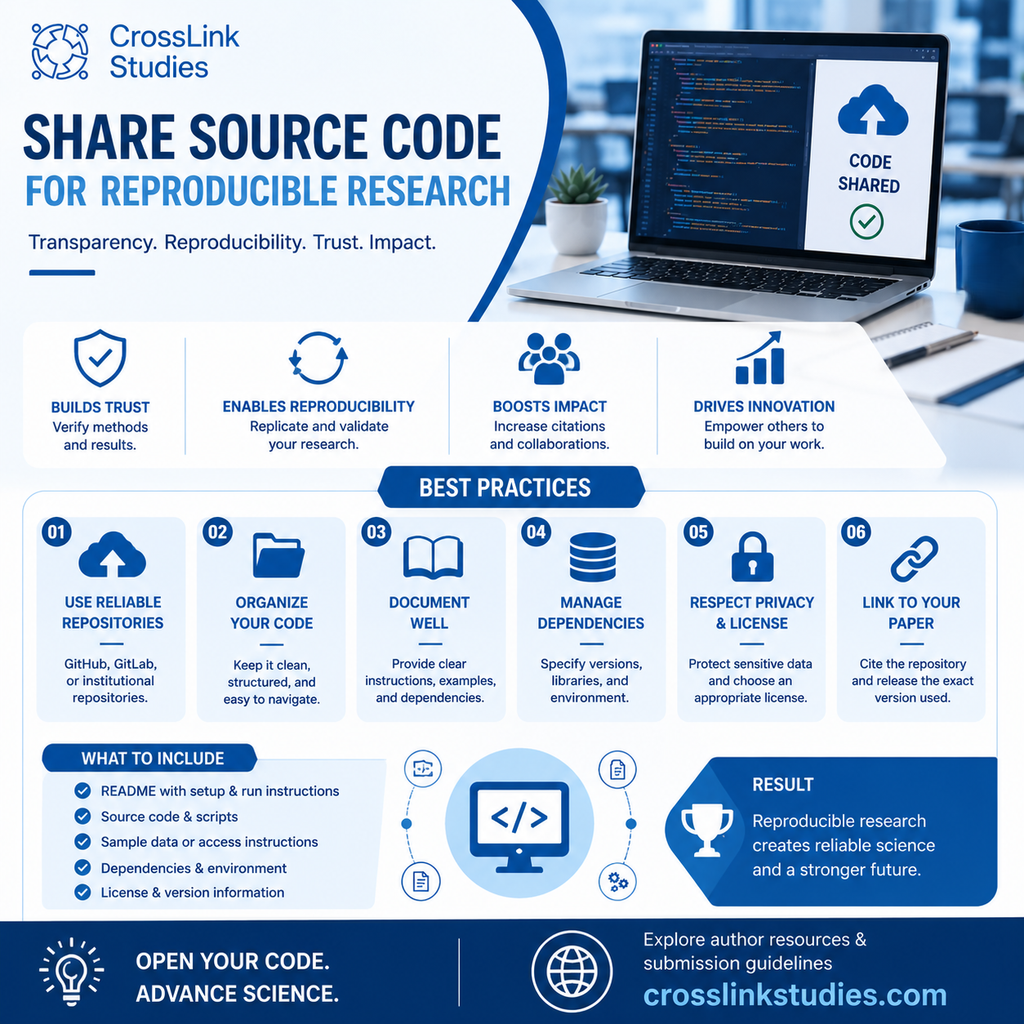
Why Source Code Sharing Matters
Many modern research studies rely on algorithms, simulations, machine learning models, software tools, and data-processing pipelines. While manuscripts often describe methods in detail, textual explanations alone may not fully capture implementation decisions, parameter settings, or computational workflows. Source code provides a transparent record of how experiments were conducted and how results were obtained.
When code is made available, researchers can validate findings more effectively, identify potential methodological issues, and reproduce experimental outcomes under similar conditions. This transparency strengthens scientific integrity and reduces uncertainty regarding the reliability of published results. Moreover, openly shared code accelerates innovation by enabling researchers to adapt, improve, and apply existing methods to new challenges.
In highly technical disciplines, reproducibility has become an important indicator of research quality. Studies supported by accessible and well-documented code are often viewed as more trustworthy because their findings can be independently verified.
Choosing the Right Repository
One of the first steps in sharing source code is selecting an appropriate repository. Personal websites and temporary storage services may become inaccessible over time, reducing the long-term availability of research outputs. For this reason, researchers are encouraged to use established platforms that support version control, collaboration, and persistent access.
Repositories such as GitHub, GitLab, and Bitbucket are widely used for software development and academic projects. For long-term scholarly preservation, researchers may also consider archival platforms that provide permanent identifiers and citation support. Using recognized repositories ensures that source code remains accessible to readers long after publication and contributes to the sustainability of scientific knowledge.
Organizing Code for Accessibility
Publishing source code does not simply mean uploading files to a repository. To support reproducibility, the code should be organized in a manner that allows others to understand and execute it with minimal difficulty.
A professional research repository should include a clear directory structure, descriptive file names, and logical organization of scripts, datasets, and documentation. Researchers should remove unnecessary files, outdated versions, temporary outputs, and personal information before public release. Clean organization improves usability and helps readers focus on the components necessary to reproduce the study.
Documenting the Research Workflow
One of the most common barriers to reproducibility is insufficient documentation. Even highly sophisticated code can become unusable if users do not understand how to run it or interpret the outputs.
A comprehensive README file should accompany every shared repository. This document should explain the purpose of the project, software requirements, installation procedures, execution steps, input data formats, and expected outputs. Researchers should also provide details regarding hardware requirements, programming language versions, package dependencies, and configuration settings.
Clear documentation transforms source code from a collection of files into a reproducible research resource. It enables researchers from different institutions and backgrounds to understand the workflow and reproduce results accurately.
Managing Dependencies and Computational Environments
Reproducibility challenges often arise when code depends on specific software libraries, operating systems, or computational environments. A program that functions correctly on one machine may fail on another due to differences in software versions or package configurations.
To address this issue, researchers should document all dependencies and, where possible, provide environment specifications. Dependency management tools, configuration files, and containerization technologies can help preserve computational environments and reduce compatibility problems.
Addressing Data and Privacy Considerations
While code sharing is strongly encouraged, researchers must also consider ethical, legal, and privacy-related obligations. In some cases, datasets may contain confidential information, proprietary content, or sensitive records that cannot be shared publicly.
When data restrictions exist, authors should clearly explain these limitations and provide alternative methods for evaluating the code. Examples may include sharing anonymized datasets, synthetic data samples, or detailed instructions for accessing restricted resources through approved channels.
Selecting an Appropriate License
Source code should be distributed under a clear license that defines how others may use, modify, and redistribute the material. Without an explicit license, potential users may be uncertain about their rights and obligations.
Researchers should choose a license that aligns with their goals for sharing and collaboration. Clearly stating licensing terms promotes responsible reuse, protects intellectual contributions, and encourages broader adoption of the research output.
Linking Code to Published Research
To maximize visibility and usability, source code should be directly connected to the published article. Authors should include repository information within the manuscript and clearly indicate which version of the code corresponds to the reported results.
Version consistency is particularly important because repositories often evolve over time. Readers should be able to access the exact implementation used in the study rather than a substantially modified version released later.
Common Mistakes Researchers Should Avoid
Despite growing awareness of reproducibility, several common mistakes continue to undermine code-sharing initiatives. These include uploading incomplete repositories, failing to document dependencies, omitting execution instructions, sharing outdated code versions, and neglecting long-term accessibility.
Another frequent issue is releasing code that cannot reproduce the published results due to missing files, hidden preprocessing steps, or undocumented parameter settings. Such practices reduce the value of code sharing and may create frustration for readers attempting to replicate the research.
The Future of Reproducible Research
The academic community is increasingly recognizing that reproducibility is fundamental to scientific credibility. Funding agencies, publishers, reviewers, and research institutions are placing greater emphasis on transparency and open research practices. As computational methods continue to expand across disciplines, source code sharing will play an increasingly important role in ensuring that research findings remain verifiable, reusable, and impactful.
For authors publishing in Crosslink Studies journals, embracing reproducible research practices demonstrates a commitment to scholarly excellence and responsible scientific communication. By sharing well-documented, accessible, and organized source code, researchers contribute not only to the validation of their own work but also to the advancement of knowledge across the broader scientific community.
Conclusion
Source code sharing is no longer simply a technical consideration; it is a cornerstone of modern research integrity. Well-prepared repositories, comprehensive documentation, transparent workflows, and responsible licensing practices strengthen reproducibility and increase the value of published research. As scholarly publishing continues to evolve toward greater openness and accountability, researchers who prioritize reproducible practices position their work for greater visibility, credibility, and long-term impact.By treating source code as a first-class research output, authors can help create a more transparent, collaborative, and trustworthy scientific ecosystem.