
How to Share Data Responsibly in CLS Publications?
Why Responsible Data Sharing Matters in Modern Research
Scientific progress depends on the ability of researchers to validate, reproduce, and build upon existing knowledge. As research becomes increasingly data-driven, the responsible sharing of research data has become a fundamental component of scholarly communication. Across disciplines, publishers, funding agencies, and research institutions are encouraging greater transparency through data availability and reproducibility practices.
However, sharing data is not simply about uploading files to a repository. Researchers must ensure that data are accurate, properly documented, ethically collected, legally shareable, and presented in a manner that protects confidentiality while supporting scientific verification.
For authors submitting to Crosslink Studies (CLS) publications, including the Ubiquitous Technology Journal (UTJ), responsible data sharing demonstrates research integrity, strengthens reviewer confidence, and contributes to the long-term value of published work. Whether a study involves artificial intelligence, Internet of Things (IoT), cybersecurity, data analytics, cloud computing, human-computer interaction, or smart environments, transparent data practices play an essential role in enhancing research quality.
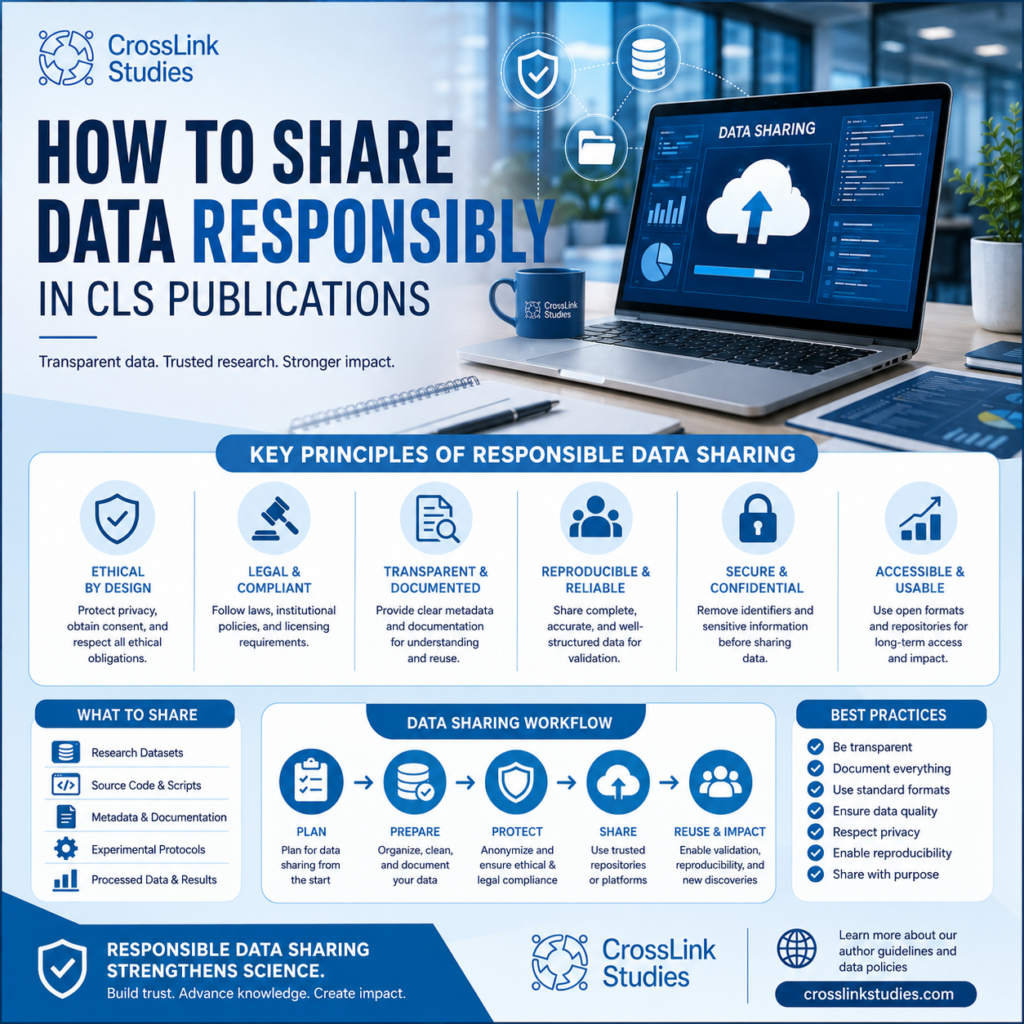
Understanding Responsible Data Sharing
Responsible data sharing refers to the practice of making research data accessible in a manner that supports transparency and reproducibility while respecting ethical, legal, and professional obligations.
Effective data sharing seeks to balance two important objectives:
- Maximizing research transparency and scientific value.
- Protecting privacy, confidentiality, intellectual property, and legal requirements.
The goal is not merely to make data available, but to ensure that others can understand, evaluate, and appropriately reuse the information.
Benefits of Responsible Data Sharing
Enhancing Research Transparency
Transparent data practices allow readers, reviewers, and fellow researchers to better understand how conclusions were reached. When supporting data are available, confidence in the reported findings increases significantly.
Supporting Reproducibility
Reproducibility is a cornerstone of scientific credibility. Providing access to relevant datasets allows other researchers to verify results, test alternative approaches, and validate findings independently.
Increasing Research Impact
Studies with accessible and well-documented datasets often receive greater visibility and may encourage future collaborations, citations, and follow-up investigations.
Facilitating Innovation
Shared data can support new discoveries beyond the original research objectives, enabling interdisciplinary applications and technological advancements.
What Types of Data Can Be Shared?
Depending on the nature of the study, authors may consider sharing:
Research Datasets
- Experimental measurements
- Sensor data
- Benchmark datasets
- Network traffic data
- Simulation outputs
- Performance evaluation results
Processed Data
- Cleaned datasets
- Feature-engineered data
- Aggregated statistical outputs
- Machine learning training and testing datasets
Supplementary Research Materials
- Data dictionaries
- Metadata files
- Annotation guidelines
- Experimental protocols
- Survey instruments
- Software configurations
Source Code and Scripts
For computational research, sharing code can significantly improve reproducibility and facilitate independent verification of results.
Ethical Considerations Before Sharing Data
Responsible data sharing begins long before manuscript submission. Authors should carefully evaluate whether their data can be shared without compromising ethical standards.
Protect Personal Information
Research involving human participants may contain sensitive information that requires protection. Before sharing data, authors should ensure that:
- Personal identifiers have been removed.
- Participant anonymity is preserved.
- Consent agreements permit data sharing.
- Ethical approval requirements are respected.
Confidentiality should never be compromised in pursuit of transparency.
Respect Legal and Regulatory Requirements
Certain datasets may be subject to institutional regulations, data protection laws, licensing agreements, industry confidentiality requirements and government restrictions. Authors should confirm that data sharing complies with all applicable legal obligations before publication.
Consider Intellectual Property Rights
Some research data may involve proprietary technologies, commercial partnerships, patent-related information and licensed materials. Researchers should verify ownership and usage rights before making such data publicly accessible.
Best Practices for Preparing Shared Data
Organize Data Clearly
Poorly organized datasets can significantly reduce their usefulness. Authors should:
- Use meaningful file names.
- Maintain consistent folder structures.
- Separate raw and processed data.
- Include explanatory documentation.
Well-structured datasets improve usability for both reviewers and future researchers.
Provide Comprehensive Metadata
Data without context are difficult to interpret. Metadata should explain data collection methods, variables and definitions, units of measurement, and experimental conditions.
Include Data Documentation
A clear data documentation file should accompany shared datasets. This document may include dataset description, research objectives, collection procedures, software requirements, version information and usage instructions. Good documentation transforms data from a collection of files into a valuable research resource.
Use Accessible Formats
Whenever possible, authors should use widely recognized and accessible formats. Examples include CSV for tabular data, TXT for text-based information, PDF for documentation, SON or XML for structured datasets, standard image and multimedia formats. Accessible formats increase long-term usability and compatibility.
Data Sharing in Technology and Computing Research
For studies published in UTJ, responsible data sharing often involves more than datasets alone. Technology-focused research may include:
Artificial Intelligence and Machine Learning
Authors should consider sharing training datasets, validation datasets, model parameters, evaluation metrics, and reproducibility scripts
Internet of Things (IoT)
Relevant materials may include sensor data device configurations, network topologies and communication protocols.
Cybersecurity Research
Researchers must balance transparency with security considerations. Data sharing should avoid exposing sensitive vulnerabilities, exploitable system configurations and confidential security information.
Cloud and Edge Computing
Authors may share experimental configurations, resource allocation settings, performance benchmarking data and simulation environments. Responsible sharing ensures that technical research remains reproducible while minimizing potential risks.
Common Mistakes Authors Should Avoid
Many data-sharing challenges arise from avoidable errors. Common mistakes include:
- Sharing Data Without Documentation
- Providing Incomplete Files
- Ignoring Privacy Concerns
- Using Proprietary or Obsolete Formats
- Delaying Data Preparation Until Submission
A Responsible Data Sharing Checklist
Before submitting your manuscript, consider the following questions:
✓ Is the dataset complete and accurate?
✓ Have confidential or personal identifiers been removed?
✓ Are legal and ethical requirements satisfied?
✓ Is the dataset clearly organized?
✓ Have metadata and documentation been provided?
✓ Are file formats widely accessible?
✓ Can another researcher understand and reuse the data?
✓ Does the shared information support reproducibility?
✓ Are intellectual property considerations addressed?
✓ Have all supporting files been reviewed before submission?
Building Trust Through Transparent Research
Responsible data sharing is increasingly recognized as a hallmark of high-quality research. By making supporting data accessible, understandable, and ethically managed, authors contribute to a more transparent and trustworthy scientific ecosystem.
For researchers publishing in Crosslink Studies journals, including the Ubiquitous Technology Journal, thoughtful data-sharing practices strengthen peer review, improve reproducibility, and increase the long-term impact of scholarly work. More importantly, they demonstrate a commitment to research integrity and scientific responsibility. As technology research continues to generate larger and more complex datasets, responsible data sharing will remain an essential component of credible, reproducible, and impactful scholarly publishing.