
How to Respond When Your Submission Fails Formatting Checks
A Returned Manuscript Is Not the End of the Publication Journey
Receiving a notification that a manuscript has failed formatting checks can be disappointing, especially after months of research, writing, analysis, and revision. For many authors, the immediate reaction is frustration, particularly when the scientific content of the study remains unevaluated.
However, failing a formatting check should not be viewed as a rejection of the research itself. In most cases, it is an administrative or technical issue that must be addressed before the manuscript can proceed to editorial assessment or peer review.
Leading scholarly journals implement formatting checks to ensure consistency, improve readability, streamline editorial workflows, and maintain publication quality. Authors who respond systematically and professionally can often resolve these issues quickly and move their submissions forward without affecting the scientific evaluation of their work.
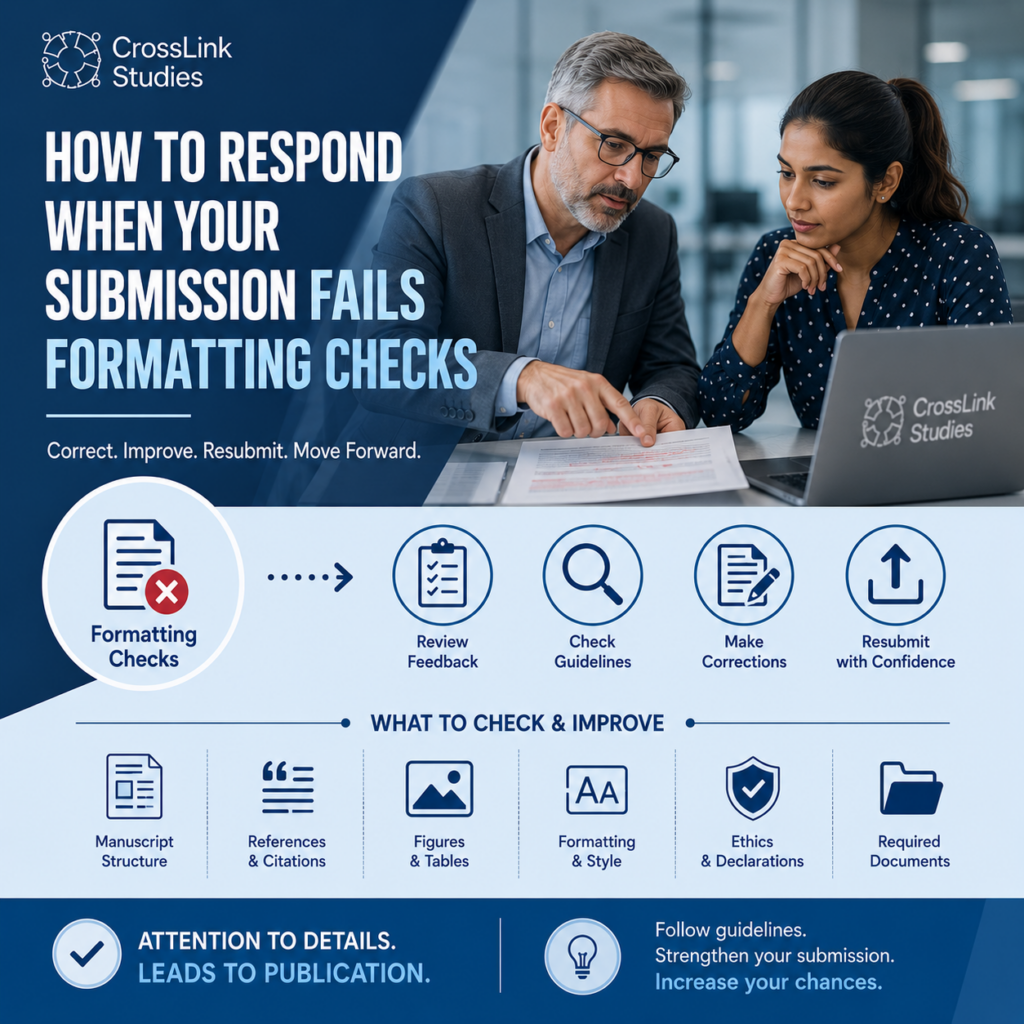
Understanding the Purpose of Formatting Checks
Before a manuscript reaches an editor or reviewer, it typically undergoes a technical screening process. During this stage, editorial staff evaluate whether the submission complies with the journal’s author guidelines and technical requirements. Formatting checks help UTJ:
- Maintain consistency across publications.
- Improve reviewer experience.
- Ensure efficient editorial processing.
- Verify submission completeness.
A manuscript that passes technical screening allows editors and reviewers to focus on the research rather than administrative issues.
Why Manuscripts Commonly Fail Formatting Checks
Formatting failures are often caused by relatively simple issues that can be corrected with careful review. Common examples include:
Incorrect Manuscript Structure
Journals frequently require specific sections arranged in a particular order. Problems may include missing abstracts, missing keywords, incomplete author information, incorrect heading structure and omitted declarations. Even minor deviations can trigger a return request.
Reference Formatting Errors
Reference-related issues are among the most common formatting concerns. For journals requiring IEEE-style citations, consistency throughout the manuscript is particularly important.
Figure and Table Problems
Visual elements often create technical challenges during submission. Common concerns include low-resolution images, missing captions, incorrect file formats, poor labeling, and figures embedded improperly. High-quality figures contribute significantly to professional manuscript presentation.
Template Non-Compliance
Many journals provide formatting templates or submission guidelines that authors are expected to follow. Problems occur when incorrect fonts are used, margin requirements are ignored, spacing differs from journal specifications and page layouts are inconsistent. Template compliance demonstrates attention to detail and professionalism.
Respond Calmly and Professionally
The first step after receiving a formatting-related return notice is to carefully review the feedback. Authors should avoid:
- Assuming the manuscript has been rejected.
- Responding emotionally.
- Making corrections without understanding the requirements.
- Ignoring editorial instructions.
Instead, view the feedback as an opportunity to improve the submission.
Formatting checks exist to help ensure a smoother publication process for everyone involved.
Read the Editorial Comments Thoroughly
Before making revisions, carefully examine every point raised by the editorial office.
Ask:
- What specific formatting issues were identified?
- Which files require modification?
- Are additional documents needed?
- Were references, figures, or declarations mentioned?
- Has the journal provided examples or templates?
Many delays occur because authors correct only part of the requested issues.
A complete review of editorial feedback helps prevent multiple rounds of technical revisions.
Compare the Manuscript with Journal Guidelines
One of the most effective strategies is to review the manuscript alongside the journal’s submission instructions.
Conduct a section-by-section comparison:
Manuscript Organization
Verify that all required sections are present and correctly ordered.
Reference Style
Ensure every citation matches the required format consistently.
Figures and Tables
Confirm that visual materials meet quality and labeling requirements.
Author Information
Check affiliations, contact details, and author metadata.
Ethical Statements
Verify that disclosures, acknowledgments, funding information, and conflict-of-interest declarations are included where required. A systematic review often reveals issues that were initially overlooked.
Create a Formatting Correction Checklist
Rather than making random edits, develop a structured action plan.
Example Formatting Checklist
✓ Abstract complies with journal requirements
✓ Keywords included
✓ Headings formatted correctly
✓ References checked and updated
✓ Figure captions verified
✓ Table formatting reviewed
✓ Author details confirmed
Leverage Reference and Formatting Tools
Modern publishing tools can significantly simplify formatting revisions. Useful resources include Zotero, Mendeley, EndNote, Microsoft word templates, Journal formatting guides. These tools help maintain consistency while reducing manual formatting errors. However, authors should still perform a final manual review before resubmission.
Perform a Final Technical Audit
Before resubmitting, evaluate the manuscript as though you were part of the journal’s editorial office. Consider:
- Is the manuscript complete?
- Does it follow all journal instructions?
- Are figures publication-ready?
- Are references consistent?
- Have all editorial comments been addressed?
A final technical audit can prevent additional rounds of corrections and accelerate processing.
Treat Formatting Feedback as a Learning Opportunity
Experienced researchers understand that formatting checks are a routine part of academic publishing. Each journal has unique expectations, and learning how to navigate these requirements strengthens future submissions. Authors who respond positively to technical feedback often benefit by improving manuscript presentation, enhancing publication readiness, reducing future submission delays and developing stronger publishing habits.
The Difference Between Technical Issues and Research Quality
It is important to distinguish formatting concerns from scientific evaluation. A formatting return generally indicates that administrative issues need correction, technical requirements were not fully met and additional information may be required. It does not necessarily indicate that the research lacks value, the methodology is flawed, the findings are unimportant and publication is unlikely. Understanding this distinction helps authors approach revisions with confidence and professionalism.
Formatting checks are an essential component of the scholarly publishing process. They help journals maintain consistency, improve efficiency, and ensure that manuscripts are prepared for fair editorial assessment and peer review. When a submission fails formatting checks, authors should view the outcome as a temporary procedural step rather than a setback. By carefully reviewing feedback, following journal guidelines, addressing every identified issue, and conducting a thorough final review, researchers can strengthen their manuscripts and improve the likelihood of successful progression through the publication process.