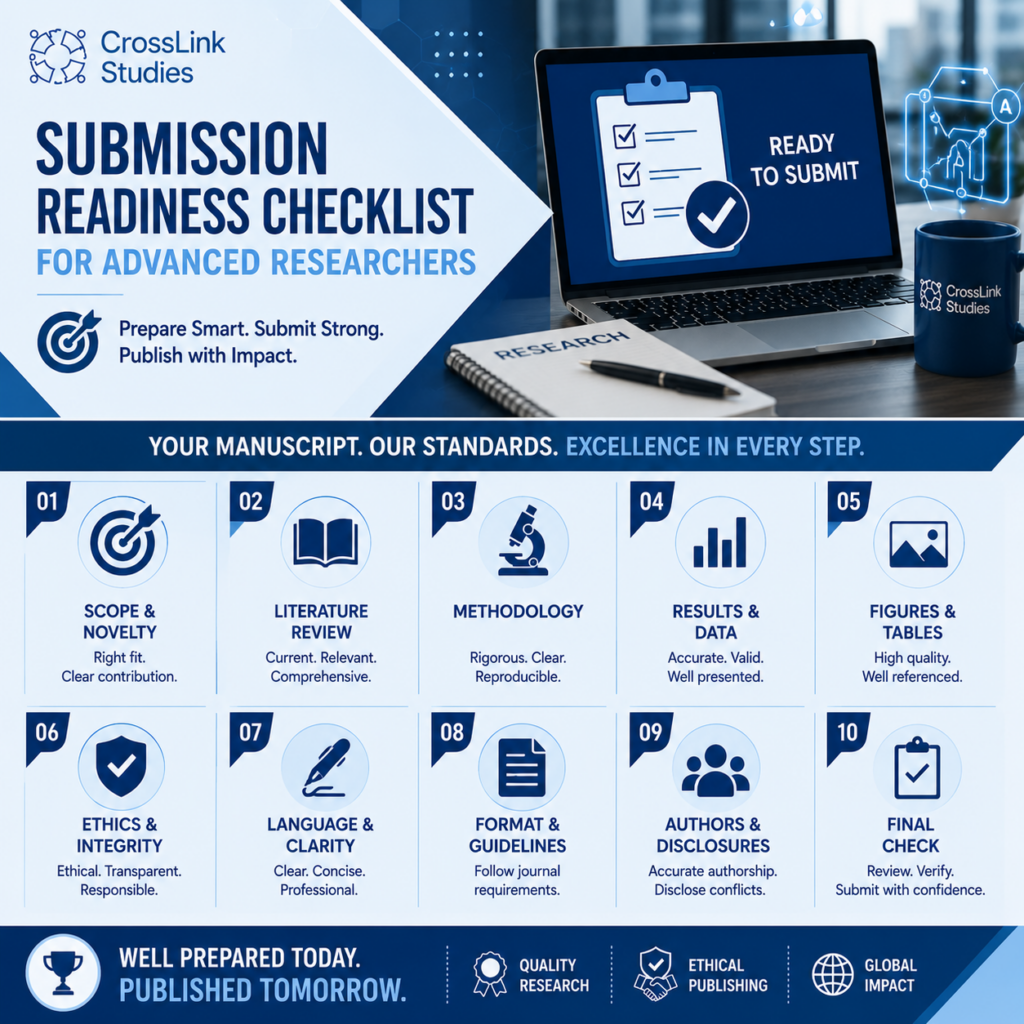
Submission Readiness Checklist for Advanced Researchers
Why Submission Readiness Matters
For experienced researchers, manuscript submission is more than simply uploading a document to a journal portal. Even highly innovative studies can face delays, requests for major revisions, or outright rejection if critical submission requirements are overlooked.
Leading journals receive a large number of submissions, and editors often conduct an initial screening before a manuscript reaches peer review. During this stage, issues related to formatting, methodology, ethics, reporting quality, and journal compliance can significantly influence editorial decisions. A comprehensive submission readiness check helps ensure that research is presented professionally, aligns with journal expectations, and enters the peer-review process with the strongest possible foundation.
Start with Journal Scope Alignment
One of the most common reasons for editorial rejection is a mismatch between the manuscript and the journal’s aims and scope.
Before submission, ask:
- Does the study address topics relevant to the journal?
- Does the manuscript contribute new knowledge to the field?
- Will the journal’s readership benefit from the findings?
- Does the research align with the journal’s thematic priorities?
For technology-focused journals such as UTJ, authors should clearly demonstrate how their work contributes to areas such as artificial intelligence, ubiquitous computing, cybersecurity, software engineering, data science, Internet of Things (IoT), cloud technologies, or related emerging technologies. A strong scope fit increases the likelihood of a positive editorial assessment.
Verify Research Novelty and Contribution
Advanced researchers should critically evaluate whether the manuscript clearly communicates its original contribution. Before submission, ensure that:
- The research gap is clearly identified.
- The novelty statement is explicit.
- Findings extend existing knowledge.
- Contributions are measurable and meaningful.
- The study advances theory, methodology, or application.
Editors and reviewers frequently ask a simple question:
“What does this manuscript add that is not already known?”
A compelling answer should be evident throughout the paper.
Strengthen the Literature Review
A high-quality literature review demonstrates scholarly depth and awareness of current developments. Review the manuscript for recent and relevant references, foundational studies in the field, balanced scholarly perspectives, current technological developments and accurate and complete citations. In rapidly evolving technology disciplines, references should reflect both established scholarship and contemporary research trends.
Confirm Methodological Rigor
Methodological clarity remains one of the strongest predictors of successful peer review outcomes. Before submission, verify that:
Research Design Is Clearly Explained
Readers should understand research objectives, study framework, data collection procedures, analytical methods and validation techniques.
Reproducibility Is Possible
The methodology should provide sufficient detail for other researchers to understand and replicate the study when appropriate.
Limitations Are Acknowledged
Transparent discussion of limitations demonstrates academic maturity and strengthens research credibility.
Evaluate Data Quality and Results
Editors and reviewers closely examine whether conclusions are supported by evidence.
Consider the following checklist:
✓ Data sources are clearly identified.
✓ Results are logically presented.
✓ Statistical analyses are appropriate.
✓ Tables and figures are accurate.
✓ Findings directly address research questions.
✓ Conclusions are supported by evidence.
Strong research findings lose impact when data presentation lacks clarity or consistency.
Review Figures, Tables, and Visual Elements
Visual content should enhance understanding rather than create confusion. Before submission ensure all figures are high quality, verify figure numbering and captions, check table formatting consistency, confirm that visuals are referenced within the text and remove redundant or unnecessary graphics. Well-designed visuals improve readability and support stronger scientific communication.
Check Ethical Compliance
Research integrity is a fundamental requirement of scholarly publishing. Authors should confirm:
Authorship Accuracy
All listed authors should have made meaningful scholarly contributions.
Conflict of Interest Disclosure
Potential conflicts should be disclosed transparently.
Ethical Approvals
Where applicable, ethical approvals and consent procedures should be documented.
Originality
The manuscript should represent original work that has not been published elsewhere. Demonstrating ethical compliance strengthens trust among editors, reviewers, and readers.
Ensure Language and Presentation Quality
Even technically strong research can be weakened by poor presentation. Conduct a final review for grammar and spelling accuracy, consistent terminology, logical organization, professional academic tone and clear and concise writing. The goal is not complexity but clarity. Well-written manuscripts allow reviewers to focus on the research itself rather than presentation issues.
Verify Journal Formatting Requirements
Many submissions encounter delays because authors overlook journal-specific instructions. Before submission, carefully review manuscript structure, formatting guidelines, citation style requirements, figure specifications, reference formatting and supplementary material requirements. For UTJ submissions, authors should ensure compliance with the journal’s stated formatting and IEEE-style referencing expectations. Attention to detail during preparation reflects professionalism and facilitates smoother editorial processing.
Conduct a Final Submission Audit
Before clicking the submission button, perform one final assessment.
Submission Readiness Checklist
Research Quality
✓ Clear research question
✓ Strong novelty and contribution
✓ Comprehensive literature review
✓ Robust methodology
✓ Evidence-based conclusions
Presentation Quality
✓ Professional language
✓ High-quality figures and tables
✓ Consistent formatting
✓ Accurate references
✓ Complete manuscript sections
Publishing Compliance
✓ Scope alignment
✓ Ethical compliance
✓ Conflict disclosures
✓ Authorship verification
✓ Journal guideline compliance
Completing this final audit can significantly reduce avoidable editorial concerns.
For advanced researchers, successful publishing is not only about conducting excellent research, it is also about presenting that research in a way that meets the expectations of editors, reviewers, and the wider scholarly community. A structured submission readiness review helps identify weaknesses before they become obstacles during editorial screening or peer review. By evaluating scope alignment, novelty, methodology, ethics, presentation quality, and journal compliance, authors can submit manuscripts with greater confidence and professionalism.
The strongest submissions are rarely the result of last-minute preparation. They are the product of careful planning, rigorous review, and a commitment to research excellence at every stage of the publication process.