
How to Suggest Three Qualified Reviewers Ethically
Supporting a Fair and Effective Peer-Review Process
Peer review remains one of the most important quality assurance mechanisms in scholarly publishing. To help editors identify suitable experts, many journals invite authors to recommend potential reviewers during manuscript submission. While this practice can improve review efficiency, it also carries ethical responsibilities.
For authors submitting to the Ubiquitous Technology Journal (UTJ), suggesting reviewers should never be viewed as an opportunity to influence editorial decisions. Instead, it is a chance to assist editors in identifying independent experts who can provide objective, constructive, and technically sound evaluations.
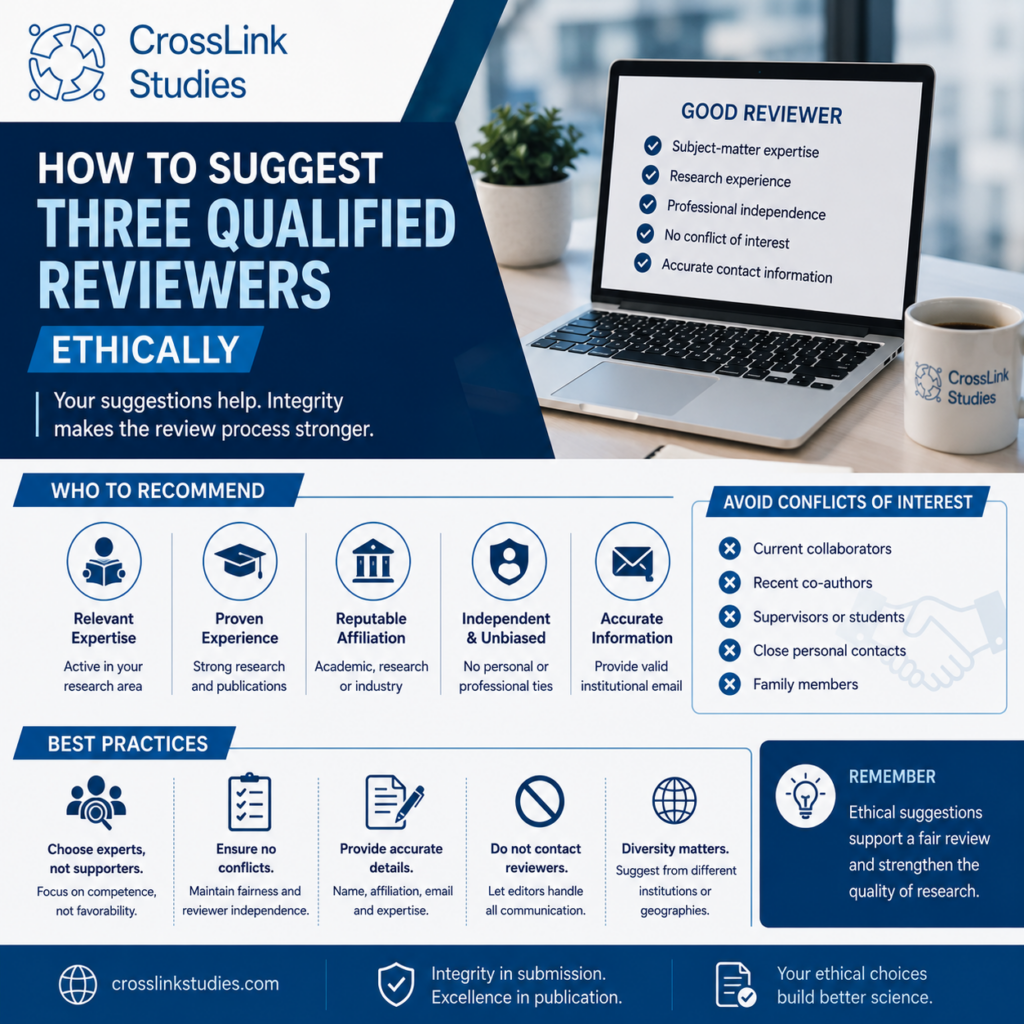
Why Journals Request Reviewer Suggestions
Editors often manage submissions covering highly specialized research areas. Author-recommended reviewers can help identify individuals with expertise that closely matches the manuscript’s topic. Reviewer recommendations may assist editors by:
- Reducing reviewer search time.
- Identifying subject-matter specialists.
- Supporting timely peer review.
- Improving the relevance of technical evaluations.
However, reviewer suggestions are recommendations only. The final reviewer selection remains entirely at the discretion of the editorial team.
What Makes a Reviewer Qualified?
A qualified reviewer should possess the knowledge and experience necessary to evaluate the manuscript fairly and competently.
Strong reviewer candidates typically:
Have Relevant Subject Expertise
The reviewer should actively publish or conduct research in areas closely related to the manuscript’s topic.
Possess Research Experience
Experienced researchers are generally better equipped to assess methodology, analysis, interpretation, and scholarly contribution.
Understand Scholarly Publishing Standards
Reviewers should be familiar with academic publishing practices, ethical standards, and peer-review expectations.
Maintain Professional Independence
The reviewer should be able to provide an unbiased assessment without personal or professional conflicts of interest.
Ethical Principles for Reviewer Recommendations
When suggesting reviewers, authors should prioritize transparency and objectivity.
Avoid Conflicts of Interest
Do not recommend current collaborators, recent co-authors, research supervisors or students, family members and close personal associates. Even if these individuals are highly qualified, their relationship with the authors may compromise the perception of impartiality.
Focus on Expertise Rather Than Favorability
Reviewer recommendations should be based on technical competence, not assumptions about whether the reviewer will provide a positive evaluation. The purpose of peer review is rigorous assessment, not guaranteed acceptance.
Provide Accurate Information
Ensure that reviewer names, affiliations, institutional email addresses, and research specialties are current and accurate. Incomplete or incorrect information can delay the review process.
Respect Reviewer Independence
Authors should never contact potential reviewers regarding the submitted manuscript before or during peer review. Maintaining reviewer independence protects the integrity of the evaluation process.
Practical Steps for Selecting Three Suitable Reviewers
A simple approach is to identify experts who:
- Publish regularly in the manuscript’s research area.
- Have demonstrated expertise through recent publications.
- Work at reputable academic, research, or industry institutions.
- Have no conflicts of interest with any of the authors.
- Represent diverse institutions or geographic regions when possible.
This approach helps ensure balanced and credible reviewer recommendations.
Common Mistakes to Avoid
Several practices may raise ethical concerns during manuscript submission:
- Recommending close collaborators.
- Suggesting reviewers with personal relationships to the authors.
- Providing non-institutional or unverifiable contact information.
- Selecting reviewers solely because they are likely to be supportive.
- Recommending individuals without demonstrated expertise in the research topic.
Avoiding these mistakes helps maintain confidence in the peer-review process.
The Editorial Perspective
Editors value reviewer recommendations when they are made responsibly and transparently. Ethical reviewer suggestions demonstrate professionalism and respect for scholarly standards. Conversely, recommendations that present potential conflicts of interest may lead editors to disregard suggested reviewers entirely and may raise concerns regarding publication ethics.
Suggesting reviewers is an important responsibility that should support—not influence—the peer-review process. The most effective reviewer recommendations are based on expertise, independence, and professional integrity.
For UTJ authors, selecting three qualified reviewers ethically contributes to a fair evaluation process and reinforces the principles of transparency, objectivity, and research excellence that underpin scholarly publishing. Strong manuscripts benefit from strong peer review, and ethical reviewer recommendations help make that possible.