
When Textbook Citations Are Appropriate in Journal Manuscripts
Understanding the Proper Role of Textbooks in Scholarly Research Writing
Citations are the foundation of scholarly communication. They acknowledge prior work, support arguments, provide context, and enable readers to verify information. In journal manuscripts, authors are generally encouraged to cite primary and recent sources whenever possible. However, many researchers particularly early-career scholars often wonder whether textbooks are acceptable references in academic journal articles.
The answer is not a simple yes or no. Textbook citations can be appropriate in certain circumstances, but they should be used strategically and sparingly. Understanding when textbooks strengthen a manuscript and when they should be replaced by primary literature is essential for producing research that meets the standards of high-quality scholarly journals.
This blog explores the role of textbook citations in journal manuscripts and provides practical guidance for authors seeking to maintain academic rigor and credibility.
Why Journals Prefer Primary Sources
Most scholarly journals encourage authors to cite original research articles rather than textbooks. Primary sources provide direct evidence, present original findings, and reflect the most current developments in a field.
When authors cite a primary study, readers can evaluate:
- The original methodology.
- Research design and data collection procedures.
- Statistical analyses.
- Interpretation of findings.
- Study limitations.
In contrast, textbooks often summarize knowledge derived from multiple studies and may not provide the detailed evidence required for scholarly evaluation.For this reason, journal editors and reviewers frequently recommend replacing textbook references with primary research sources whenever possible.
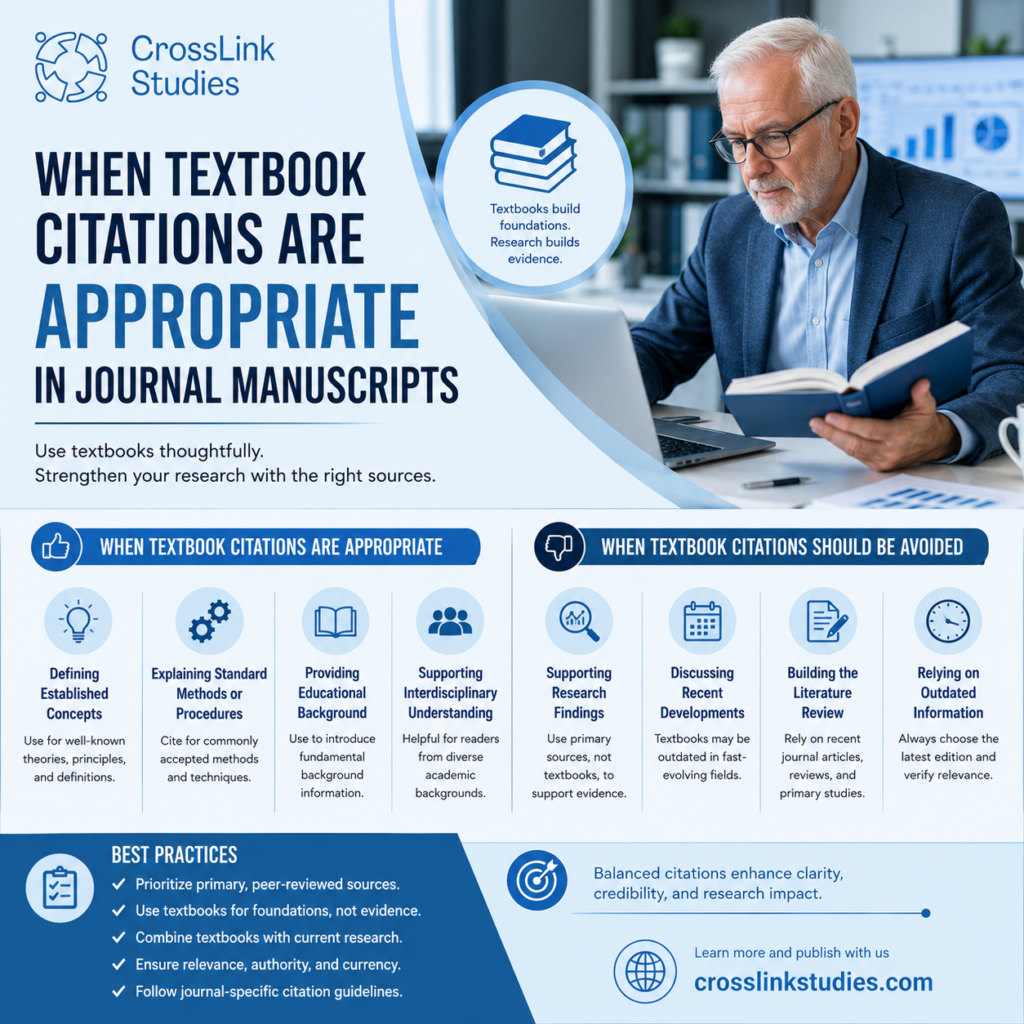
Situations Where Textbook Citations Are Appropriate
Although primary literature is generally preferred, textbooks still serve important functions in academic writing.
Defining Established Concepts
Textbooks are often suitable for citing widely accepted definitions, theories, principles, and foundational concepts that are well established within a discipline.For example, when introducing fundamental concepts such as supply and demand in economics, basic thermodynamic laws in engineering, or established theoretical frameworks in education, a respected textbook may provide an authoritative source.
In such cases, textbook citations help readers understand the conceptual foundation of the study without requiring extensive discussion of original historical literature.
Explaining Standard Methods or Procedures
Many textbooks contain detailed descriptions of commonly accepted research methods, statistical techniques, laboratory procedures, and analytical frameworks. When a method is standard, universally recognized, and not the focus of methodological innovation, citing a reputable textbook can be appropriate.
However, if a manuscript applies a novel methodological approach or a modified procedure, authors should also cite relevant primary methodological studies.
Providing Educational Background
In introductory sections, textbooks can be useful for presenting background information intended to orient readers who may not be specialists in the field. Such citations can support explanations of basic concepts before the manuscript transitions to more specialized literature and recent research findings. This approach is particularly valuable in interdisciplinary research where readers may come from diverse academic backgrounds.
When Textbook Citations Should Be Avoided
While textbooks have legitimate uses, excessive reliance on them can weaken a manuscript.
Supporting Research Findings
Textbooks should generally not be used as evidence for specific research claims, empirical findings, or contemporary scientific conclusions. Research-based statements should be supported by original studies, systematic reviews, meta-analyses, or other scholarly sources that directly investigate the topic. For example, if an author claims that a particular intervention improves learning outcomes, the supporting citation should come from empirical research rather than a textbook summary.
Discussing Recent Developments
Textbooks often require years to write, review, and publish. As a result, they may not reflect the most current advances in rapidly evolving disciplines. Fields such as artificial intelligence, biotechnology, information systems, climate science, and public health frequently experience rapid changes that cannot always be captured in textbook editions.
Building the Literature Review
A strong literature review demonstrates engagement with current scholarly discussions. Excessive textbook citations may suggest that the author has not adequately examined recent research.
Editors and reviewers generally expect literature reviews to be grounded in:
- Peer-reviewed journal articles.
- Systematic reviews.
- Meta-analyses.
- Conference proceedings where appropriate.
- Recent scholarly publications.
A literature review dominated by textbooks may raise concerns regarding the depth and currency of the research.
Evaluating Textbook Quality Before Citation
Not all textbooks carry the same scholarly value. Before citing a textbook, authors should consider several factors.
Author Expertise
The textbook should be written or edited by recognized experts with demonstrated contributions to the field.
Publisher Reputation
Academic publishers with established peer review and editorial standards generally produce more reliable educational resources.
Edition Currency
Whenever possible, authors should cite the most recent edition available, particularly in fields characterized by rapid scientific advancement.
Relevance to the Manuscript
The cited material should directly support the argument, concept, or explanation being presented.
Careful selection of textbook sources helps maintain scholarly credibility.
Balancing Textbooks and Research Literature
Effective manuscripts often use textbooks and primary literature in complementary ways.
A common strategy is to:
- Use textbooks to introduce foundational concepts.
- Cite seminal studies to establish historical context.
- Incorporate recent research to support current arguments and findings.
- Reference systematic reviews or meta-analyses to synthesize broader evidence.
This balanced approach demonstrates both theoretical understanding and engagement with contemporary scholarship.
Common Reviewer Concerns About Textbook Citations
Reviewers frequently identify several issues related to textbook references:
- Excessive reliance on textbooks.
- Outdated editions.
- Lack of primary source citations.
- Textbooks cited for empirical claims.
- Limited engagement with current research literature.
Authors can reduce the likelihood of revision requests by evaluating whether each textbook citation serves a clear scholarly purpose.
Best Practices for Authors
To use textbook citations effectively in journal manuscripts, authors should:
- Prioritize primary and peer-reviewed sources whenever available.
- Use textbooks primarily for definitions, theories, and foundational concepts.
- Avoid relying on textbooks as evidence for research findings.
- Supplement textbook references with current scholarly literature.
- Verify that cited editions are recent and authoritative.
- Consider journal-specific citation expectations.
These practices strengthen both the credibility and scholarly impact of a manuscript.
Textbook citations remain a valuable component of academic writing when used appropriately. They can effectively support foundational concepts, standard methodologies, and educational background information. However, journal manuscripts should primarily rely on primary research literature to support empirical claims, literature reviews, and discussions of contemporary developments.
Authors who understand the proper role of textbooks within scholarly communication are better positioned to meet reviewer expectations, strengthen their arguments, and contribute meaningful research to the academic community. By balancing authoritative textbooks with current peer-reviewed evidence, researchers can create manuscripts that are both informative and academically rigorous.