
How to Avoid Missing In-Text Citations?
A Simple Step That Protects Research Credibility
Among the most common issues identified during manuscript screening and peer review are missing in-text citations. While often viewed as a minor formatting oversight, uncited statements can create significant concerns regarding source attribution, evidence support, and scholarly rigor.
For authors preparing submissions to the Ubiquitous Technology Journal (UTJ), ensuring that every borrowed idea, method, dataset, figure, or factual claim is properly cited is an essential part of responsible academic writing. Accurate citation practices strengthen research credibility and help reviewers evaluate the foundation of the work effectively.
What Is a Missing In-Text Citation?
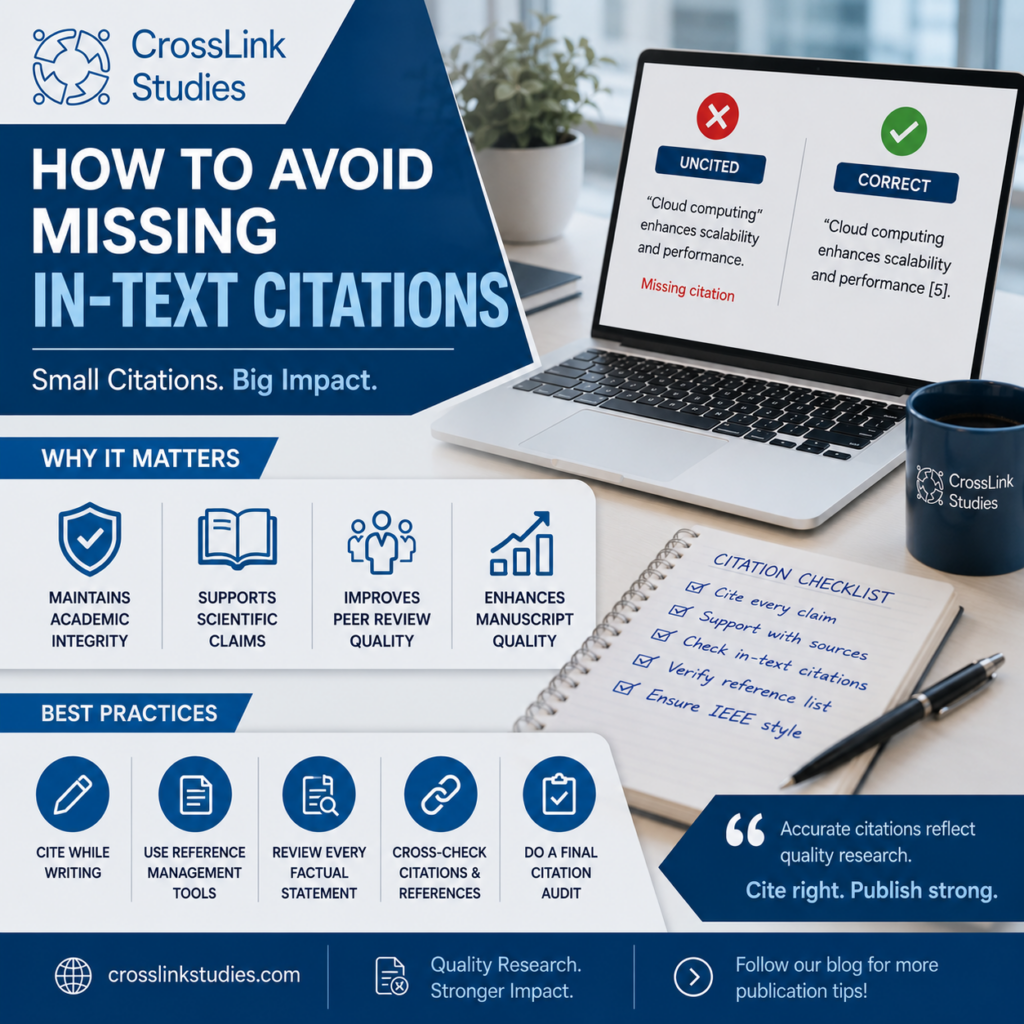
A missing in-text citation occurs when information derived from another source appears in the manuscript without a corresponding reference within the text.
Examples include:
- Literature findings presented without citation.
- Technical definitions borrowed from published studies.
- Performance comparisons based on previous research.
- Methodologies adapted from earlier work.
- Statistical data presented without source attribution.
Even when the referenced source appears in the bibliography, failing to cite it within the manuscript creates a disconnect between the text and reference list.
Why Missing Citations Matter
Maintaining Academic Integrity
Proper citation acknowledges the contributions of previous researchers. Missing citations can unintentionally suggest that borrowed ideas or findings originated from the current author.
Supporting Scientific Claims
Research conclusions should be supported by reliable evidence. Citations provide readers and reviewers with a pathway to verify information and evaluate its validity.
Strengthening Peer Review
Reviewers assess the relevance and quality of supporting literature. Missing citations make it difficult to determine whether statements are evidence-based or unsupported assertions.
Improving Manuscript Quality
Well-cited manuscripts demonstrate scholarly discipline and attention to detail, both of which contribute positively to editorial evaluation.
Common Causes of Missing Citations
Many citation omissions occur during manuscript development rather than intentional oversight.
Frequent causes include:
- Multiple rounds of editing and restructuring.
- Copying notes from literature reviews without citation markers.
- Adding background information during revisions.
- Removing references but forgetting to update related citations.
- Manual citation management errors.
Recognizing these risks allows authors to establish better citation-checking practices before submission.
Practical Strategies to Prevent Citation Omissions
Cite While Writing
Rather than adding citations at the end of the writing process, insert references immediately when incorporating information from external sources.
Use Reference Management Software
Reference management tools help maintain consistency and reduce the likelihood of forgotten citations during revisions.
Review Every Factual Statement
During final proofreading, examine claims, statistics, definitions, and technical descriptions. Ask whether each statement originates from original work or requires external support.
Cross-Check Citations and References
Ensure that:
- Every in-text citation has a matching reference entry.
- Every reference listed is cited within the manuscript.
- Citation numbering follows IEEE requirements consistently.
Conduct a Pre-Submission Audit
A dedicated citation review before submission can identify overlooked references that standard proofreading may miss.
The Editorial Perspective
Editors and reviewers often view citation accuracy as an indicator of overall manuscript quality. Missing citations can raise questions about literature review completeness, source attribution, and adherence to publication standards.
Conversely, manuscripts with thorough and accurate citation practices communicate professionalism, transparency, and respect for scholarly conventions.
Avoiding missing in-text citations is one of the simplest yet most important steps authors can take to improve manuscript quality. Every cited source strengthens the transparency and credibility of research while helping reviewers assess the work efficiently. By adopting systematic citation practices throughout the writing process, authors can reduce revision requests and present their research with greater confidence and scholarly integrity.In academic publishing, strong research should always be supported by clearly documented evidence and that begins with accurate in-text citations.