
Editing Technical Sentences for Precision and Readability
Why Clear Scientific Writing Is Essential for Research Visibility, Reviewer Confidence, and Publication Success
In scientific publishing, researchers devote substantial time to designing experiments, collecting data, developing algorithms, conducting analyses, and interpreting results. Yet despite the sophistication of modern research methods, one factor continues to influence publication outcomes across disciplines: the clarity of technical writing.
Editors and reviewers regularly encounter manuscripts that contain valuable findings but communicate them through complex, ambiguous, or unnecessarily complicated sentences. In many cases, the scientific contribution is overshadowed by writing that makes the research difficult to understand.A manuscript does not communicate its value through data alone. It communicates value through language. Every sentence serves as a bridge between the researcher’s knowledge and the reader’s understanding. When that bridge is weak, even strong research can lose impact.
This challenge is particularly important in technology-driven disciplines such as computer science, artificial intelligence, data science, engineering, information systems, cybersecurity, and emerging digital technologies. These fields often involve highly technical concepts, specialized terminology, mathematical models, and complex methodologies. Authors must therefore balance technical accuracy with readability.
The Hidden Cost of Poorly Written Technical Sentences
Many researchers assume that reviewers focus exclusively on scientific content. While methodological rigor remains the primary evaluation criterion, reviewers must first understand what the manuscript is attempting to communicate. Poorly constructed technical sentences create several challenges increased reviewer fatigue, misinterpretation of findings, confusion regarding methodology and reduced confidence in research quality.
Consider the following example:
Less Effective:
“The proposed framework which incorporates multiple optimization procedures that were integrated within the architecture was utilized for improving the prediction performance under different operational scenarios.”
Improved Version:
“The proposed framework integrates multiple optimization procedures to improve prediction performance across diverse operational scenarios.”
The second sentence communicates the same idea more directly, reducing cognitive effort while preserving technical accuracy.
Understanding Precision in Scientific Writing
Precision refers to the ability of a sentence to communicate exactly what the author intends without creating uncertainty or multiple interpretations. In scientific writing, precision is essential because research conclusions often depend on subtle distinctions.
A precise sentence answers key questions clearly:
- What was done?
- How was it done?
- Why was it done?
- What was observed?
- What does the result indicate?
Ambiguous language weakens scientific communication.
Ambiguous Statement:
“The model performed significantly better.”
Better than what? Under which conditions? According to which metric? A precise version provides context: “The proposed model achieved a 12.4% improvement in classification accuracy compared with the baseline Random Forest model.”
Why Readability Matters in Technical Research
Some authors mistakenly believe technical writing should be difficult because the subject matter is complex. In reality, the most influential scientific articles often explain highly sophisticated concepts through remarkably clear language. Readability does not mean oversimplification.
A readable manuscript maintains logical sentence structure, uses consistent terminology, eliminates redundant wording. Strong readability allows readers to focus on scientific content rather than sentence interpretation.
Common Problems Found in Technical Sentences
Excessive Sentence Length
One of the most common issues in academic manuscripts is overly long sentences containing multiple ideas. Consider this example:
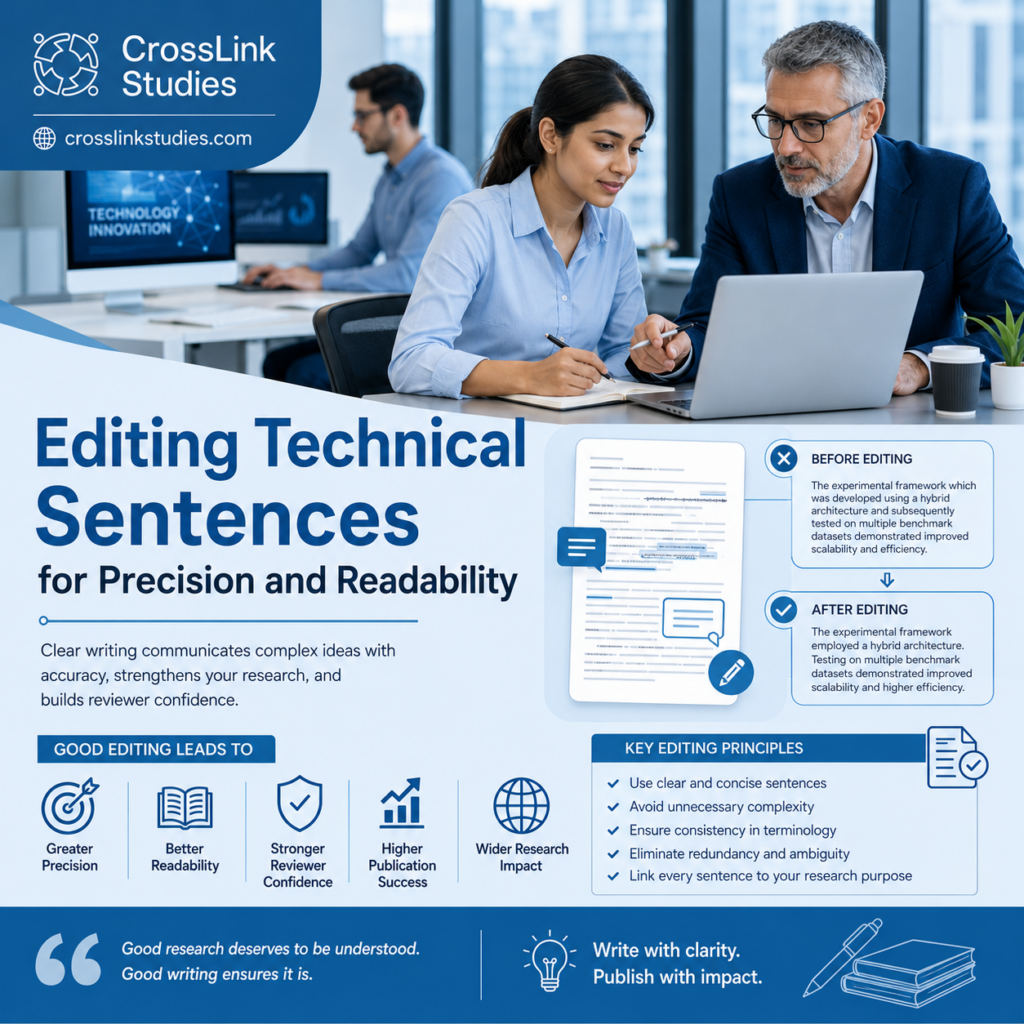
Before Editing:
“The experimental framework which was developed using a hybrid architecture and subsequently tested on multiple benchmark datasets demonstrated improved scalability and efficiency while simultaneously reducing computational complexity across various deployment environments.”
After Editing:
“The experimental framework employed a hybrid architecture. Testing on multiple benchmark datasets demonstrated improved scalability, higher efficiency, and reduced computational complexity across diverse deployment environments.”
Unnecessary Passive Construction
Passive voice remains common in scientific writing. While it has legitimate uses, excessive reliance on passive structures often reduces clarity.
Before Editing:
“The dataset was analyzed and the performance metrics were calculated.”
After Editing:
“We analyzed the dataset and calculated performance metrics.” The revised versions identify the action more directly.
Redundant Expressions
Technical manuscripts often contain phrases that increase word count without adding meaning.
Before Editing:
“It is important to note that the proposed algorithm achieved higher accuracy.”
After Editing:
“The proposed algorithm achieved higher accuracy.”
Ambiguous References
Authors frequently use pronouns without clear antecedents.
Example: “The system was integrated with the framework, and it improved performance.”
What improved performance? The system?
Improved Version:
“The integrated system improved overall framework performance.”
Editing for Methodological Clarity
Methodology sections are particularly vulnerable to readability issues because they contain procedural details, technical terminology, and experimental specifications. Authors should ensure that every methodological sentence answers a clear question.
Editing Results for Scientific Impact
Results sections often suffer from two opposite problems:
- Excessive description.
- Insufficient interpretation.
Many authors simply report numerical outputs without explaining their significance.
Strengthening Discussion Through Precise Language
The discussion section should interpret findings with confidence while avoiding overstatement. Reviewers generally favor carefully qualified conclusions over exaggerated claims.
The Importance of Consistent Terminology
Consistency is a cornerstone of technical readability. A concept should not be described using multiple interchangeable labels throughout the manuscript. Terminological consistency improves flow and reduces cognitive burden.
Editing Figures, Tables, and Technical Descriptions
Readability extends beyond the main text. Figure captions, table titles, and technical descriptions should also be edited carefully.
Effective captions describe content clearly, explain abbreviations and highlight key observations.
A Practical Editing Framework for Researchers
Before manuscript submission, authors can evaluate every technical sentence using five questions:
Is the sentence precise?
Is the sentence necessary?
Is the sentence specific?
Is the sentence consistent?
If the answer to any question is no, additional editing may be required.
What Reviewers Expect from Technical Writing
Reviewers are not searching for literary sophistication. They expect clarity, accuracy, transparency and logical structure.
The Relationship Between Writing Quality and Research Impact
Clear writing influences more than publication decisions. Research that is easier to understand is also more likely to be cited by other researchers, influence future studies, reach interdisciplinary audiences and support knowledge transfer.
Careful editing helps transform dense technical content into a clear and persuasive scientific narrative. By eliminating ambiguity, improving sentence structure, maintaining consistency, and prioritizing reader comprehension, researchers can strengthen reviewer confidence and maximize the visibility of their work. Ultimately, successful scientific writing achieves a balance between rigor and clarity. The most influential manuscripts are not those that sound the most complex, they are those that communicate complex ideas with exceptional precision, transparency, and purpose.