
How to Cite Reused Figures, Diagrams, and Datasets Properly
Modern research builds upon existing knowledge. As scholars develop new studies, they often incorporate previously published figures, conceptual diagrams, datasets, charts, frameworks, and visual models to provide context, support arguments, or compare findings. While the reuse of scholarly materials is a common and legitimate practice, it carries important ethical and legal responsibilities.
One of the most frequent publication issues encountered during editorial screening is the improper use of previously published visual or data-based content. Authors sometimes assume that citing a source in the reference list alone is sufficient when reusing a figure, diagram, or dataset. However, scholarly publishing standards require clear attribution, appropriate permissions when necessary, and transparent acknowledgment of the original source.
Proper citation protects intellectual property, demonstrates academic integrity, and helps readers trace the origins of research materials. More importantly, it ensures that authors comply with copyright requirements and publication ethics standards expected by reputable journals.
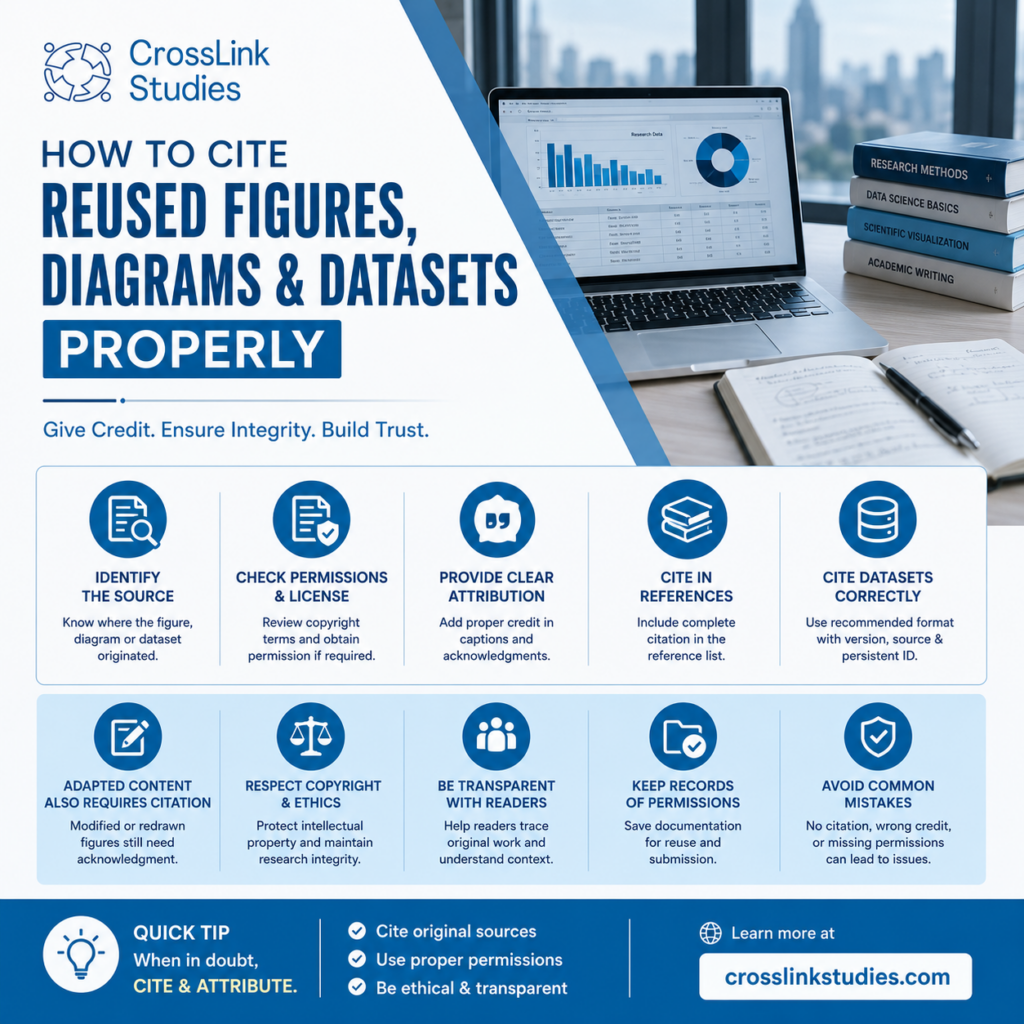
Understanding What Constitutes Reused Content
Reused content extends beyond direct quotations and includes various forms of visual and research materials. Authors may reuse figures from journal articles, diagrams from conference papers, illustrations from books, datasets from public repositories, conceptual models from previous studies, or adapted graphics created from existing sources.
Even when a figure is modified, redesigned, or partially adapted, the original source often still requires acknowledgment. The key principle is transparency. Readers should be able to identify which materials originated from previous work and how they have been incorporated into the current manuscript.
Recognizing reused content correctly is the first step toward maintaining ethical publishing practices.
Reusing Published Figures
Figures often communicate complex information more effectively than text. Researchers frequently wish to reuse published figures to explain methodologies, compare architectures, summarize theoretical concepts, or provide background information.
However, published figures are typically protected by copyright. In many cases, authors must obtain permission from the copyright holder before reproducing a figure in a new publication. Depending on the publisher’s policies and licensing terms, permission requirements may vary.
When a figure is reused, the figure caption should clearly acknowledge the original source. Readers should immediately understand that the visual was reproduced from a previously published work rather than created specifically for the current study. Proper attribution not only respects intellectual property rights but also strengthens the credibility of the manuscript by demonstrating transparency regarding source materials.
Citing Adapted or Modified Figures
A common misconception among researchers is that modifying a figure eliminates the need for attribution. In reality, adapted figures still require citation because the original intellectual contribution remains part of the final visual presentation.
For example, an author may redesign a workflow diagram, change colors, simplify components, or reorganize a conceptual framework while retaining the underlying structure from an earlier publication. In such cases, the figure should be identified as adapted from the original source. Adapted figures provide an excellent way to improve clarity or tailor visuals to a specific research context, but they must always acknowledge the work that inspired or informed their design.
Proper Attribution of Diagrams and Conceptual Frameworks
Conceptual diagrams, theoretical frameworks, system architectures, and process models are frequently reused in technology and engineering research. Because these visuals often represent original intellectual contributions, authors should exercise particular care when incorporating them into new manuscripts.
Simply redrawing a diagram does not make it original. If the structure, relationships, or conceptual design originate from another publication, appropriate citation remains necessary. Authors should clearly identify whether a framework has been reproduced, adapted, extended, or developed based on existing research. Such transparency helps readers understand the scholarly foundation of the proposed work while ensuring proper credit to the original creators.
Using Publicly Available Datasets Responsibly
Datasets have become central to research in artificial intelligence, machine learning, data science, cybersecurity, IoT, and numerous other technology-related disciplines. Many researchers rely on publicly available datasets to train models, evaluate algorithms, and validate findings.
Although datasets may be openly accessible, they still require formal citation. Dataset creators invest substantial effort in collecting, cleaning, documenting, and maintaining research data. Proper citation recognizes these contributions and supports reproducibility within the scientific community.
Authors should cite datasets according to the format recommended by the dataset provider, repository, or publisher. Information such as dataset title, creator, version, publication year, repository name, and persistent identifier should be included whenever available. Accurate dataset citation enables readers and reviewers to locate the exact data used in the study and verify research outcomes.
Understanding Copyright and Licensing Requirements
Before reusing any figure, diagram, or dataset, authors should review the licensing terms associated with the material. Different publications and repositories may operate under different copyright conditions.
Some materials are distributed under open-access licenses that permit reuse with attribution. Others may require explicit permission from the copyright holder. Certain licenses allow adaptation but prohibit commercial use, while others may restrict modifications altogether. Authors should never assume that online availability implies unrestricted reuse. Reviewing licensing information before manuscript submission can prevent delays, corrections, and potential copyright disputes later in the publication process.
Best Practices for Figure and Dataset Attribution
Researchers can avoid most attribution-related issues by following several practical principles. First, identify the original source of every reused visual or dataset. Second, determine whether permission is required before reuse. Third, provide clear attribution directly within figure captions when applicable. Fourth, include complete references in the manuscript reference list. Fifth, maintain records of permissions and licensing information throughout the publication process.
Most importantly, when uncertainty exists, authors should disclose the source and provide attribution rather than risk insufficient acknowledgment. Transparency is always preferable to ambiguity in scholarly communication.
Common Mistakes Authors Should Avoid
Several recurring mistakes continue to appear in journal submissions. These include copying figures without permission, citing only the reference list while omitting figure-level attribution, failing to acknowledge adapted diagrams, using screenshots from published papers, neglecting dataset citations, and assuming that publicly accessible content is automatically free to reuse.
Such oversights can lead to editorial queries, revision requests, copyright concerns, or delays during peer review. In severe cases, they may raise questions regarding publication ethics and research integrity. Authors who address attribution requirements before submission significantly improve the professionalism and compliance of their manuscripts.
Supporting Research Integrity Through Proper Citation
Research integrity extends beyond accurate reporting of methods and results. It also includes responsible acknowledgment of the intellectual contributions of others. Proper citation of reused figures, diagrams, and datasets demonstrates respect for scholarly work, promotes transparency, and strengthens trust within the academic community.
For authors submitting to the Ubiquitous Technology Journal and other reputable scholarly publications, careful attribution is an essential component of publication readiness. By understanding copyright requirements, acknowledging adapted materials appropriately, and citing datasets accurately, researchers contribute to a culture of ethical scholarship while enhancing the quality and credibility of their own work.
Ultimately, proper citation is not merely a technical requirement, it is a fundamental practice that supports the integrity, reproducibility, and advancement of scientific research.