
How to Report Failed Experiments Honestly and Usefully
In scientific and technological research, failed experiments are often viewed as setbacks rather than meaningful contributions. Many researchers hesitate to report unsuccessful outcomes because academic publishing has historically favored positive results, statistically significant findings, and successful system performance. However, modern research culture is increasingly recognizing that failed experiments can provide valuable scientific insight when reported transparently, critically, and responsibly.
Crosslink Studies (CLS)highlight originality, analytical depth, and practical contribution rather than simply rewarding successful outcomes. In this context, failed experiments should not be hidden or minimized. When communicated professionally, they help strengthen scientific reliability, improve future methodologies, and support evidence-based innovation.
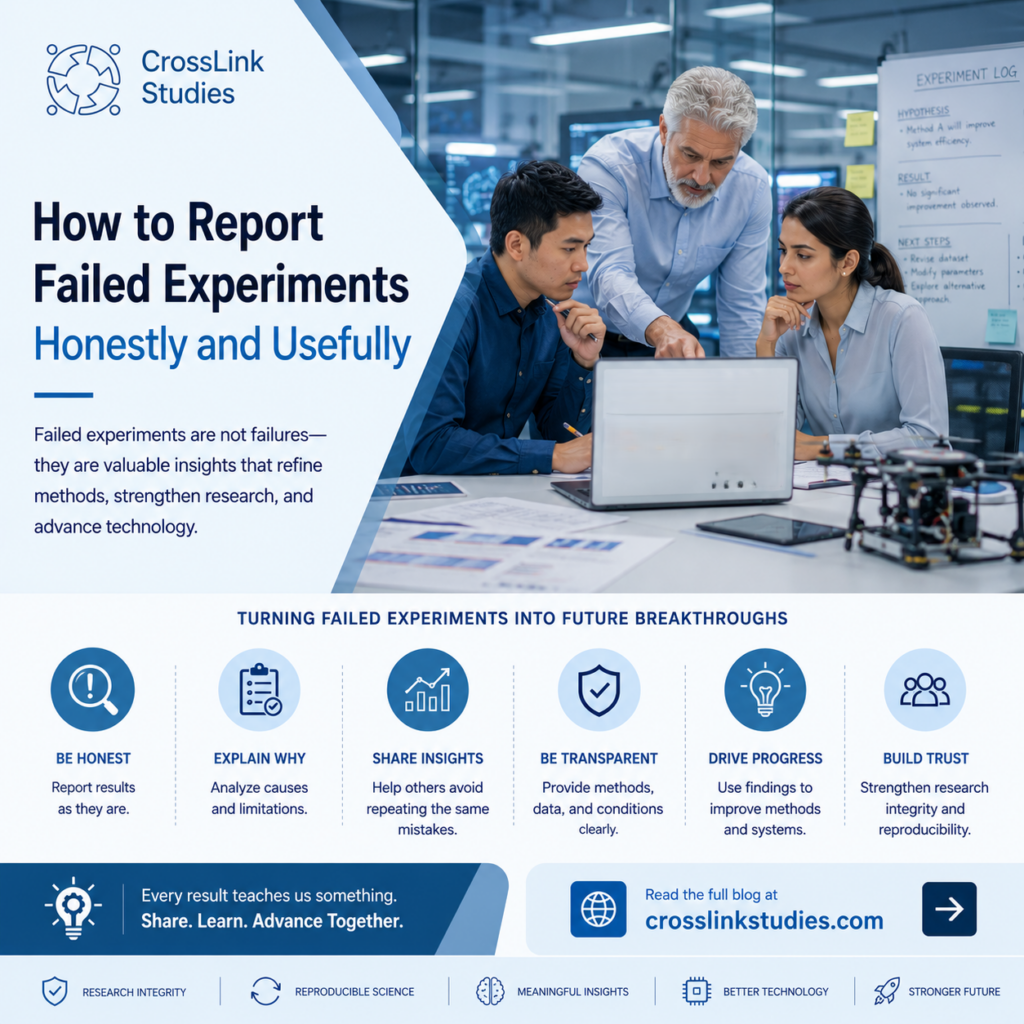
Understanding Failed Experiments in Research
A failed experiment does not necessarily mean the research lacks value. In many cases, experiments fail because assumptions were incomplete, datasets were insufficient, system environments were unstable, or proposed methods could not adapt to real-world complexity.
In computer engineering and emerging technology research, failed outcomes may include:
- AI models producing inconsistent predictions,
- cybersecurity systems failing under dynamic attacks,
- IoT architectures experiencing scalability limitations,
- or optimization techniques increasing computational overhead instead of reducing it.
These findings reveal important operational realities that successful experiments may overlook.
Research becomes scientifically meaningful not only through successful validation but also through identifying limitations and constraints.
Why Honest Reporting Matters
One major challenge in modern academic publishing is selective reporting. Researchers sometimes publish only positive findings while ignoring unsuccessful experiments or contradictory outcomes. This creates publication bias and produces an incomplete understanding of technological performance.
Honest reporting matters because it improves scientific transparency, supports reproducibility, prevents duplication of ineffective methods, and strengthens methodological reliability. In rapidly evolving disciplines such as artificial intelligence, edge computing, robotics, ubiquitous computing, and autonomous systems, transparent reporting is essential for responsible scientific progress.
Focus on Analysis, Not Failure
One common mistake when discussing failed experiments is presenting them emotionally or defensively. Professional academic writing should avoid language that frames the research as wasted effort.
Weak examples include:
“Unfortunately, the experiment failed.” or “The proposed system did not work properly.”
Instead, strong scholarly writing focuses on analytical insight. For example:
“Experimental evaluation identified significant scalability limitations under heterogeneous deployment conditions, indicating the need for adaptive optimization strategies.”
Explain Why the Experiment Failed
A failed experiment becomes useful when researchers critically analyze the reasons behind the outcome. Strong discussions often examine dataset imbalance, parameter sensitivity, hardware limitations, algorithmic assumptions, computational inefficiencies, environmental variables, or system integration challenges.
Maintain Methodological Transparency
UTJ prioritize reproducibility and methodological clarity. Failed experiments should therefore include detailed experimental settings, system configurations, evaluation metrics, baseline comparisons, and testing environments.
Transparent reporting allows other researchers to verify findings, understand system limitations, and improve future implementations. This is especially important in computational research where reproducibility challenges remain widespread. Methodological transparency demonstrates scientific integrity and strengthens research credibility even when outcomes are not successful.
Avoid Manipulating or Hiding Results
Researchers sometimes feel pressure to modify experiments, selectively remove data, or overstate findings to make results appear successful. However, this weakens scientific trust and reduces research quality.
Professional research ethics require accurate data representation, objective interpretation, and honest discussion of limitations. Strong academic writing acknowledges uncertainty rather than hiding it. For example, instead of exaggerating weak findings, researchers should discuss confidence limitations, operational constraints, or inconsistent system performance. Transparent limitation reporting is considered a strength in high-quality scholarly communication.
Show the Contribution of the Failed Experiment
A failed experiment still contributes knowledge when it helps refine methodologies, challenge theoretical assumptions, improve system design, or guide future investigations. Research contribution should therefore be evaluated by the quality of insight generated, not solely by experimental success.
Failed Experiments and Responsible Innovation
In emerging technology research, responsible innovation requires acknowledging both strengths and weaknesses of technological systems. Publishing only successful outcomes creates unrealistic expectations and reduces scientific reliability.
Failed experiments encourage evidence-based innovation, balanced technological evaluation, and more realistic system development practices. This is particularly important in areas such as AI governance, autonomous systems and cybersecurity, In computer engineering and emerging technology disciplines, unsuccessful experiments often reveal important limitations, operational challenges, and methodological insights that strengthen future innovation. High-quality research is not defined only by successful validation but by the clarity, rigor, and reliability of the knowledge it contributes. For CLS journals like UTJ, impactful scholarship comes from transparent investigation, analytical depth, and evidence-based discussion, even when the experimental outcome is unexpected or unsuccessful.
