
How to Write a Perspective Article on Emerging Technology Debates?
Emerging technologies continuously reshape scientific research, industrial systems, social interaction, healthcare, education, cybersecurity, and global economies. Innovations such as Artificial Intelligence (AI), generative AI, Internet of Things (IoT), quantum computing, digital twins, block chain, autonomous robotics, extended reality, and cyber-physical systems are creating unprecedented opportunities while simultaneously generating complex ethical, technical, and societal debates.
Unlike traditional research papers that primarily focus on experiments or system development, perspective articles aim to provide informed scholarly interpretation, conceptual analysis, and forward-looking arguments regarding the direction of a field. Ubiquitous Technology Journal (UTJ), published by Crosslink Studies, encourages scholarly contributions that analyze emerging technological trends, interdisciplinary innovation, ethical challenges, and future-oriented computing systems within ubiquitous and intelligent environments.
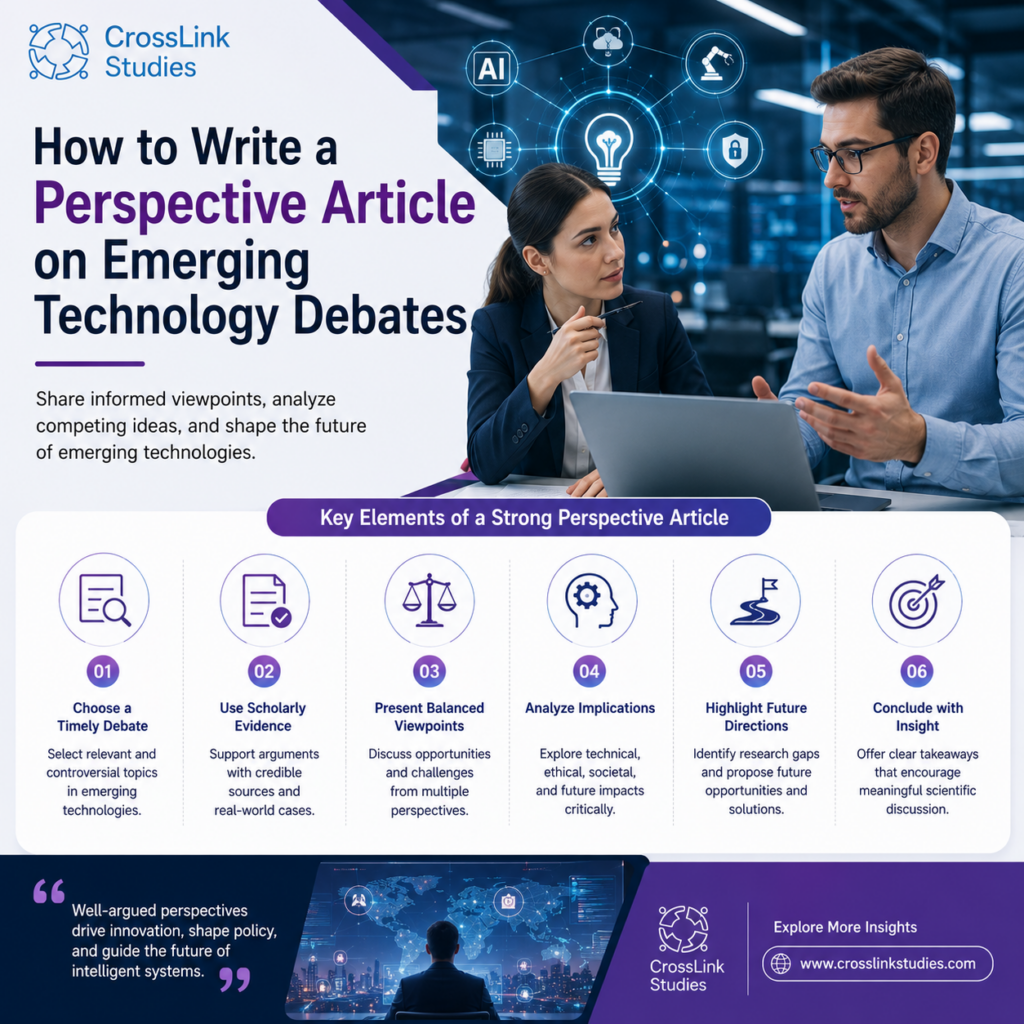
Understanding the Purpose of a Perspective Article
A perspective article differs significantly from a research paper, systematic review, or survey article. Its primary purpose is not to present new experimental results or summarize all existing literature. Instead, it seeks to interpret emerging developments, evaluate competing ideas, identify unresolved concerns, and propose future directions within a rapidly evolving research area. Perspective articles are particularly valuable in technology-related disciplines because innovation often advances faster than regulatory frameworks, ethical standards, industrial readiness, or societal adaptation. As a result, many scientific questions remain open to debate.
Selecting a Debate Worth Discussing
The foundation of a strong perspective article lies in selecting a meaningful and timely debate. Weak topics often fail because they discuss issues that are already widely accepted or insufficiently important to generate scholarly interest.
An effective perspective topic generally includes scientific uncertainty, conflicting viewpoints, rapid technological development, ethical or societal implications and methodological disagreements. In fields related to ubiquitous technology, strong debate-oriented topics may include ethical governance of AI systems, security risks in IoT ecosystems, human dependence on autonomous technologies and trustworthiness of AI-generated scientific content.
UTJ’s interdisciplinary scope covering AI, IoT, distributed systems, ubiquitous computing, intelligent environments, robotics, and cyber-physical systems provides an ideal academic context for such perspective-based discussions.
Building Arguments Through Scholarly Evidence
One of the most important characteristics of a high-quality perspective article is evidence-based argumentation. Although the article expresses interpretation and scholarly viewpoint, its arguments must remain grounded in credible scientific evidence rather than personal opinion alone.
Authors should support their perspectives through:
- Peer-reviewed journal articles.
- Systematic reviews.
- Technical reports.
- Policy documents.
- Industrial case studies.
- Recent conference findings.
- Verified technological developments.
Maintaining Balance in Technology Debates
A common weakness in many perspective manuscripts is excessive bias toward one viewpoint. High-impact journals typically favor balanced analytical discussion that acknowledges both opportunities and limitations.
For instance, an article examining AI-driven automation should discuss productivity improvements, intelligent decision-making capabilities and economic efficiency benefits. At the same time, it should also evaluate job displacement concerns, ethical governance issues and bias and fairness limitations.
Structuring a Perspective Article Professionally
A professional perspective article should follow a clear and logical structure consistent with scholarly publishing standards.
A commonly effective structure includes:
- Introduction
- Background of the Emerging Debate
- Current Technological Developments
- Competing Perspectives or Challenges
- Ethical, Societal, or Scientific Implications
- Future Research Directions
- Author Perspective and Recommendations
- Conclusion
Addressing Ethical and Societal Dimensions
Modern technology debates increasingly extend beyond technical performance into ethical, legal, environmental, and societal domains. As technologies become more integrated into everyday life, perspective articles must examine how these innovations affect individuals, institutions, industries, and global systems.
Several major themes currently shaping technology debates include:
- Responsible AI governance.
- Algorithmic fairness and bias.
- Data privacy protection.
- Human autonomy in intelligent systems.
- Sustainable computing practices.
- Digital inequality and accessibility.
- Cybersecurity resilience.
- Ethical robotics and autonomous systems.
Identifying Future Research Opportunities
One of the defining strengths of impactful perspective articles is their ability to guide future research directions. Instead of focusing exclusively on current problems, strong perspective papers identify where scientific investigation should move next.
Future-oriented discussion may include new interdisciplinary collaborations, emerging methodological needs, standardization requirements and ethical governance frameworks. UTJ particularly values future-oriented technological research that combines innovation with practical relevance, interdisciplinary integration, and analytical depth within ubiquitous computing ecosystems.
Writing Style and Scholarly Presentation
Perspective articles should maintain a formal, analytical, and intellectually engaging writing style. The language should remain professional while still encouraging thoughtful discussion and conceptual exploration.
Authors should avoid emotional language, unsupported claims, excessive speculation, and informal commentary. Instead, the article should emphasize clarity, logical argumentation and evidence-based interpretation. Figures, conceptual frameworks, comparison tables, and debate-oriented diagrams can further strengthen the manuscript by visually organizing complex arguments and technological relationships. Proper citation formatting, originality, and ethical writing practices are also essential because perspective articles often synthesize insights from multiple sources and emerging debates.
For CLS impactful perspective articles are expected to combine technological understanding, interdisciplinary insight, ethical awareness, and evidence-based argumentation to contribute constructively to contemporary scientific debates. Ultimately, the most influential perspective articles are those that do not simply react to technological change, but help shape how future innovation is understood, governed, and responsibly developed within society.