
Turning a Literature Matrix into a Critical Review
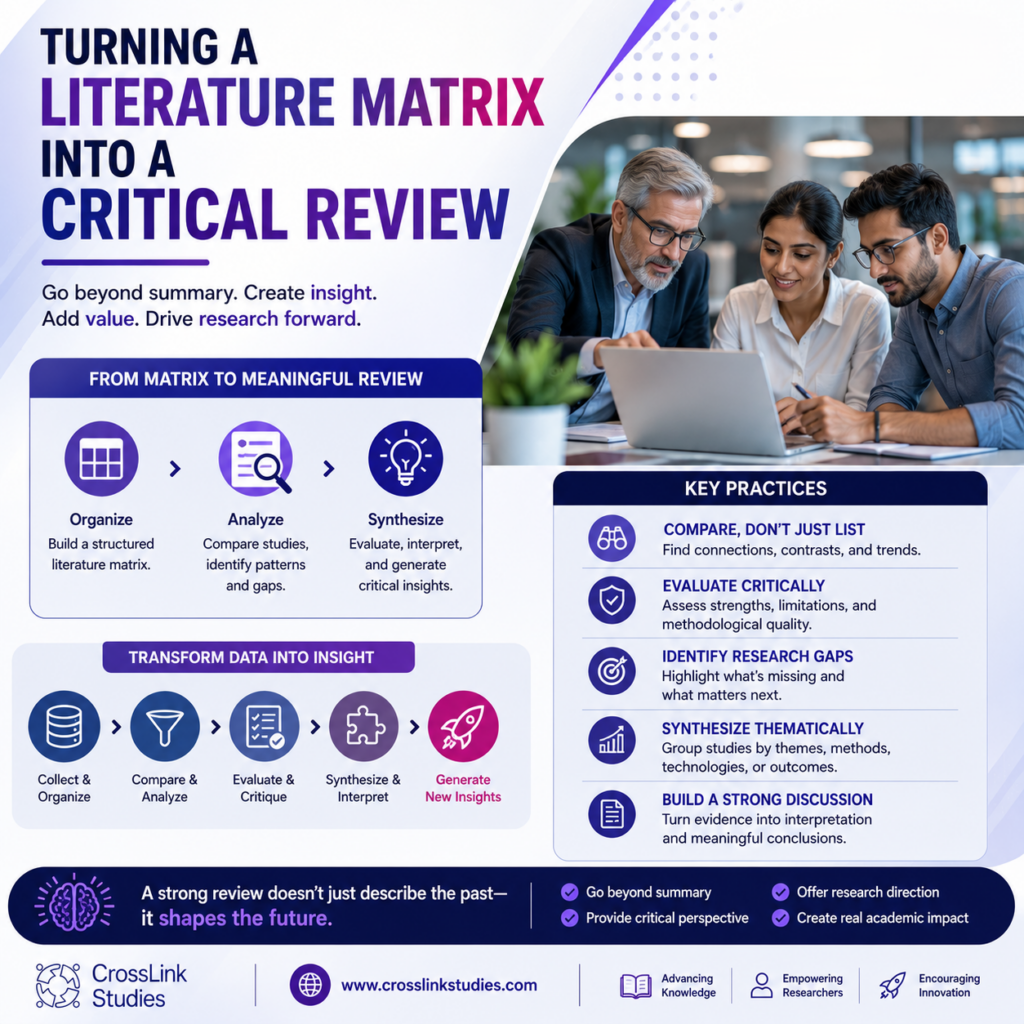
A literature matrix is one of the most valuable organizational tools in academic research, particularly when preparing review articles, systematic reviews, and theoretical studies. However, many researchers make a critical mistake: they stop at summarizing studies instead of transforming the collected literature into meaningful scholarly analysis.
Crosslink Studies (CLS) and Ubiquitous Technology Journal (UTJ) authors are expected to demonstrate analytical depth, structured synthesis, and evidence-based discussion throughout review manuscripts. Simply listing previous studies rarely meets the expectations of modern peer-reviewed publishing.
What Is a Literature Matrix?
A literature matrix is a structured table researchers use to organize and compare scholarly studies during the literature review process. Typically, a literature matrix includes Author and year, research objectives, methodology, dataset or sample, key findings, limitations, research gaps. The matrix acts as a research management tool that helps authors track studies systematically and compare evidence across multiple publications.
Why Summary Alone Is Not Enough
One of the most common weaknesses in review manuscripts is descriptive reporting without critical interpretation. A strong critical review goes further by asking:
- Which methodologies are most effective?
- What limitations repeatedly appear?
- Which datasets dominate the field?
- What contradictions exist between findings?
- Which research areas remain underexplored?
- How has the field evolved over time?
The Purpose of a Critical Review
A critical review evaluates existing literature systematically while developing scholarly interpretation and intellectual contribution. High-quality critical reviews aim to compare methodologies, analyze strengths and weaknesses, identify research trends, detect inconsistencies and evaluate evidence quality.
Step 1: Organize the Literature Matrix Strategically
Before writing begins, the literature matrix should be reorganized into analytical categories rather than remaining as isolated study entries. Researchers can group studies by:
Research Themes
Artificial intelligence applications, cybersecurity Frameworks, IoT Architectures and educational Technologies.
Methodologies
Quantitative studies, qualitative studies, experimental research and hybrid models.
Technologies or Algorithms
Machine learning models, deep learning frameworks, block chain approaches and cloud computing systems.
Time Periods
Foundational studies, emerging approaches and recent advancements. Thematic organization helps researchers identify patterns across studies more effectively.
Step 2: Compare Studies Instead of Listing Them
A critical review synthesizes relationships between studies rather than discussing papers individually.
Weak structure:
“Author A found this. Author B found that.”
Improved structure:
“Recent studies consistently demonstrate the effectiveness of deep learning models in predictive analytics; however, many rely on small datasets and lack real-world validation.”
The second approach creates analysis, comparison, and interpretation simultaneously.
Step 3: Identify Research Patterns and Trends
A literature matrix allows researchers to identify recurring themes and methodological patterns.
Important questions include:
- Which research methods dominate the field?
- Which technologies are most frequently studied?
- Are researchers using similar datasets repeatedly?
- Which regions or industries are underrepresented?
- What theoretical frameworks appear most often?
Step 4: Critically Evaluate Strengths and Weaknesses
A high-quality critical review evaluates evidence quality instead of accepting all findings equally.
Authors should assess:
Methodological Limitations
Small sample sizes, lack of validation, limited experimental settings and poor reproducibility.
Theoretical Weaknesses
Weak conceptual frameworks, missing interdisciplinary perspectives and inconsistent definitions
Technical Limitations
Computational inefficiency, dataset imbalance and scalability issues.
Step 5: Identify Research Gaps Clearly
Research gaps are among the most valuable outputs of a critical review. However, gaps should emerge logically from evidence synthesis rather than vague assumptions. Strong gap identification demonstrates deep engagement with the literature.
Step 6: Build Analytical Discussion Sections
Instead of structuring the review as isolated paper summaries, authors should develop discussion-oriented sections. Example structure:
AI Models Used in Smart Healthcare
- Common algorithms
- Performance comparisons
- Dataset limitations
- Ethical concerns
- Research opportunities
This structure encourages synthesis and critical discussion naturally.
Step 7: Maintain Methodological Transparency
Critical reviews should still maintain transparency regarding database selection, search strategies, inclusion and exclusion criteria, screening procedures and study categorization methods. Transparent methodology strengthens reproducibility and aligns with modern review standards expected by peer-reviewed journals.
Common Mistakes When Writing Critical Reviews
Many review articles remain descriptive because authors fail to move beyond the literature matrix. Common issues include:
- Listing Studies Sequentially
- Lack of Comparative Analysis
- Ignoring Contradictions
- Weak Research Gap Identification
- Overdependence on Citation Quantity
Best Practices for CLS and UTJ Authors
Authors preparing review manuscripts for CLS journals should focus on evidence synthesis rather than descriptive reporting. Transform data into insight, prioritize analytical structure, evaluate research quality, focus on research gaps, maintain clear methodology. Document the literature selection and synthesis process transparently.
These practices improve scholarly impact and align with the methodological expectations emphasized in UTJ review standards.
The Role of Critical Reviews in Scholarly Publishing
Critical reviews play an essential role in advancing scientific understanding. They help researchers understand the current state of a field, identify unresolved challenges and compare competing methodologies. A well-written critical review is not merely informative; it becomes a scholarly contribution in its own right.
For researchers submitting manuscripts to CLS and UTJ, the ability to critically analyze literature rather than merely summarize it significantly improves review quality, peer-review outcomes, and academic impact. Strong critical reviews demonstrate methodological rigor, intellectual depth, and research maturity, qualities that define high-quality scholarly publishing. By moving beyond descriptive summaries and focusing on evidence-based synthesis, authors can produce review articles that genuinely contribute to the advancement of technology and interdisciplinary research.