
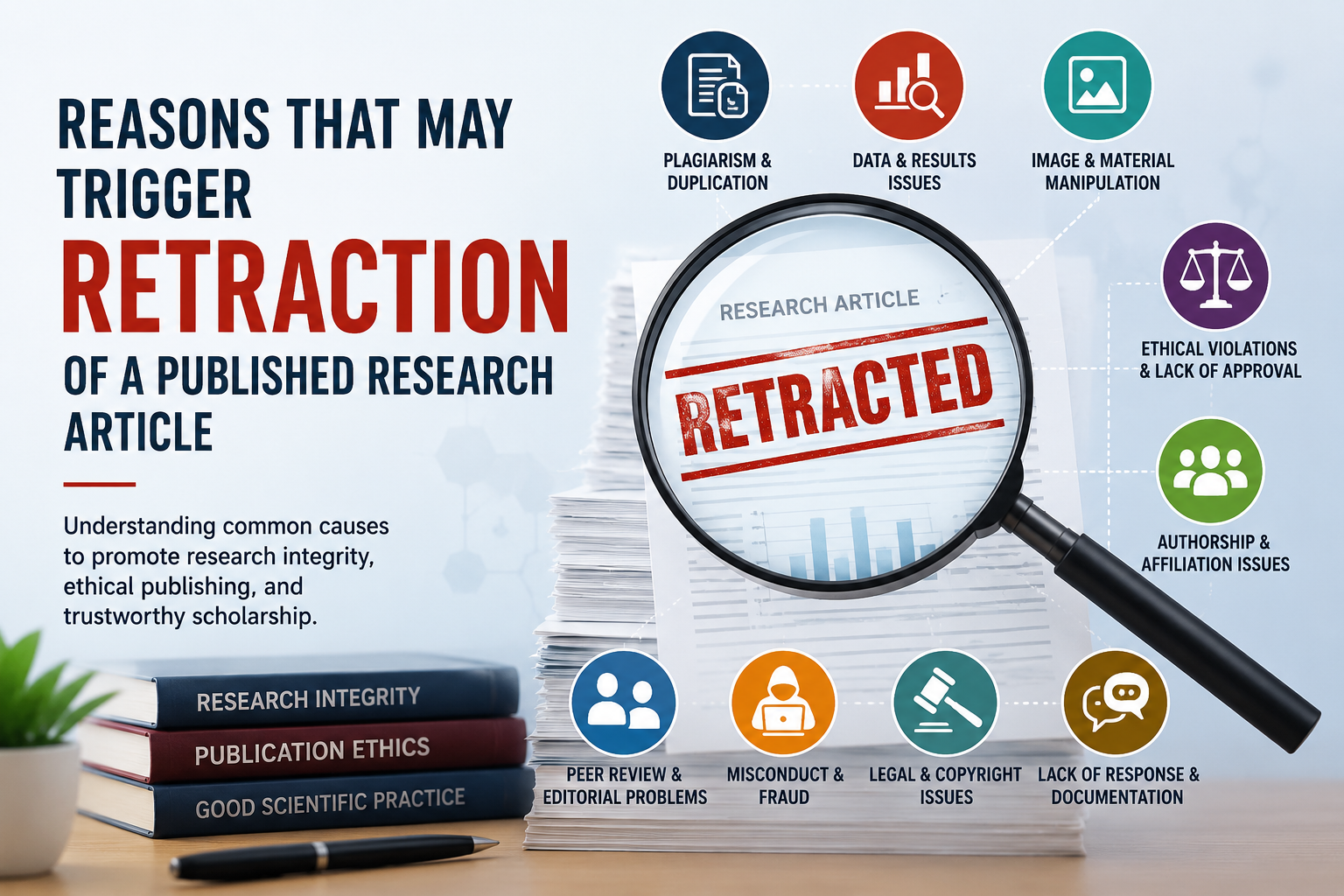
Reasons That May Trigger Retraction of a Published Research Article
Retraction is one of the most serious actions in scholarly publishing. It is used when a published research article contains major problems that affect its reliability, integrity, originality, ethical compliance, or legal status. A retraction does not always mean that misconduct occurred; in some cases, it results from honest error, publisher mistakes, legal issues, or the discovery that results cannot be reproduced.
As per Crosslink Studies [CLS] defined rules, this post summarizes many reasons that may lead journals or publishers to retract published research, including author-related issues, data problems, plagiarism, peer-review manipulation, ethical violations, legal disputes, and unreliable results. The document lists these reasons in Arabic and English and notes that the classification is based on Retraction Watch terminology.
1. Problems Related to Data, Results, and Conclusions
A published article may be retracted when its data, results, or conclusions are found to be unreliable. This may include:
- Errors in data collection, analysis, calculations, or interpretation.
- Use of unreliable or unavailable original data.
- Fabrication or falsification of data.
- Manipulation of results to support a desired conclusion.
- Failure to reproduce the results using the same materials and methods.
For researchers in sciences, computer science, software engineering, information systems, and engineering fields, the reproducibility of results is essential. When datasets, algorithms, experimental protocols, simulations, or statistical analyses cannot be verified, the credibility of the published work becomes questionable.
2. Plagiarism, Duplication, and Improper Reuse
Retraction may also occur when a publication contains plagiarized or duplicated content. This can involve:
- Plagiarism of text, images, data, or ideas.
- Duplicate publication of the same article or parts of it.
- Reuse of previously published material without proper citation.
- Salami slicing, where one study is divided into multiple smaller papers to increase publication count.
- Content taken from a thesis, dissertation, translation, or peer-review process without proper attribution.
Authors should ensure that every reused figure, paragraph, dataset, or method description is properly cited and that copyright permissions are obtained where required.
3. Image, Figure, and Material Manipulation
Many retractions occur because of problems with images, figures, or experimental materials. These include:
- Image duplication.
- Image manipulation or inappropriate editing.
- Fabrication or falsification of figures.
- Use of unreliable images.
- Errors in experimental materials, cell lines, tissues, software tools, or laboratory protocols.
- Contamination of materials, samples, or cell lines.
In technical and computational research, similar concerns may apply to manipulated screenshots, altered graphs, unverifiable benchmark results, or selective reporting of experimental outputs.
4. Ethical Violations and Lack of Approval
Ethical compliance is a core requirement in high-quality research. A paper may be retracted if the authors failed to obtain required approvals or violated ethical standards. Common examples include:
- Lack of institutional review board approval.
- Lack of approval for human or animal studies.
- Missing or withdrawn informed consent.
- Concerns about human participant welfare.
- Concerns about animal welfare.
- Violations of journal, publisher, or institutional ethics policies.
Researchers should obtain approvals before starting the study, keep documentation, and clearly report ethical compliance in the manuscript.
5. Authorship, Affiliation, and Conflict of Interest Issues
A research article may be retracted if there are serious concerns about who contributed to the work or whether affiliations were represented honestly. Retraction triggers may include:
- False or forged authorship.
- False or forged institutional affiliation.
- Lack of approval from one or more authors.
- Authorship disputes.
- Unreported conflicts of interest.
- Complaints about authors, institutions, companies, or third parties.
Transparent authorship contribution statements, accurate affiliations, and complete conflict-of-interest disclosures help prevent such problems.
6. Peer Review and Editorial Process Problems
The integrity of peer review is central to scholarly publishing. Retraction may occur when the review or editorial process was compromised, such as through:
- Fake peer review.
- Manipulated reviewer identities.
- Peer-review conflicts of interest.
- Editorial misconduct.
- Rogue editor behavior.
- Journal or publisher errors in the review process.
Authors should submit only through legitimate journal systems, avoid suggesting fabricated reviewers, and ensure that all communication with journals is transparent.
7. Misconduct, Paper Mills, and Fraudulent Content
Some retractions result from intentional misconduct or organized publication fraud. Examples include:
- Fabricated papers.
- Paper mill submissions.
- Hoax papers.
- Misconduct by authors, institutions, companies, or third parties.
- Computer-generated or AI-generated content used deceptively.
- Fabricated references, citations, or results.
The use of generative AI tools must be transparent and compliant with journal policy. AI-assisted writing should never replace genuine research, original analysis, proper citation, or author accountability.
8. Legal, Copyright, and Ownership Issues
Legal and ownership disputes may also trigger retraction. These may involve:
- Copyright claims.
- Unauthorized use of protected material.
- Patent or ownership disputes.
- Civil or criminal legal proceedings.
- Legal threats involving the article or its content.
- Transfer of copyright or ownership complications.
Before submission, authors should confirm that all figures, datasets, software, instruments, and third-party materials are used legally and with appropriate permissions.
9. Lack of Author Response or Documentation
In some cases, a journal may request clarification, original data, ethics documentation, or explanation of concerns. Retraction may follow if the corresponding author does not respond or cannot provide the required evidence. This includes:
- Failure to respond to journal or publisher inquiries.
- Failure to provide original data or images.
- Failure to provide proof of ethical approval.
- Failure to clarify concerns about methods, results, or authorship.
Authors should keep complete research records, including raw data, code, analysis files, approval letters, consent forms, peer-review correspondence, and version histories.
10. Publisher, Journal, or Third-Party Errors
Not every retraction is caused by author misconduct. Some cases result from errors by the journal, publisher, or third parties. These may include:
- Accidental duplicate publication.
- Publisher production errors.
- Incorrect article status or notices.
- Temporary removal of content.
- Retraction and replacement with a corrected version.
- Removal because the article is outdated or replaced.
In such cases, retraction may be part of correcting the scholarly record rather than assigning blame.
How Researchers Can Reduce Retraction Risk
Researchers can reduce the risk of retraction by applying strong publication ethics from the beginning of the project:
- Design studies with clear methods, valid data, and reproducible workflows.
- Keep original datasets, images, code, and analysis files securely stored.
- Use plagiarism detection and reference verification before submission.
- Obtain all required ethical approvals before conducting the research.
- Disclose conflicts of interest and funding sources.
- Confirm that all authors approve the final manuscript.
- Avoid duplicate publication and salami slicing.
- Follow the target journal’s author guidelines carefully.
- Respond promptly and professionally to editorial inquiries.
- Use AI tools responsibly and transparently, according to journal policy.
Conclusion
Retraction protects the integrity of the scholarly record. For researchers and scientists, understanding the reasons behind retraction is essential for producing reliable, ethical, and publishable work. High-quality research is not only about novel findings; it also requires transparent methods, valid data, ethical approval, proper authorship, accurate citations, and responsible communication with journals and publishers.
By following publication ethics and maintaining strong research documentation, authors can reduce the risk of retraction and contribute more confidently to trustworthy scientific knowledge.
