
Writing Contributions for AI, Software, and Engineering Manuscripts
In high-impact academic publishing, the “contribution” section is not a formality, it is the core value proposition of a manuscript. Editors and reviewers in leading journals prioritize submissions that clearly articulate what is new, why it matters, and how it advances the field.
For Crosslink Studies (CLS)and the Ubiquitous Technology Journal (UTJ), which emphasize interdisciplinary innovation across AI, software systems, and engineering, a well-defined contribution is essential for editorial acceptance, peer-review success, and research visibility.
What is a Research Contribution?
A research contribution defines the original intellectual advancement introduced by a study. It answers:
- What new knowledge, method, or system is introduced?
- How does it differ from existing work?
- Why is it significant for the field?
In engineering and AI domains, contributions typically fall into:
- Algorithmic Contributions (e.g., novel ML models, optimization techniques)
- System Contributions (e.g., architectures, frameworks, platforms)
- Experimental Contributions (e.g., datasets, benchmarks, validation studies)
- Theoretical Contributions (e.g., proofs, models, analytical insights
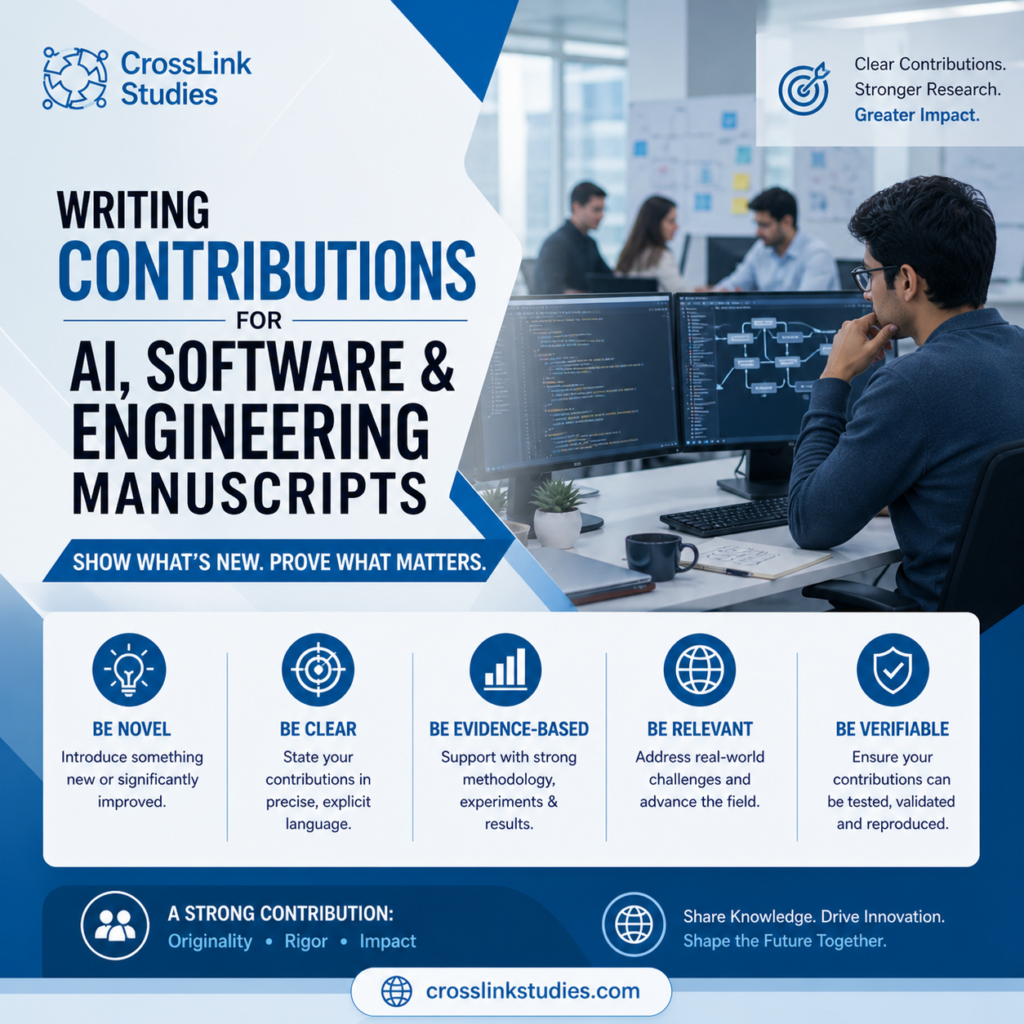
CLS guidelines emphasize that authorship itself is tied to substantial intellectual contribution, including design, analysis, and interpretation of results. This highlights how central “contribution” is to both authorship and publication quality.
Where to Present Contributions in a Manuscript
Top journals follow a consistent pattern:
1. Introduction Section (Primary Location)
- Contributions are usually listed at the end of the introduction
- Often presented as bullet points or numbered statements
2. Abstract
- A concise version of the contribution should be included
- Must highlight novelty and impact clearly
3. Discussion/Conclusion
- Reinforces how contributions advance the field
- Connects results to broader implications
CLS structure guidelines confirm that research papers must clearly link objectives, methods, and results to meaningful contributions.
Characteristics of High-Quality Contributions
✔ Novelty
- Introduces something new or significantly improved
- Avoids incremental or trivial changes
✔Clarity
- Written in precise, unambiguous language
- Easily identifiable by reviewers
✔ Technical Depth
- Demonstrates methodological rigor
- Supported by experiments, simulations, or proofs
✔ Relevance
- Addresses real-world or theoretical challenges
- Aligns with journal scope (AI, IoT, smart systems, etc.)
✔ Verifiability
- Can be tested, reproduced, or validated
Writing Contributions Effectively
Weak Example
“This paper studies AI techniques in smart systems.”
Strong Example
“This paper proposes a hybrid deep learning framework that improves anomaly detection accuracy by 18% in IoT-based smart grid systems.”
Best Practices
- Use action-oriented verbs: propose, develop, evaluate, demonstrate
- Quantify results where possible
- Avoid vague claims like “novel” without evidence
- Keep each contribution concise and distinct
Recommended Contribution Structure (UTJ-Aligned)
Use a numbered format for clarity:
The main contributions of this work are as follows:
- A novel AI-based predictive model for real-time anomaly detection in IoT systems.
- A scalable architecture integrating edge and cloud computing for latency reduction.
- A comprehensive evaluation using real-world datasets demonstrating improved performance over existing methods.
This format aligns with top-tier journal practices and improves readability during peer review.
Common Mistakes to Avoid
❌ Vague or Generic Statements
- “We present a new system” (without explaining how it is new)
❌ Mixing Contributions with Results
- Contributions should state what is done, not detailed findings
❌ Over claiming Novelty
- Claims must be supported by literature comparison
❌ Too Many Contributions
- Focus on 2–4 strong contributions, not a long list
❌ Misalignment with Results
- Every stated contribution must be validated in results section
Contribution Types in AI & Engineering (CLS Focus)
For CLS and UTJ, strong manuscripts often include:
AI Research
- New models, architectures, or training strategies
- Performance improvements validated with benchmarks
Software Engineering
- Frameworks, tools, or system designs
- Scalability, efficiency, or reliability enhancements
Engineering Systems
- IoT, cyber-physical systems, embedded solutions
- Real-world deployment or simulation validation
Why Contributions Matter in Peer Review
Reviewers typically evaluate: Is the contribution original and significant? Is it clearly stated and easy to identify, Is it supported by evidence and methodology? A poorly written contribution section can lead to desk rejection, reviewer confusion and lower acceptance probability.
Conversely, a strong contribution statement enhances clarity and credibility, speeds up review process and increases citation potential. Writing strong contributions is a strategic skill in academic publishing, particularly in AI, software, and engineering disciplines. For authors submitting to Crosslink Studies (CLS) and UTJ, contributions must be Precise in definition, technically grounded, scientifically validated and aligned with real-world impact.
In an increasingly competitive research landscape, clearly articulated contributions are not just a requirement, they are the key to transforming research into publishable, high-impact knowledge.