
How Data Availability Statements Improve Trust in Research
In today’s data-driven research environment, transparency is no longer optional, it is essential. One of the most effective ways journals and authors promote transparency is through Data Availability Statements (DAS).
Leading academic publishers increasingly require authors to clearly state where, how, and under what conditions their research data can be accessed. For journals like Ubiquitous Technology Journal (UTJ), especially in AI, computing, and interdisciplinary fields, data availability plays a critical role in ensuring credibility, reproducibility, and trust.
What Is a Data Availability Statement?
A Data Availability Statement is a section in a manuscript that explains whether the data supporting the study are available, where the data can be accessed (repository, supplementary files, etc.), any restrictions on access (privacy, confidentiality, licensing). This statement provides readers, reviewers, and editors with clear guidance on data transparency.
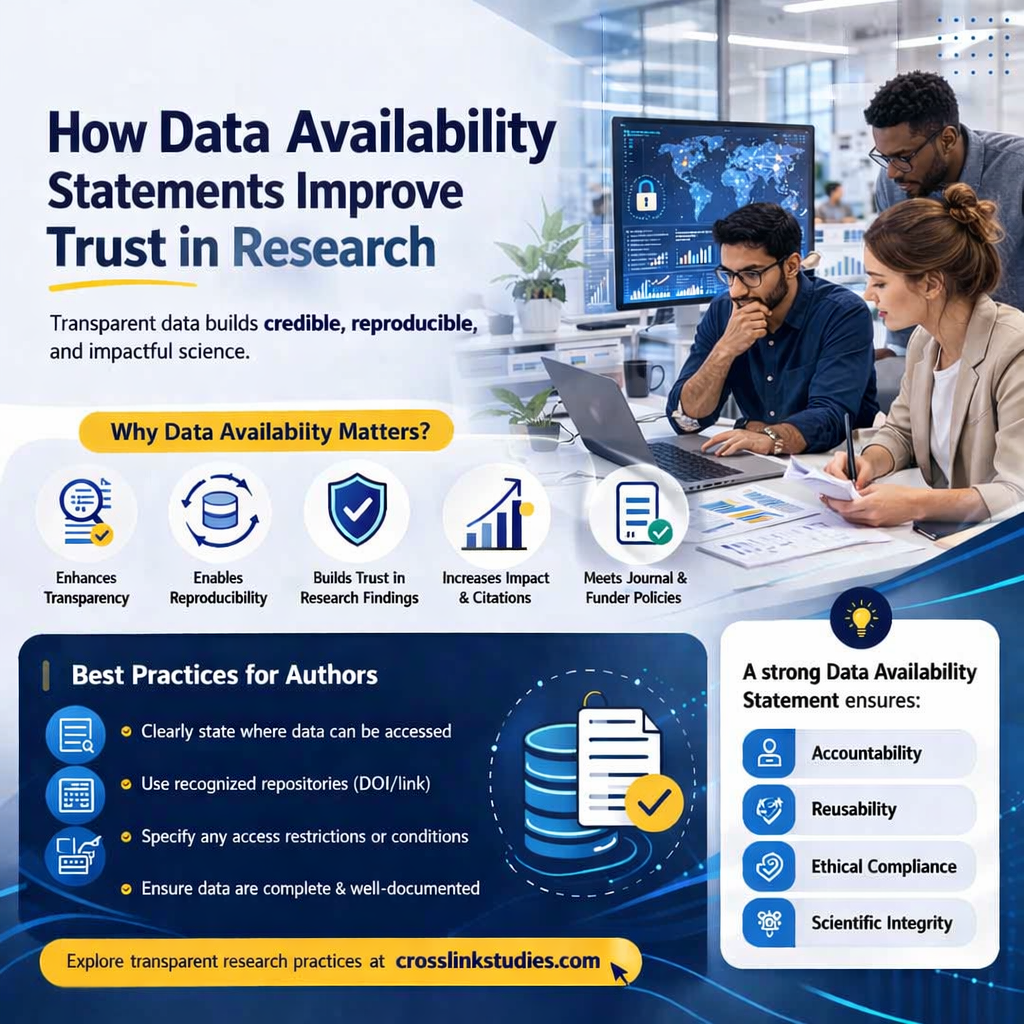
Why Data Availability Matters
Enhancing Research Transparency
Transparency allows others to understand how results were produced. When data are openly described or shared readers can verify findings, reviewers can assess robustness, editors can ensure compliance with standards. Transparency is a cornerstone of credible scientific communication.
Supporting Reproducibility
Reproducibility is fundamental to scientific progress. Data availability statements enable other researchers to replicate analyses, allow validation of results, strengthen confidence in conclusions. Without access to underlying data, reproducibility becomes limited or impossible.
Building Trust in Research Findings
Trust in research depends on openness. When authors clearly disclose data availability, it signals honesty and accountability, reduces suspicion of data manipulation or bias, encourages wider acceptance of findings. In fields like AI and data science, where models rely heavily on datasets, this trust is even more critical.
Increasing Research Impact and Citations
Studies have shown that research with accessible data often receives higher visibility, greater reuse by other researchers, increased citation rates. Data sharing enhances the reach and influence of scholarly work.
Aligning with Publisher and Funding Policies
CLS and funding agencies increasingly require mandatory data availability statements, deposition of datasets in recognized repositories. Compliance ensures smoother peer review and reduces delays in publication.
Types of Data Availability Statements
Authors can choose the appropriate type depending on their study:
✔ Open Data
Data are publicly available in a repository (e.g., institutional or domain-specific repositories).
✔ Restricted Data
Data are available upon reasonable request due to privacy or legal constraints.
✔ No New Data Generated
Applicable for theoretical or review-based studies.
✔ Data Included in Article
All relevant data are provided within the manuscript or supplementary files.
Best Practices for Writing a Strong Data Availability Statement
To meet international standards, authors should clearly specify where the data are stored (repository name, DOI, link), describe access conditions (open, restricted, request-based), ensure data are properly documented and usable, avoid vague statements like “data available upon request” without explanation, follow journal-specific guidelines. Clarity and precision are essential.
Common Mistakes to Avoid
- Providing incomplete or unclear data access information
- Claiming availability but not actually sharing data
- Ignoring ethical or legal data restrictions
- Using generic statements without context
Such issues can delay review or lead to editorial concerns.
CLS Crosslink Studies Perspective
At Crosslink Studies (CLS), we strongly support open, transparent, and reproducible research practices, particularly in technology and AI-related fields.
We encourage authors to provide clear and verifiable data availability statements, use recognized repositories, ensure ethical handling of sensitive data. Data transparency is not just a requirement it is a commitment to research integrity. In modern scholarly publishing, trusted research is transparent research and data availability is at its core.