
Preparing a Response to Similarity-Check Concerns
In today’s publishing environment, similarity-checking tools have become a standard part of the editorial screening process. Before a manuscript enters peer review, editors often evaluate its textual similarity to previously published literature to ensure originality, transparency, and compliance with publication ethics standards.
For many authors, receiving a notification about similarity concerns can be unsettling. However, a similarity report should not automatically be viewed as an accusation of misconduct. Instead, it serves as a tool that helps editors assess whether overlapping content is appropriately cited, justified, and presented within an ethical scholarly framework.
At Crosslink Studies (CLS), maintaining research integrity is a shared responsibility between authors, reviewers, and editors. Understanding how to respond professionally and transparently to similarity-related questions can significantly improve the efficiency of the editorial process and strengthen confidence in the submitted work.
Why Similarity Reports Require Careful Interpretation
A similarity percentage alone does not determine whether a manuscript is acceptable for publication. Similarity detection software identifies matching text, but it cannot evaluate context, scholarly intent, originality of findings, or the significance of a manuscript’s contribution.
Certain types of overlap may occur naturally in academic writing, including:
- Technical terminology.
- Standard methodological descriptions.
- Properly quoted material.
- References and citations.
- Institutional affiliations.
- Common scientific expressions.
For this reason, editors evaluate not only the quantity of overlap but also the nature and location of the matching content.
Remain Professional and Objective
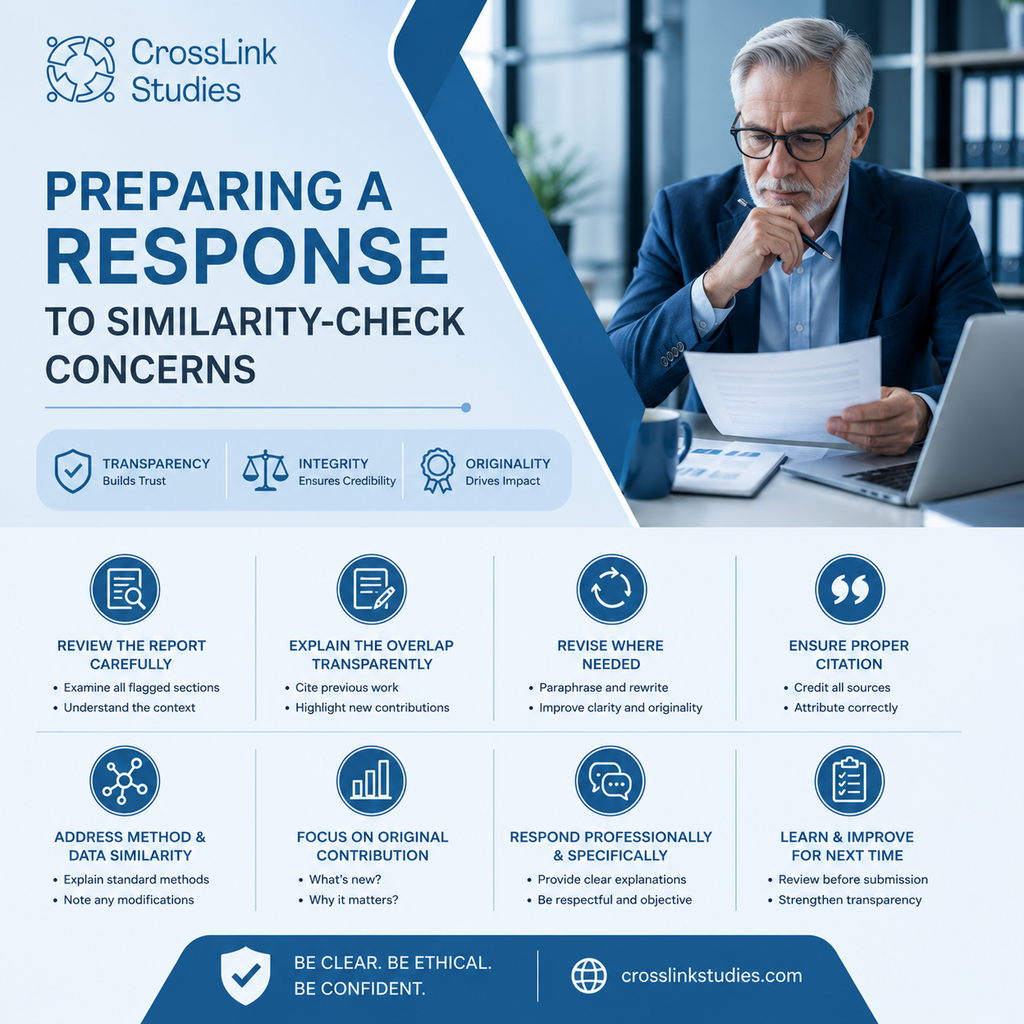
When informed of a similarity concern, the most effective response is a calm, professional, and evidence-based explanation. Authors should avoid viewing editorial inquiries as confrontational. In most cases, editors are simply seeking clarification before proceeding with manuscript evaluation. A constructive response demonstrates:
- Respect for publication ethics.
- Willingness to cooperate.
- Commitment to transparency.
- Understanding of scholarly standards.
Review the Similarity Report Carefully
Before preparing a response, authors should thoroughly examine the areas identified in the similarity report. Consider the following questions:
- Which sections contain overlapping text?
- Are the overlapping sources properly cited?
- Does the overlap involve the author’s previous publications?
- Are there duplicated figures, tables, or data?
- Is the overlap concentrated in methods sections or throughout the manuscript?
- Can any sections be revised for greater originality?
Explain Overlap with Previous Publications Transparently
One of the most common sources of similarity involves an author’s own previously published work. Research often progresses incrementally, and new studies may naturally build upon earlier findings. However, authors should clearly explain how the current manuscript differs from previous publications and identify the novel contributions of the new study.
Address Methodological Similarity Appropriately
Methods sections frequently generate similarity matches because scientific procedures often require consistent descriptions. When overlap occurs in methodology sections, authors should explain whether:
- The same experimental procedures were used.
- Standard protocols were followed.
- The methods were previously published and cited.
- Modifications have been introduced in the current study.
Where feasible, authors can revise repetitive descriptions while preserving technical accuracy and reproducibility. Editors generally recognize that certain methodological similarities may be unavoidable, provided they are properly disclosed and referenced.
Revise Text Where Necessary
If similarity concerns involve extensive textual overlap, revising the manuscript may be the most effective solution. Authors should focus on:
- Rewriting duplicated passages.
- Improving explanations and interpretations.
- Updating literature discussions.
- Expanding analytical insights.
- Clarifying unique contributions.
The goal is not simply to reduce a similarity score but to enhance the originality and clarity of the manuscript. Meaningful revision demonstrates that the manuscript contributes new scholarly value rather than repeating previously published content.
Ensure Proper Citation and Attribution
Many similarity concerns can be addressed through accurate citation practices. Authors should verify that:
- All borrowed concepts are appropriately referenced.
- Previous publications are cited when relevant.
- Adapted figures and tables are acknowledged.
- Direct quotations are properly identified when used.
- Related studies are discussed transparently.
Respond with Specific Evidence
When preparing a response to editors, specificity is essential. Rather than providing general statements, authors should explain:
- Which sections contain overlap.
- Why the overlap occurred.
- Whether citations were included.
- What revisions have been made.
- How the manuscript differs from previous work.
Highlight the Manuscript’s Original Contribution
Regardless of the source of similarity, authors should consistently emphasize what is new in the manuscript. Editors and reviewers ultimately seek evidence that the study advances knowledge within the field.
Novel contributions may include new research findings, enhanced experimental validation, expanded datasets, improved algorithms and additional performance evaluations.
Learn from Similarity Feedback
Similarity-related inquiries can also serve as valuable learning opportunities. Authors who proactively evaluate overlap before submission often improve manuscript quality, citation practices, research transparency, writing originality and publication readiness.
Over time, these improvements contribute to stronger submissions and a more efficient publication process. Rather than viewing similarity checks as obstacles, researchers can use them as tools for strengthening scholarly communication.
Best Practices Before Submission
To minimize similarity concerns before submission, authors should:
- Review related previous publications.
- Cite all relevant prior work.
- Clearly define the manuscript’s novel contribution.
- Revise duplicated text where appropriate.
- Check permissions for reused figures and tables.
- Maintain transparent reporting practices.
- Conduct an internal originality review.
Conclusion
Similarity screening plays an important role in maintaining the integrity and credibility of scholarly publishing. While overlap concerns may initially appear challenging, they can often be resolved through transparency, careful explanation, proper citation, and thoughtful revision.
For authors submitting to Crosslink Studies journals, the most effective response to similarity-check concerns is one grounded in professionalism, evidence, and a clear demonstration of originality. By understanding how similarity reports are evaluated and by communicating openly with editors, researchers can strengthen their manuscripts and contribute to a trustworthy and ethical scholarly record.
Ultimately, the goal is not merely to pass a similarity check but to ensure that every published article delivers a meaningful, original, and well-documented contribution to the advancement of knowledge.

