Licensing Considerations for Research Software and Datasets
Research increasingly depends on software, code, datasets, computational workflows, and digital tools. These materials can be essential to understanding how research findings were produced and to enabling other researchers to reproduce, validate, or extend the work. Yet one important question is often overlooked: Who is allowed to use the software or data, and under what conditions?
A dataset being publicly accessible does not necessarily mean that it is free to reuse. Similarly, placing research code on GitHub does not automatically grant others permission to modify or redistribute it. A clear and appropriate license provides the legal framework that tells users what they may do with research materials and what obligations they must follow.
For authors preparing research for journals such as the Ubiquitous Technology Journal (UTJ), understanding licensing is therefore part of responsible and reproducible research.
Why Licensing Matters in Research
Modern research workflows frequently combine several types of material: original code, open-source libraries, third-party datasets, APIs, pretrained models, public databases, and researcher-generated data. Each component may have different ownership and usage conditions.
Without clear licensing information, potential users may be uncertain whether they can:
- reuse the software;
- modify or redistribute the code;
- use datasets in new studies;
- combine materials with other datasets;
- use the materials commercially;
- publish results based on the materials; or
- create derivative works.
Software and Dataset Licenses Are Not the Same
One of the most important considerations is that software and research data should not automatically be licensed in the same way.
Licensing Research Software
Software licenses determine how users can execute, study, modify, and redistribute code. Common open-source choices include:
- MIT License – permissive and relatively simple, allowing broad reuse with required copyright and license notices.
- Apache License 2.0 – permissive and includes additional provisions concerning patents.
- GNU GPL – a copyleft license that generally requires distributed derivative software to remain under the GPL.
- Mozilla Public License 2.0 – a weaker copyleft approach that provides greater flexibility than the GPL in some situations.
Licensing Research Data
Data require a different approach. For openly shared research datasets, CC0 and CC BY are commonly considered, depending on the creator’s objectives and applicable rights.
CC0 is designed to maximize reuse by placing material as close to the public domain as legally possible. CC BY permits reuse and adaptation while requiring appropriate attribution. Creative Commons’ current guidance identifies CC0 and CC BY as particularly useful approaches for scientific data sharing and does not recommend Noncommercial or No Derivatives restrictions for scholarly or scientific databases intended for reuse.
Check Your Rights Before Applying a License
Researchers should first establish whether they actually have the authority to license the material.
This is particularly important when a project incorporates:
- government or institutional datasets;
- commercial databases;
- data obtained through subscription;
- third-party APIs;
- participant or human-subject data;
- proprietary software;
- datasets supplied under specific terms of use;
- code developed by another researcher; or
- material obtained from multiple sources.
A researcher may have permission to use a dataset for analysis without having permission to redistribute the dataset.
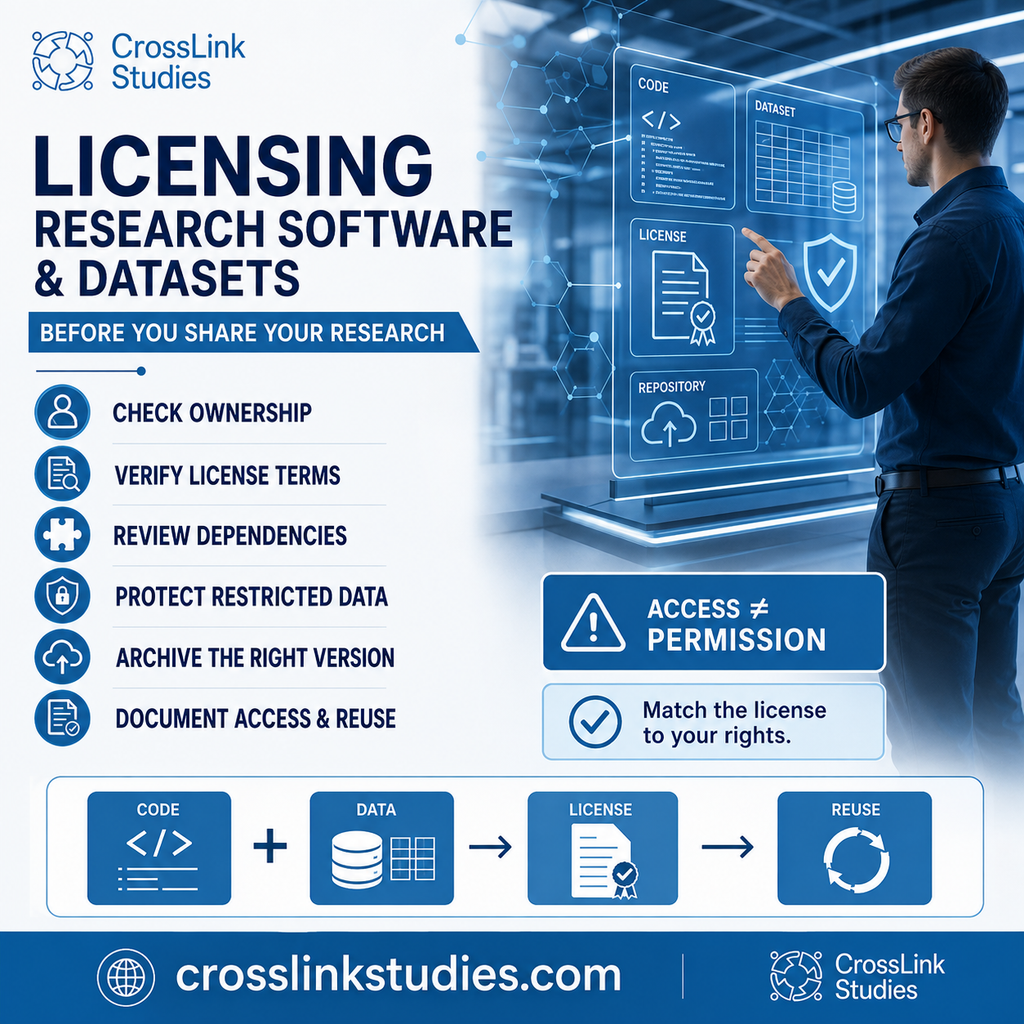
Do Not Confuse Accessibility with Permission
A common misconception is: “If I can download it, I can reuse it.” This is not necessarily true.
A webpage may provide unrestricted access to information while imposing conditions on reproduction, redistribution, commercial use, or derivative works. Researchers should therefore record the source, ownership, license, access conditions, and permitted uses of external datasets and software. This information should ideally be documented during the research process rather than reconstructed immediately before submission.
Consider License Compatibility
Research software rarely operates in isolation. A project may use several external packages, libraries, frameworks, or code components. Before releasing your own software, examine the licenses of these dependencies.
For example, a researcher should not simply select an MIT or Apache license for an entire project without checking whether incorporated components impose additional obligations. Copyleft licenses such as the GPL can create different redistribution requirements from permissive licenses such as MIT or Apache.
A practical approach is to maintain a simple software inventory containing:
| Component | Source | License | Action Required |
| Original research code | Authors | Selected project license | Include license |
| External library | Official repository | MIT | Retain notice |
| External package | Official repository | Apache 2.0 | Retain license information |
| Third-party dataset | Data provider | Restricted | Check redistribution rights |
Protect Sensitive and Restricted Research Data
Not every dataset should be openly released. Research involving identifiable individuals, confidential information, commercially sensitive material, security-sensitive information, or restricted third-party data may require controlled access or other safeguards.
In these situations, researchers should not simply remove a dataset from the publication process. Instead, they should explain the restriction clearly and identify how qualified researchers may obtain access, where appropriate.
Choose a Trusted Repository and Preserve Versions
Where possible, research software and datasets should be deposited in a stable repository rather than relying exclusively on a personal website or an ordinary project page. A persistent identifier, such as a DOI, can help readers locate the exact version associated with a publication. Springer Nature specifically recommends repositories that provide persistent identifiers and notes that a GitHub link alone does not provide the same permanence as a DOI-bearing archival record.
For software, researchers should consider preserving:
Version → Repository → DOI/Persistent Identifier → License → Documentation
Document the License in the Manuscript
A license should not be hidden from readers. Where relevant, authors should provide:
- the name of the software or dataset;
- the repository location;
- the specific version;
- the DOI or persistent identifier;
- the applicable license;
- any access restrictions; and
- instructions or documentation needed for reuse.
What This Means for Crosslink Studies (CLS) Authors
For authors submitting to Crosslink Studies, licensing should be considered alongside reproducibility, data availability, and research integrity.
The Ubiquitous Technology Journal (UTJ) publishes open-access research and currently identifies a Creative Commons Attribution-Share Alike 4.0 (CC BY-SA 4.0) license for its published articles, while authors retain copyright in their work.
However, authors should distinguish between the license applied to the published article and the licensing status of underlying software, datasets, code, or third-party materials. Publishing an article under a Creative Commons license does not automatically give the author permission to redistribute material belonging to someone else.
UTJ’s submission guidance also emphasizes reproducibility and asks authors to provide sufficient methodological detail for other researchers to understand and reproduce the research.
A Practical Pre-Submission Licensing Checklist
Before submitting your manuscript, ask:
- Ownership: Do I have the right to share this material?
- Software: Is the research code clearly licensed?
- Data: Is the dataset’s reuse license identified?
- Dependencies: Have third-party libraries and packages been checked?
- Restrictions: Are privacy, commercial, ethical, or contractual restrictions documented?
- Version: Does the shared version match the version used in the research?
- Repository: Is the material stored in a stable repository?
- Identifier: Does the repository provide a DOI or other persistent identifier?
- Documentation: Can another researcher understand how to use the material?
- Manuscript: Are code/data availability statements accurate?
- Citation: Are datasets, software, and important external resources properly cited?