
Avoiding Conflicts of Interest When Recommending Reviewers
Protecting the Integrity of the Peer-Review Process
Peer review is the foundation of scholarly publishing. It serves as an essential quality-control mechanism that helps journals evaluate the validity, originality, significance, and scientific rigor of submitted research. For this system to function effectively, reviews must be conducted by independent experts capable of providing objective and unbiased assessments.
Many journals invite authors to recommend potential reviewers during manuscript submission. While reviewer recommendations can help editors identify specialists in highly focused research areas, they also introduce an important ethical responsibility. Authors must ensure that suggested reviewers are free from conflicts of interest that could compromise the fairness and credibility of the review process.
For researchers submitting to the Ubiquitous Technology Journal (UTJ), understanding how to avoid conflicts of interest is particularly important. As an interdisciplinary journal covering ubiquitous computing, artificial intelligence, Internet of Things (IoT), cybersecurity, cloud computing, smart environments, human-computer interaction, and emerging digital technologies, UTJ relies on rigorous peer review to maintain scientific quality and publication integrity.
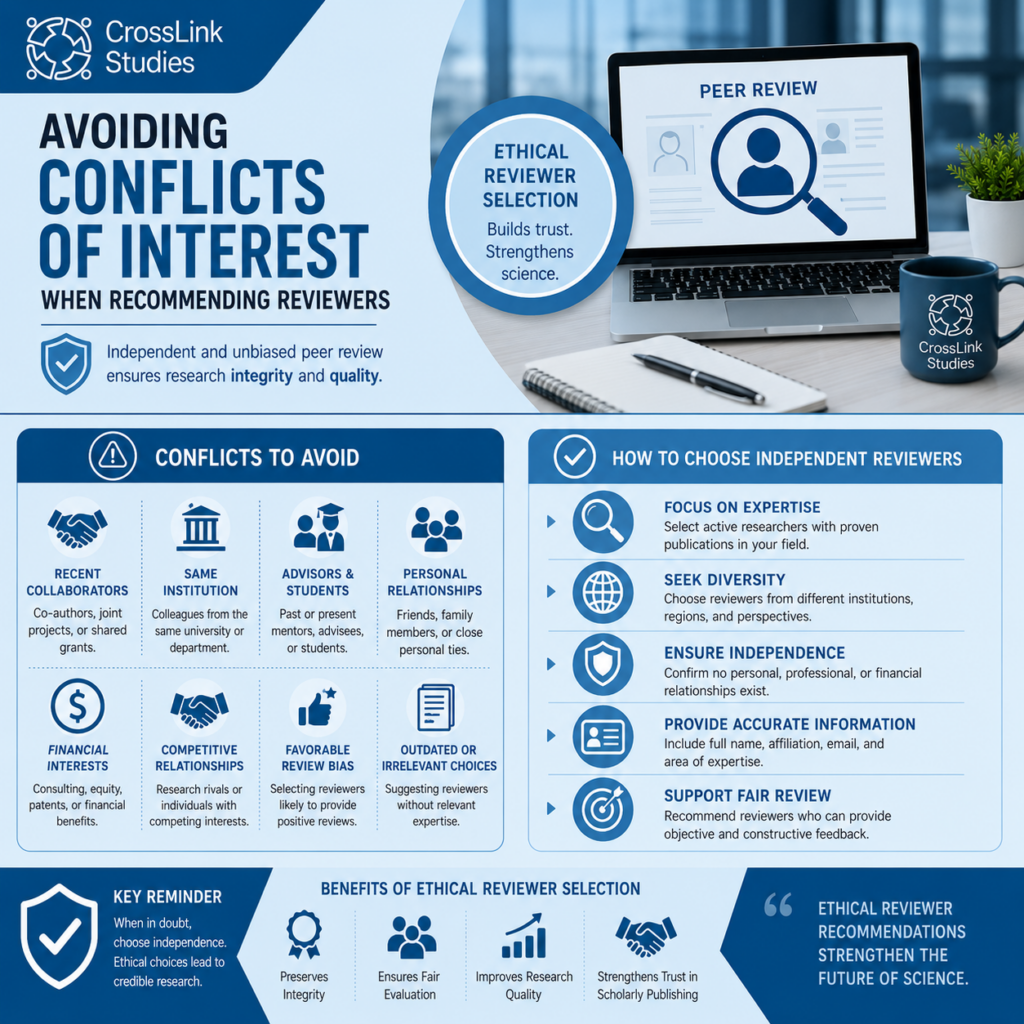
What Is a Conflict of Interest?
A conflict of interest occurs when a reviewer has a personal, professional, academic, or financial relationship that may influence or appear to influence their judgment regarding a manuscript.
Importantly, conflicts of interest do not necessarily imply misconduct. However, they create circumstances in which objectivity may reasonably be questioned. Because peer review depends on impartial evaluation, even the appearance of bias can undermine confidence in the process. Editors therefore expect authors to exercise caution when recommending reviewers and to avoid suggesting individuals whose independence could be compromised.
Why Conflicts of Interest Matter
The credibility of scientific publishing depends on trust. Editors trust reviewers to provide honest assessments, authors trust editors to ensure fairness, and readers trust journals to publish research that has undergone rigorous evaluation.
When conflicts of interest are overlooked, several problems can arise:
- Biased evaluations.
- Unfair recommendations.
- Reduced confidence in editorial decisions.
- Compromised research integrity.
- Damage to the journal’s reputation.
- Erosion of public trust in scientific research.
For these reasons, leading publishers such as Springer Nature, IEEE, Wiley, and MDPI place significant emphasis on reviewer independence and ethical peer-review practices.
Common Types of Reviewer Conflicts of Interest
Authors should understand the most common situations that may create conflicts of interest when recommending reviewers.
Recent Research Collaborators
One of the clearest conflicts occurs when a recommended reviewer has recently collaborated with the authors.
Examples include:
- Co-authored journal articles.
- Joint conference publications.
- Shared research grants.
- Collaborative research projects.
- Ongoing scientific partnerships.
Even if the collaborator is highly qualified, their close professional relationship may affect objectivity and create concerns regarding impartial evaluation.
Colleagues from the Same Institution
Reviewers working within the same university, department, research center, or laboratory as the authors should generally not be recommended.
Institutional relationships can create professional dependencies, organizational pressures, personal familiarity and shared academic interests. Editors often view same-institution reviewer recommendations as potential conflicts, particularly when authors and reviewers work closely together.
Former Advisors and Students
Academic mentoring relationships can also create conflicts of interest. Examples include PhD supervisors, postdoctoral mentors, former graduate students, academic advisors and dissertation committee members. Such relationships frequently involve long-term professional connections that may affect independent judgment.
Personal Relationships
Authors should never recommend reviewers based on personal relationships. Potential conflicts include family members, close friends, personal acquaintances, individuals with significant social relationships. Regardless of expertise, these reviewers cannot be considered fully independent.
Financial Interests
Financial connections may also compromise reviewer objectivity. Examples include shared commercial ventures, consulting arrangements, patent ownership, equity interests and sponsored research partnerships. If a reviewer could benefit financially from the manuscript’s publication outcomes, they should not be recommended.
Identifying Truly Independent Reviewers
The most ethical reviewer recommendations prioritize expertise and independence equally.When evaluating potential reviewers, authors should ask:
- Have I collaborated with this person recently?
- Do we work at the same institution?
- Do we have a personal relationship?
- Could this reviewer gain financially from the research?
- Would an editor view this reviewer as independent?
If any answer raises concern, it is generally advisable to identify an alternative candidate.
A reviewer should be selected because of their scholarly expertise—not because they are likely to provide a favorable review.
Finding Qualified Reviewers Without Creating Conflicts
Authors often worry that avoiding collaborators will limit their options. In reality, numerous methods exist for identifying independent experts.
Useful sources include:
- Recently published journal articles.
- International conference proceedings.
- Research databases.
- University faculty directories.
- Editorial board profiles.
- Professional societies and associations.
- Review articles and systematic surveys.
Researchers who publish actively in the same field but have no direct connection to the authors are often ideal reviewer candidates.
The Importance of Transparency
Transparency is a key principle of publication ethics. When suggesting reviewers, authors should provide:
- Full names.
- Institutional affiliations.
- Professional email addresses.
- Areas of expertise.
- Brief justification for suitability.
Editors appreciate concise explanations that demonstrate why each reviewer is qualified to evaluate the manuscript.
For example:
“Dr. X has published extensively on edge computing resource optimization and distributed IoT architectures, making their expertise highly relevant to the methodology presented in this study.”
Providing transparent rationale helps editors assess reviewer suitability more effectively.
Supporting UTJ’s Commitment to Research Integrity
UTJ publishes research in rapidly evolving technological fields where methodological rigor and scientific reliability are essential. Because submissions often involve interdisciplinary topics spanning computing, engineering, intelligent systems, and digital innovation, selecting unbiased reviewers is critical for maintaining high publication standards.
When recommending reviewers for UTJ submissions, authors should prioritize experts in areas such as artificial intelligence and machine learning, Internet of Things (IoT), cybersecurity and privacy, cloud and edge computing, smart environments, human-computer interaction, data science and analytics and ubiquitous and pervasive computing.
Independent experts in these fields are best positioned to provide balanced and constructive evaluations that contribute to the journal’s mission of publishing high-quality technological research.
Common Mistakes Authors Should Avoid
Several reviewer recommendation practices can create ethical concerns:
- Recommending recent co-authors.
- Suggesting colleagues from the same institution.
- Selecting personal friends.
- Providing reviewers with known conflicts.
- Choosing reviewers based on expected support.
- Reusing outdated reviewer lists without verification.
- Ignoring potential financial relationships.
- Prioritizing convenience over independence.
These mistakes can delay the review process and may raise questions regarding publication ethics.
Avoiding conflicts of interest when recommending reviewers is a fundamental responsibility of every author. Ethical reviewer selection strengthens the credibility of peer review, supports objective editorial decisions, and protects the integrity of scholarly publishing. For researchers submitting to the Ubiquitous Technology Journal, thoughtful reviewer recommendations should balance subject-matter expertise with complete independence. By selecting qualified, unbiased experts and avoiding personal, professional, and financial conflicts, authors contribute to a transparent, fair, and trustworthy publication process that benefits the entire research community. Strong science depends on strong peer review and strong peer review begins with ethical reviewer selection.