
Writing a Cover Letter That Explains Contribution and Fit
Making a Strong First Impression Before Peer Review
When submitting a manuscript, authors often devote significant attention to research quality, formatting requirements, and reference accuracy. However, one important document is frequently overlooked: the cover letter.
A well-written cover letter serves as the first communication between authors and the editorial team. Beyond introducing the manuscript, it provides an opportunity to explain the study’s contribution, relevance, and suitability for the journal. For submissions to the Ubiquitous Technology Journal (UTJ), a thoughtful cover letter can help editors quickly understand why the research deserves consideration and how it aligns with the journal’s scope.
Why a Cover Letter Matters
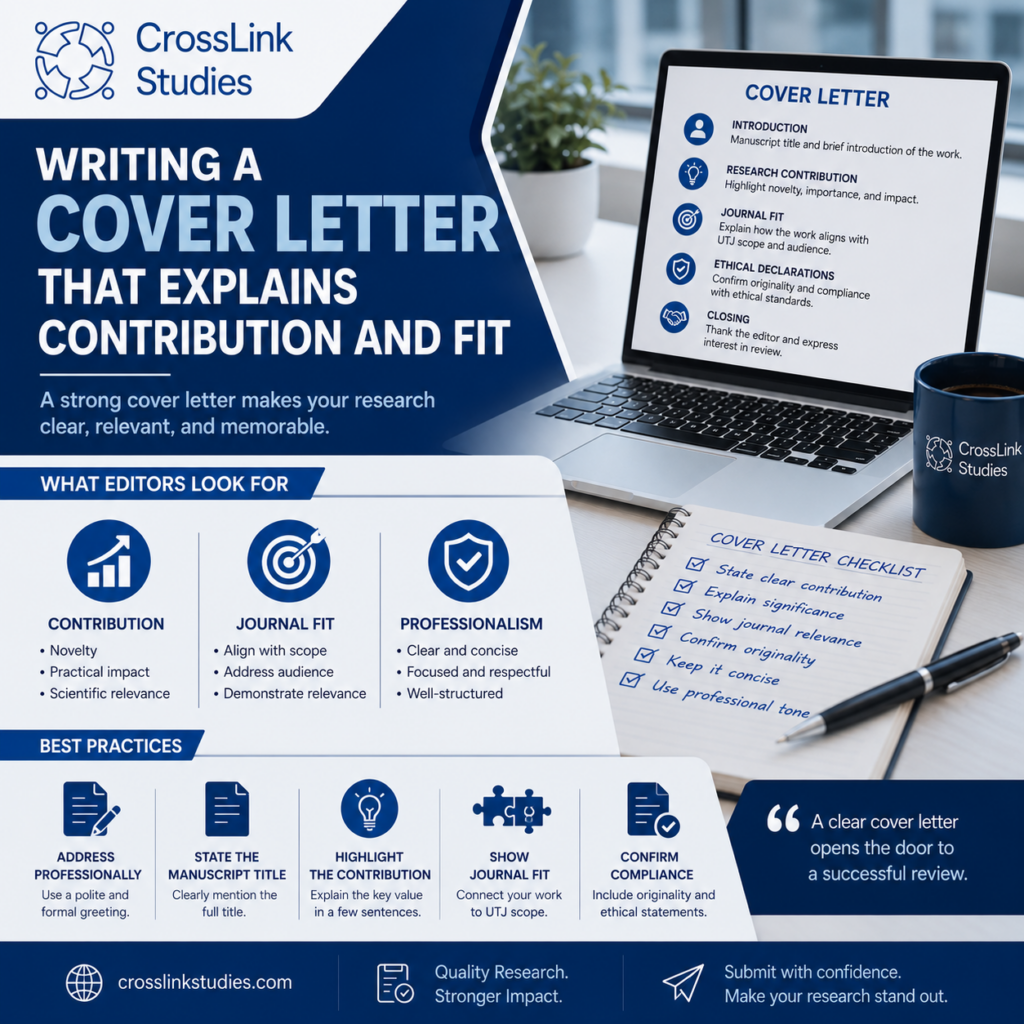
Editors handle numerous submissions across diverse research areas. A concise and professional cover letter helps them assess the manuscript efficiently by highlighting its significance and positioning within the journal’s focus. An effective cover letter should answer three fundamental questions:
- What does the research contribute?
- Why is the contribution important?
- Why is the manuscript a good fit for the journal?
Providing clear answers to these questions demonstrates professionalism and helps establish the context for editorial evaluation.
Explaining the Research Contribution
One of the most valuable sections of a cover letter is the explanation of the manuscript’s contribution. Rather than summarizing every result, authors should focus on the study’s unique value. Consider highlighting:
Novelty
Explain what distinguishes the work from existing research.
Examples include:
- A new methodology or framework.
- An innovative application of technology.
- A unique dataset or experimental design.
- An improved analytical approach.
Practical Impact
Editors are interested in understanding how the findings advance knowledge or address real-world challenges. Clearly state the problem being solved, the significance of the solution and the potential implications for researchers, practitioners, or industry.
Scientific Relevance
Briefly explain how the study contributes to ongoing discussions within the field and how it extends previous work.
Demonstrating Journal Fit
Even strong research may be unsuitable for a journal if it falls outside the publication’s scope. A cover letter should explain why the manuscript aligns with the journal’s aims and audience.
For UTJ submissions, authors may highlight how their research relates to areas such as:
- Ubiquitous computing.
- Smart systems and intelligent technologies.
- Internet of Things (IoT).
- Artificial intelligence applications.
- Cybersecurity and digital infrastructure.
- Emerging computing technologies.
- Technology-driven innovation and implementation.
Editors appreciate when authors demonstrate familiarity with the journal rather than submitting generic cover letters.
Common Cover Letter Mistakes
Many cover letters fail to add value because they contain avoidable issues. Common mistakes include:
Repeating the Abstract
The cover letter should complement the manuscript, not duplicate the abstract.
Making Unsupported Claims
Avoid statements such as “This is the best study” or “This research is groundbreaking” without evidence.
Using Generic Language
Generic letters sent to multiple journals often fail to explain why the manuscript fits a specific publication.
Excessive Length
Editors prefer concise and focused communication. A cover letter should be informative without becoming overly detailed.
Best Practices for Authors
To create a stronger cover letter:
- Address the editorial team professionally.
- State the manuscript title clearly.
- Summarize the primary contribution in a few sentences.
- Explain the manuscript’s relevance to the journal.
- Confirm originality and ethical compliance where required.
- Maintain a respectful and professional tone throughout.
A clear, concise letter often has greater impact than a lengthy explanation.
The Editorial Perspective
From an editorial standpoint, a cover letter provides valuable context that may not be immediately visible in the manuscript itself. It helps editors understand the author’s intentions, identify the manuscript’s contribution, and evaluate its suitability for peer review.
While a cover letter cannot compensate for weak research, it can ensure that strong research is presented effectively from the beginning of the submission process.
A cover letter is more than a submission formality, it is an opportunity to communicate the significance and relevance of a manuscript directly to the editorial team. By clearly explaining the research contribution and demonstrating alignment with the journal’s scope, authors can create a professional first impression and support a smoother editorial assessment. Strong manuscripts deserve clear representation. A well-crafted cover letter helps ensure that the value of the research is recognized from the moment the submission is received.