
Writing a Conclusion That Shows Knowledge Advancement
How to End a Research Paper with Strong Academic Impact?
In academic publishing, the conclusion section is more than a summary of findings. It is the final opportunity for researchers to demonstrate how their study contributes to existing knowledge, advances scholarly understanding, and creates value within a specific field of research.
However, many manuscripts submitted to scholarly journals fail to present a strong conclusion. Authors often repeat earlier results without clearly explaining the significance, originality, or broader implications of their work. As a result, reviewers may perceive the research as incomplete, limited in contribution, or lacking academic impact.
Ubiquitous Technology Journal (UTJ), published under Crosslink Studies (CLS) encourage authors to prepare manuscripts that demonstrate originality, scholarly value, and meaningful contribution to knowledge through professional academic writing and proper research structure. A well-written conclusion strengthens the overall quality of a manuscript and helps reviewers understand why the research matters.
Why the Conclusion Section Is So Important
The conclusion is often the last section editors and reviewers read before making publication decisions. A weak ending can reduce the perceived importance of otherwise strong research.
An effective conclusion should reinforce the significance of the study, explain the contribution to knowledge, connect findings to broader research contexts and demonstrate originality and relevance. The conclusion should leave readers with a clear understanding of what has been learned and why it matters.
What “Knowledge Advancement” Means in Research
Knowledge advancement refers to how a study improves, expands, challenges, or refines existing understanding within a discipline.
Research contributes to knowledge when it introduces new findings, solves existing research problems, develops new methods or frameworks and provides updated evidence. A conclusion that clearly explains these contributions creates stronger academic impact and increases publication potential.
Common Problems in Research Conclusions
1. Repeating the Abstract
One of the most common mistakes is simply rewriting the abstract or results section.
Weak Example
“This study examined social media usage among university students and found significant effects on academic performance.”
This only repeats information already presented earlier.
Better Approach
Explain what the findings contribute to existing research and why they matter academically or practically.
2. Failing to Highlight Original Contribution
Many conclusions summarize findings but never explain how the research advances current knowledge.
Reviewers often ask:
- What is new in this study?
- How does this research improve existing understanding?
- Why is this contribution important?
If the conclusion does not answer these questions clearly, the manuscript may appear weak despite good methodology.
3. Introducing Completely New Information
The conclusion should not introduce entirely new arguments, datasets, or major findings that were not discussed previously. This creates confusion and weakens the manuscript structure. Focus on synthesizing and interpreting existing findings rather than adding unrelated content.
4. Writing Conclusions That Are Too Short
Very brief conclusions often fail to communicate research significance effectively.
A conclusion limited to only two or three sentences may appear incomplete, especially in full-length research articles.
Best Practice
Develop a balanced conclusion that summarizes key insights while emphasizing contribution and implications.
5. Avoiding Practical or Theoretical Implications
UTJ expect authors to explain how findings influence theory, policy, practice and industry. Ignoring implications reduces the broader value of the study.
How to Write a Strong Conclusion That Demonstrates Knowledge Advancement?
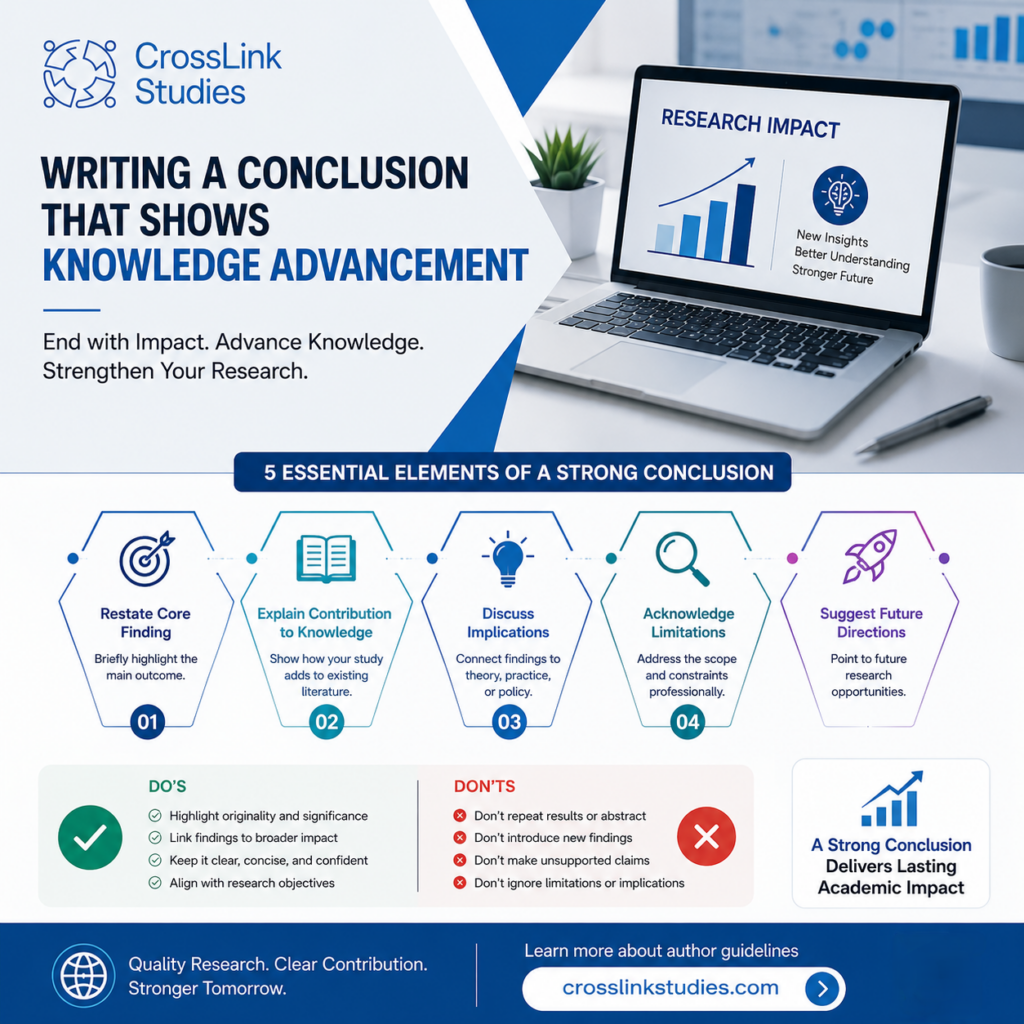
1. Begin with the Core Research Outcome
Start by briefly restating the primary purpose or finding of the study in a concise manner.
Example
“This study demonstrated the significant relationship between digital learning environments and student engagement in higher education institutions.”
2. Explain the Contribution to Existing Literature
Clearly state how the findings expand or refine previous research.
Example
“The findings contribute to existing educational technology literature by providing evidence from developing academic environments where limited empirical studies previously existed.” This demonstrates originality and scholarly relevance.
3. Discuss Broader Implications
Strong conclusions connect research findings to larger academic or professional contexts.
Implications may include policy recommendations, practical applications, social impact and industry relevance
Example
“These findings may support universities in designing more effective digital learning strategies that improve academic engagement and educational outcomes.”
4. Acknowledge Research Limitations Professionally
Professional academic writing recognizes limitations without weakening the study.
Example
“Although the study focused on selected institutions, the findings provide valuable insight for future comparative research.” This shows academic maturity and transparency.
5. Suggest Future Research Directions
Future research recommendations demonstrate that the study contributes to an ongoing scholarly conversation.
Example
“Future studies may examine long-term behavioral changes across different educational systems and geographic regions.” This strengthens the academic value of the manuscript.
Characteristics of High-Impact Conclusions
A strong scholarly conclusion is:
✔ Clear and concise
✔ Academically confident
✔ Evidence-based
✔ Forward-looking
✔ Connected to literature
✔ Focused on contribution
✔ Relevant to real-world contexts
✔ Aligned with research objectives
Professional conclusions should not simply end the paper — they should elevate the significance of the entire study.
The Role of Journal Guidelines in Conclusion Writing
Different journals may have specific expectations regarding manuscript structure, contribution statements, research implications and ethical writing standards.
Authors submitting to CLS Crosslink Studies Journals are encouraged to follow the journal’s submission and formatting requirements carefully to improve manuscript quality and editorial evaluation. Carefully structured conclusions help demonstrate professionalism, research quality, and publication readiness.
By writing conclusions that emphasize knowledge advancement, implications, and future relevance, researchers can strengthen both the quality and influence of their work. For authors publishing in Crosslink Studies(CLS) a strong conclusion can play a critical role in communicating research excellence and academic contribution effectively.