
How to Discuss Autonomous Systems, Accountability, and Human Oversight
Autonomous systems are rapidly transforming modern society. From self-driving vehicles and intelligent healthcare platforms to industrial robotics, smart surveillance systems, and AI-powered decision-making tools, automation is increasingly embedded within critical infrastructures and everyday human activities. However, as these systems become more independent and capable of making real-time decisions without direct human intervention, concerns regarding accountability, transparency, ethics, and human oversight continue to intensify.
Crosslink Studies (CLS) highlights the importance of technologically advanced yet socially responsible research contributions in computing and ubiquitous technologies.
Writing effectively about autonomous systems therefore requires more than describing automation capabilities. Professional academic discussion must critically analyze how these systems operate, who remains accountable for their decisions, and how human oversight can be maintained in increasingly automated environments.
Understanding Autonomous Systems Beyond Automation
Autonomous systems are computational or robotic systems capable of performing tasks, making decisions, and adapting to environments with limited or no continuous human control. These systems rely on technologies such as Artificial Intelligence (AI), Machine Learning (ML), Computer Vision, Edge Computing and Internet of Things (IoT). Examples include autonomous vehicles, AI-assisted medical diagnostics, smart manufacturing robots and autonomous drones.
However, technological autonomy introduces significant questions:
- Who is responsible when autonomous systems fail?
- How can humans monitor complex AI decisions?
- What level of human control is necessary?
- Can automated systems remain transparent and fair?
- How should governance frameworks regulate autonomous technologies?
Why Accountability Matters in Autonomous Systems
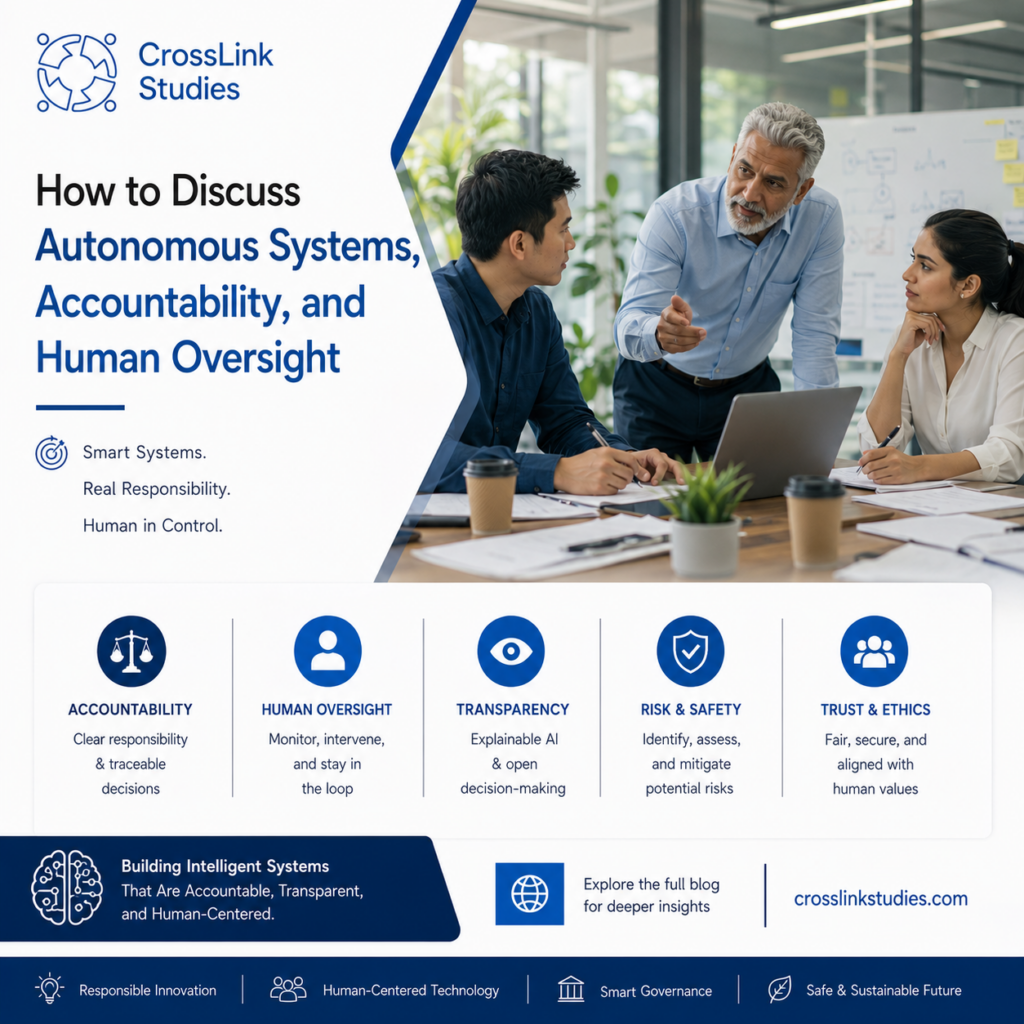
One of the most critical challenges in autonomous technologies is accountability. Traditional systems operate under direct human instruction, making responsibility relatively clear. In contrast, autonomous systems can independently analyze data, prioritize actions, and generate outcomes that developers or operators may not fully predict.
For example, a self-driving vehicle may misinterpret environmental conditions and healthcare AI system may produce biased diagnostic recommendations. In such cases, accountability becomes distributed across software developers, data engineers, organizations and regulators. Strong academic discussions should therefore avoid simplistic statements such as: “AI systems should be accountable. “Instead, professional writing should explain accountability mechanisms, governance structures and legal implications.
The Importance of Human Oversight
As autonomous systems become increasingly sophisticated, human oversight remains essential for ensuring safety, fairness, and ethical compliance. Human oversight refers to the ability of human operators, regulators, or stakeholders to monitor system behavior, intervene when necessary, and validate automated decisions. In academic discussions, human oversight should not be treated merely as “human supervision.” Instead, it should be explored as a structured operational framework involving real-time monitoring, explainable AI mechanisms, and emergency intervention systems,
Human-in-the-Loop Systems
In these systems, humans actively participate in decision-making processes. Examples include:
- medical AI assisting physicians,
- cybersecurity analysts validating automated threat detection,
- or legal experts reviewing algorithmic recommendations.
Human-on-the-Loop Systems
These systems operate autonomously while humans monitor system performance and intervene only when required. Examples include autonomous drones, industrial robotics, and intelligent transportation systems. The distinction between these models is important because it directly affects responsibility, transparency, and operational risk management.
Avoiding Overly General Discussions
Many academic blogs become too broad when discussing autonomous systems because they focus only on futuristic narratives or generalized ethical concerns. Weak discussions often include statements like:
- “AI may replace humans.”
- “Automation is dangerous.”
- “Technology should remain ethical.”
While these ideas may appear relevant, they lack analytical depth and scholarly value. Professional academic writing should instead address specific technical contexts, measurable risks and governance models.
Transparency and Explain ability in Autonomous Decision-Making
One major issue with autonomous systems is the “black-box” nature of advanced AI models. Many systems produce outputs without clearly explaining how decisions were generated. This creates challenges for regulatory compliance, public trust, ethical validation, and operational accountability. Therefore, discussions surrounding autonomous systems should include concepts such as explainable AI (XAI), interpretable machine learning and algorithmic transparency. Explain ability is particularly important in high-risk domains including healthcare, finance, law enforcement, and public governance systems.
Governance and Regulatory Perspectives
Modern autonomous technologies require robust governance frameworks capable of balancing innovation with public protection. Academic discussions should examine ethical AI regulations, data governance policies, cybersecurity standards, privacy protection mechanisms, and international AI governance initiatives.
Professional research writing becomes more impactful when it explores how policymakers, researchers, industries, and regulatory institutions collaborate to establish responsible technological ecosystems.
The Future of Responsible Autonomous Systems
The future of autonomous systems will depend not only on computational intelligence but also on responsible governance and human-centered design principles. Future research directions include adaptive ethical AI, transparent autonomous reasoning systems, privacy-preserving automation, sustainable intelligent infrastructures, and collaborative human-AI environments.
As automation expands across industries, researchers must focus on creating systems that remain accountable, explainable, secure, inclusive, and aligned with societal values. Technological advancement without responsible oversight risks undermining public trust and long-term sustainability. For CLS and UTJ impactful discussions are those that connect advanced automation with ethical implementation, sustainable governance, and long-term societal benefit.