
Writing About Responsible Innovation Without Becoming Too General
In today’s rapidly evolving technological landscape, responsible innovation has become more than a theoretical discussion. It is now a central expectation in research, engineering, artificial intelligence, smart systems, sustainability studies, and digital transformation. However, many researchers and writers face a recurring challenge: when discussing responsible innovation, their writing often becomes overly broad, abstract, and disconnected from practical or technical realities.
The publication expectations of Crosslink Studies(CLS) emphasize originality, methodological clarity, analytical discussion, and practical contribution within technology and interdisciplinary research domains.
Responsible innovation writing becomes impactful when it connects ethical thinking with technical implementation, policy implications, stakeholder impact, and measurable outcomes. Instead of simply stating that innovation should be “ethical” or “sustainable,” strong academic writing explains how, why, and through which mechanisms responsibility is integrated into technological systems.
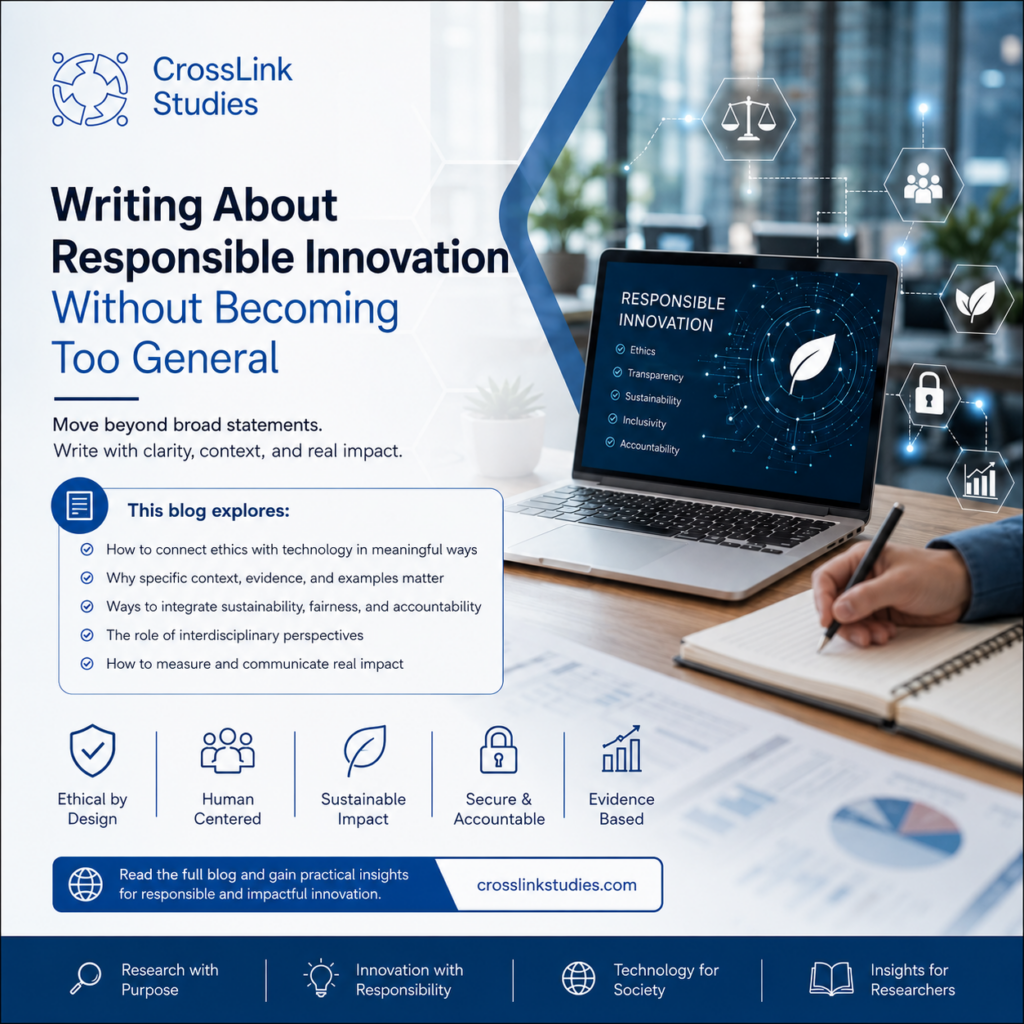
Understanding the Core Meaning of Responsible Innovation
Responsible innovation refers to the process of designing, developing, and deploying technologies while considering their societal, environmental, ethical, legal, and economic consequences. It promotes innovation that is not only efficient and profitable but also socially beneficial and transparent.
In modern research environments, responsible innovation is strongly associated with artificial intelligence governance, data privacy and cybersecurity, sustainable computing and human-centered system design. For UTJ focusing on ubiquitous technologies and interdisciplinary computing research, responsible innovation should demonstrate a balance between technological advancement and societal accountability.
Why Many Blog Posts and Research Discussions Become Too General
One of the most common weaknesses in academic blogs and conceptual papers is the excessive use of generic ethical language without analytical depth. Statements such as:
- “Technology should help society.”
- “Innovation must be ethical.”
- “Researchers should consider sustainability.”
may sound meaningful, but they lack specificity, evidence, and scholarly contribution. CLS rarely accept discussions that remain purely philosophical without demonstrating clear research context, defined technological scope and practical examples. Generalized writing often fails because it avoids difficult questions such as:
- What specific risks emerge from the innovation?
- Which stakeholders are affected?
- How can the risks be measured or minimized?
- What governance mechanisms are required?
- How does the technology align with sustainability goals?
- What are the long-term social implications?
Without addressing these questions, responsible innovation discussions remain superficial.
How to Write About Responsible Innovation Professionally
1. Start with a Specific Technological Context
Instead of discussing responsible innovation broadly, anchor the discussion within a real technological domain. Specificity improves both academic value and reader engagement. A strong introduction should establish the technological problem, innovation context, and societal relevance,
2. Integrate Ethics with Technical Discussion
One major mistake is separating ethics from technology. High-impact academic writing integrates both simultaneously. For instance, rather than writing: “AI systems should be fair.” a stronger academic statement would be:
“Bias mitigation frameworks in AI-driven healthcare systems should incorporate transparent training datasets, explainable decision mechanisms, and demographic fairness evaluation metrics.”
3. Use Evidence and Real-World Examples
Professional academic blogs should include current examples, case studies, or emerging challenges. Examples may include facial recognition controversies, AI bias in recruitment systems, and cybersecurity failures in IoT devices,
4. Avoid Moralizing Language
Academic readers prefer analytical reasoning over emotional persuasion. Avoid phrases like “Technology is destroying humanity.” Instead, use balanced scholarly language such as: “Unregulated AI systems may introduce risks related to algorithmic bias and data privacy.”
5. Include Multidisciplinary Perspectives
Responsible innovation is inherently interdisciplinary. Strong discussions combine insights from computer science, engineering, public policy and sustainability studies.
6. Discuss Measurable Responsibility
One defining feature of advanced academic writing is measurability.Instead of discussing responsibility conceptually, discuss ESG indicators, energy efficiency metrics, AI fairness scores and carbon footprint reduction.
The Role of Responsible Innovation in Ubiquitous Technology Research
In ubiquitous computing environments, technologies continuously interact with human behavior, data systems, smart infrastructures, and intelligent networks. Therefore, responsible innovation becomes essential rather than optional. Areas requiring responsible innovation include smart cities, wearable healthcare systems and ambient intelligence.
Building a Strong Structure for Responsible Innovation Blogs
A professional academic-style blog should generally follow this structure:
- Clear and focused introduction
- Contextual definition of responsible innovation
- Current technological relevance
- Identification of practical challenges
- Critical analysis with examples
- Future implications and recommendations
- Concise conclusion with scholarly insight
For researchers, and scholars contributing to technology-focused journals, responsible innovation should not be treated as a symbolic concept added at the end of a discussion. Instead, it should function as an integrated framework shaping how technologies are designed, evaluated, deployed, and governed in real-world environments.
As emerging technologies continue transforming societies globally, the quality of innovation will increasingly be judged not only by performance and efficiency, but also by responsibility, inclusivity, sustainability, and long-term societal impact.