How to Write Constructive Reviewer Comments Without Being Vague
Peer review is the backbone of scholarly publishing, but its value depends heavily on the quality of reviewer comments. Vague, generic, or overly critical feedback can frustrate authors and delay publication, while clear, constructive, and actionable comments enhance research quality and foster academic collaboration.
At Ubiquitous Technology Journal (UTJ), reviewers are expected not only to evaluate manuscripts but also to guide authors toward improvement with precision and clarity.
Why Avoiding Vagueness Matters
Leading publishers emphasize that reviewer comments should be specific, structured, and evidence-based, rather than general opinions. Vague comments such as “The paper needs improvement”, “The methodology is weak”.
offer little value because they do not explain what is wrong or how to improve it. In contrast, constructive reviews provide clear reasoning, examples, and direction.
Core Principles of Constructive Reviewer Comments
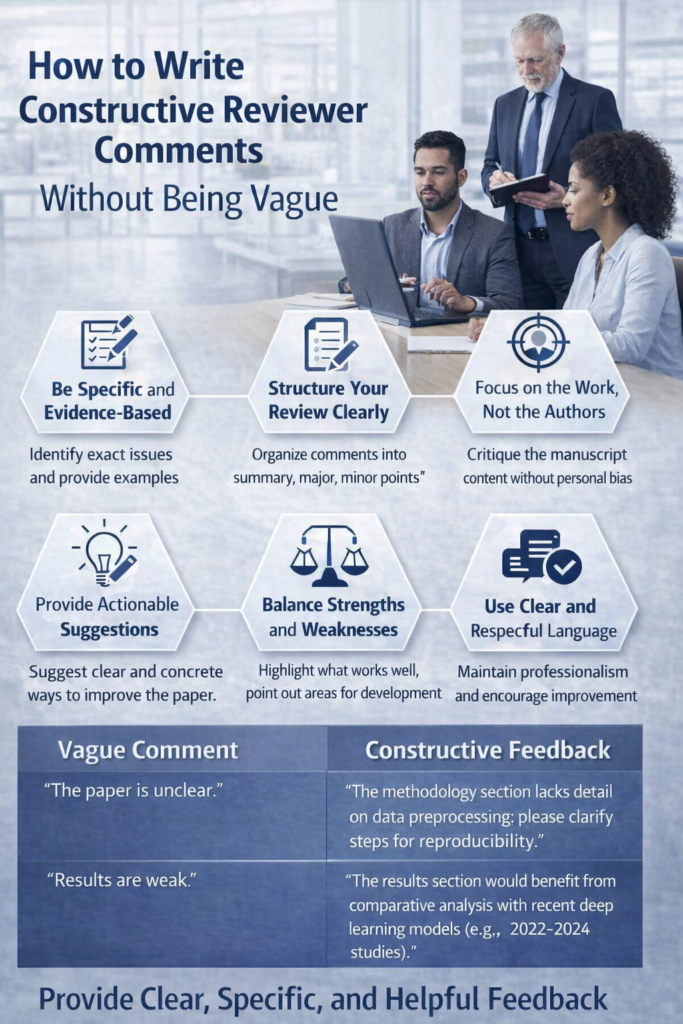
Be Specific and Evidence-Based
High-quality reviews identify exact issues and their locations. For example, instead of “Introduction is unclear” write “The introduction lacks a clear research gap in paragraph or “consider specifying how this study differs from recent AI-based models.”
IEEE guidelines stress that comments should be supported with reasoning and examples, not just opinions.
Structure Your Review Clearly
Top journals recommend organizing reviews into sections such as summary of the manuscript, major issues, minor issues, final recommendation. This structure helps editors and authors quickly understand your evaluation.
Focus on the Work, Not the Authors
Constructive reviews evaluate the manuscript not the researcher.
- Avoid: “The authors failed to understand…”
- Prefer: “The discussion section could better explain…”
This maintains professionalism and avoids bias or personal tone.
Provide Actionable Suggestions
Constructive feedback should guide revision, not just highlight problems.
For example,
- Weak: “Figures are poor”
- Strong: “Figure 3 lacks labelling of axes; adding units and improving resolution would enhance clarity.”
Reviewers are expected to help improve the manuscript, not just critique it.
Balance Strengths and Weaknesses
A good review highlights both what the paper does well, what needs improvement? CLS guidance recommends acknowledging strengths while suggesting improvements to maintain a constructive tone.
Avoid Overly Short or Generic Comments
Brief comments often appear dismissive and unhelpful. Effective reviews include context, explanation, suggested improvement. Editors often filter out superficial comments because they do not aid decision-making.
Use Clear and Respectful Language
Even when recommending rejection, the tone should remain professional, objective, respectful. Constructive criticism should encourage improvement, not discourage authors.
Transforming Vague Comments into Constructive Feedback
| Vague Comment | Constructive Alternative |
| “The paper is unclear” | “The methodology section lacks detail on data pre-processing; please clarify steps for reproducibility.” |
| “Results are weak” | “The results section would benefit from comparative analysis with recent deep learning models (e.g., 2022–2024 studies).” |
| “Needs more references” | “Consider adding recent references on AI-driven optimization (last 3–5 years) to strengthen the literature review.” |
Common Mistakes Reviewers Should Avoid
- Providing only general impressions without details
- Using harsh or personal language
- Suggesting irrelevant citations
- Giving contradictory or unclear feedback
- Ignoring key sections of the manuscript
CLS Crosslink Studies Perspective
At Crosslink Studies (CLS), we encourage reviewers to adopt a precision-driven, constructive approach, especially in interdisciplinary fields like AI, computing, and emerging technologies. Clear reviewer comments accelerate editorial decisions, improve manuscript quality, strengthen the credibility of published research. By avoiding vague comments and providing structured, actionable, and respectful feedback, reviewers contribute meaningfully to the advancement of research and uphold the highest standards of academic publishing.