

How to Handle Overlap with Your Previous Publications?
Understanding Publication Overlap in Academic Research
As researchers advance their careers, it is common for new studies to build upon previous work. Research projects often evolve through multiple stages, extending earlier findings, refining methodologies, expanding datasets, or exploring new applications. While such progression is a natural part of scholarly development, authors must carefully manage overlap with their previous publications to maintain transparency, originality, and research integrity.
One of the most common concerns raised during editorial screening and peer review is whether a submitted manuscript contains excessive similarity to an author’s earlier work. Responsible handling of publication overlap is therefore essential for maintaining trust in scholarly communication and ensuring compliance with publication ethics standards.
For authors submitting to Crosslink Studies journals, understanding how to appropriately reuse, extend, and cite previous work can help prevent unnecessary delays and strengthen the credibility of a manuscript.
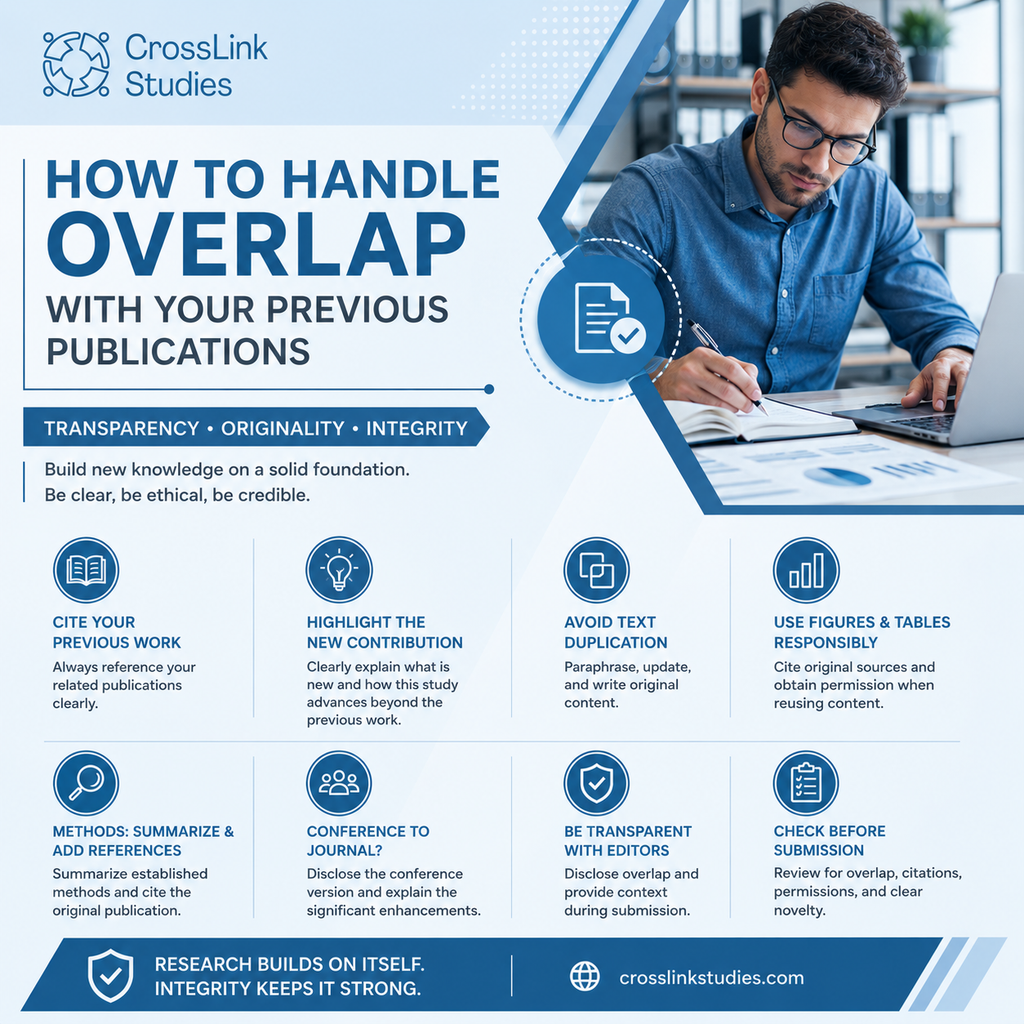
When Overlap Becomes a Concern
Not all overlap is problematic. Research naturally builds upon prior knowledge, and authors are often expected to reference their own earlier contributions when relevant. However, overlap becomes a concern when previously published content is reused without proper disclosure, citation, or sufficient new contribution. Editorial teams typically evaluate overlap in terms of:
- Reused text.
- Previously published figures or tables.
- Identical datasets.
- Similar methodologies.
- Repeated analyses.
- Duplicate conclusions.
The central question is not whether overlap exists, but whether the new manuscript provides a meaningful and original scholarly contribution beyond what has already been published.
Distinguishing Research Extension from Duplicate Publication
A legitimate extension study differs significantly from duplicate publication. An extension manuscript typically introduces new knowledge through expanded experiments, additional data, improved methodologies, broader evaluations, or deeper theoretical analysis. The new work should answer questions that were not fully addressed in the earlier publication.
In contrast, duplicate publication occurs when substantially similar content is published multiple times with little or no additional contribution. Such practices can distort the scholarly record, create confusion for readers, and undermine the integrity of academic publishing. Authors should critically assess whether their manuscript offers clear scientific advancement before submission.
Always Cite Your Previous Publications
One of the most important principles in managing publication overlap is transparency.
If a manuscript builds upon previously published work, authors should clearly cite the earlier publication and explain the relationship between the two studies. Self-citation in this context is not only acceptable but often necessary to provide readers and reviewers with the appropriate background. Transparent self-citation helps:
- Establish the development of the research.
- Clarify what has been published previously.
- Identify the novel contribution of the current study.
- Prevent misunderstandings during editorial review.
- Demonstrate academic honesty.
Failing to cite closely related prior work can create the appearance of attempting to present old findings as new discoveries.
Clearly Define the Novel Contribution
Editors and reviewers often look for a straightforward answer to a simple question:
What is new in this manuscript?
Authors should clearly articulate the unique contributions of the study in the introduction and discussion sections. The distinction between previous and current work should be easy for reviewers to identify. Examples of meaningful new contributions may include:
- New experimental results.
- Expanded datasets.
- Additional validation studies.
- Improved algorithms or models.
- New application domains.
- Comparative analyses.
- Theoretical advancements.
- Enhanced system performance evaluations.
Be Careful When Reusing Text
Text overlap is one of the most frequently identified issues during similarity screening.
Although certain technical descriptions may require consistent terminology, authors should avoid copying large sections of text from previously published papers, even if they are the original authors. Instead, researchers should:
- Rewrite explanations in the context of the new study.
- Update descriptions to reflect current findings.
- Provide fresh interpretation and discussion.
- Cite the original publication where appropriate.
Particular attention should be given to the introduction, literature review, results, and discussion sections, where originality is expected.
Reusing Methods Sections Responsibly
Methodology sections often present unique challenges because experimental procedures may remain consistent across related studies.
In such situations, authors should balance clarity with transparency. Rather than reproducing extensive text verbatim, researchers can briefly summarize previously established methods and cite the original publication for detailed descriptions.
This approach:
- Reduces unnecessary duplication.
- Improves manuscript efficiency.
- Maintains transparency.
- Provides readers with access to comprehensive methodological details.
Managing Previously Published Figures and Tables
Figures, tables, diagrams, and visual content often involve copyright and ethical considerations in addition to publication overlap concerns. Authors should exercise caution when reusing previously published materials, even if they originally created them. Before reusing visual content, authors should:
- Verify publisher permissions where applicable.
- Cite the original source.
- Clearly indicate when a figure has been adapted.
- Explain any modifications or updates.
- Ensure compliance with journal policies.
Whenever possible, updated or newly generated visuals should be used to reflect the current study’s contribution
Address Conference-to-Journal Extensions Properly
In technology and engineering disciplines, research frequently progresses from conference presentations to full journal publications.
A journal manuscript based on a conference paper is generally acceptable when it includes substantial new content beyond the original publication. However, authors should openly disclose the existence of the conference version and explain the enhancements made in the journal submission.
Common extensions may include:
- Additional experiments.
- Expanded datasets.
- More comprehensive evaluations.
- Enhanced discussion and analysis.
- New theoretical contributions.
- Broader validation studies.
Understand Similarity Screening Expectations
Many journals use similarity detection software during initial editorial evaluation. These tools help identify textual overlap but do not independently determine whether overlap constitutes misconduct. Editorial decisions typically consider:
- The location of overlapping text.
- The extent of duplication.
- Whether sources are properly cited.
- The originality of the contribution.
- The context of reused material.
Authors should therefore focus on ethical writing practices rather than attempting to meet a specific similarity percentage target. A low similarity score does not automatically guarantee originality, and a higher score does not necessarily indicate misconduct if overlap is properly disclosed and justified.
Best Practices Before Submission
Before submitting a manuscript, authors should conduct a thorough internal review to evaluate overlap with previous publications. Consider the following questions:
- Have all related prior publications been cited?
- Is the novel contribution clearly explained?
- Has previously published text been appropriately revised?
- Are reused figures and tables properly attributed?
- Does the manuscript provide significant new knowledge?
- Have conference versions been disclosed where relevant?
- Can readers easily distinguish old findings from new findings?
Why Transparency Benefits Authors
Researchers sometimes worry that openly discussing related prior work may weaken the perceived originality of a manuscript. In reality, transparency often strengthens reviewer confidence.When authors clearly explain how a study extends earlier work, they demonstrate professionalism, integrity, and respect for the scholarly record. Reviewers are more likely to focus on evaluating the scientific contribution rather than questioning publication ethics concerns. Transparent reporting creates a stronger foundation for constructive peer review and long-term research impact.
Conclusion
Building upon previous research is a fundamental aspect of scientific progress. However, authors must carefully distinguish legitimate research advancement from unnecessary duplication. Responsible management of publication overlap requires transparency, proper citation, clear communication of novelty, and adherence to publication ethics principles.
For authors preparing submissions to Crosslink Studies journals, the goal should not be to avoid all overlap but to ensure that any overlap is justified, disclosed, and accompanied by a meaningful new contribution. By following ethical publication practices, researchers can strengthen the quality of their manuscripts, support research integrity, and contribute to a more trustworthy scholarly ecosystem.

